FIELD NOTE / 01 — AUG 2026
The graph is
the specification.
Give people and agents the same durable map of what you know, why you chose it, what is running, and how the work must stop.
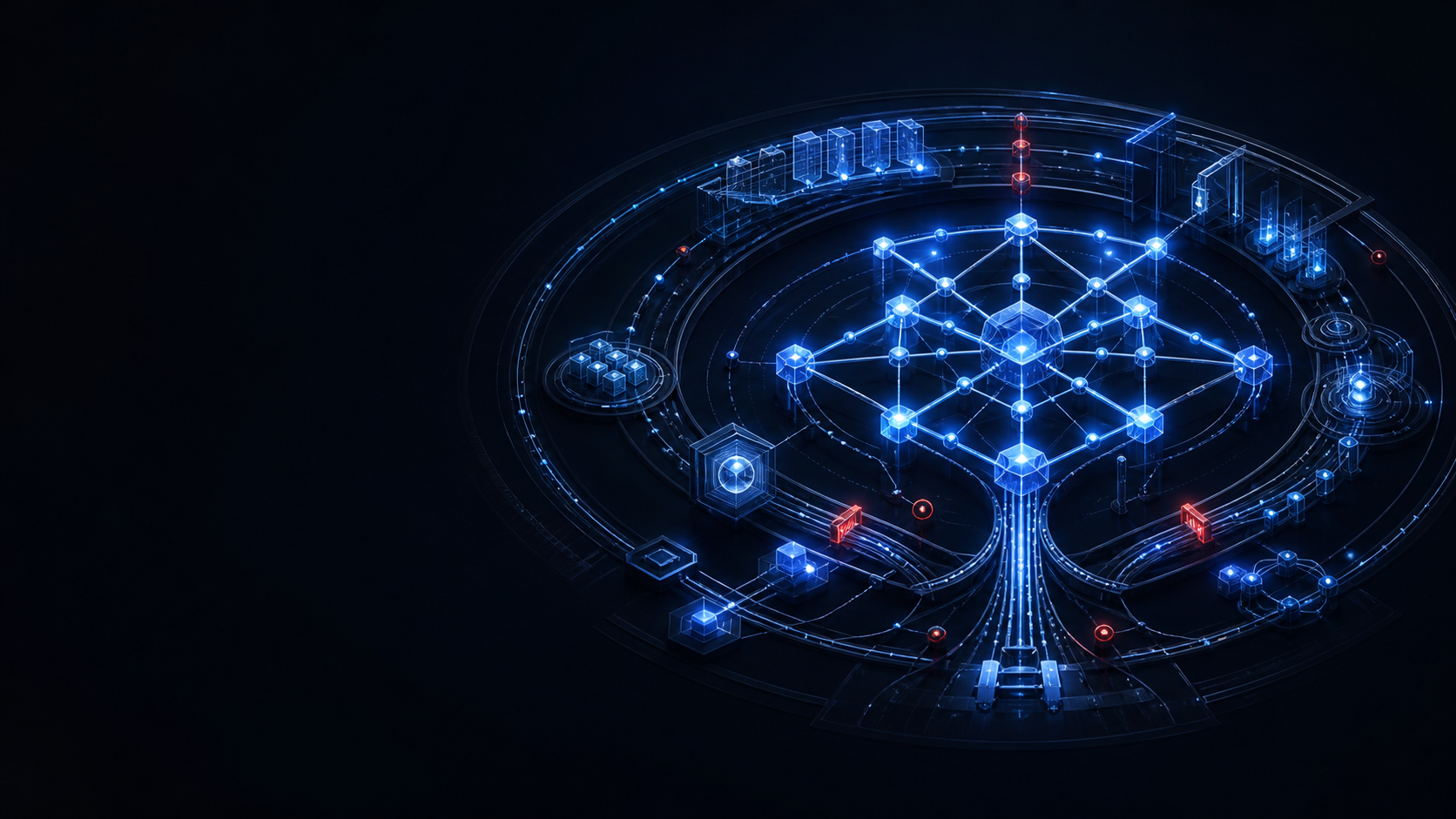
THE SECOND BRAIN GRAPH
Not a wiki dump.
A working memory for systems that build systems.
Projects generate reasoning that ordinarily dies in meetings, tickets, chat threads, spikes, and people's heads. Agent architectures disappear into prompt strings and framework glue. This stack turns both into small, linked, reviewable artifacts that people and agents can retrieve at the moment of decision.
OPEN KNOWLEDGE FORMAT / OKF
One tree.
Many owners.
Typed Markdown files in Git are the source of truth. Each specialized capture system owns its nouns and writes to the same graph. Disposable indexes accelerate search; the durable files and their history remain reviewable by humans.
Four ways to make
memory operational.
How facts link
Open Knowledge Format
A portable graph made of small Markdown concepts, typed edges, and Git history. It is the substrate every specialized capture system can share.
Without a common format, project memory, architecture, research, and agent design become separate silos that cannot explain their impact on one another.
Use OKF when knowledge must be reviewable like code, portable across tools, and small enough to load as a bounded ContextPack.
Capture the mess.
Promote the signal.
Capture
Meetings, transcripts, spikes, tickets, PRs, research, and an inherited codebase.
Promote
Informal notes become typed nouns with provenance, ownership, and a clear non-goal.
Pack
The agent sees a bounded neighborhood—not the entire archive, not a stale summary.
Inventing a relationship type is a violation, not a convenience.
AGENT BRAIN / RETRIEVAL BINDING
A graph that cannot be retrieved
at decision time is just an archive.
Agent Brain searches the same corpus people maintain. Exact names go through keyword search, conceptual questions through vector search, dependency questions through graph traversal, and difficult questions through fused retrieval.
Why does the checkout agent stop before payment capture?
Retrieval keeps the agent grounded in the current graph instead of asking a context window to impersonate durable memory.
Use it when the corpus is too large to preload, the question crosses domains, or the answer must include a traceable source.
The next run starts with the relevant neighborhood, not with a stale summary or a blank slate.
AGER / A FRAMEWORK-NEUTRAL SPEC
A loop that cannot stop
is not a design.
AGER does not execute an agent graph. It makes the graph inspectable: its agents, tools, contracts, memory, failure paths—and the machine that decides when a turn ends.
while loopOne manuscript.
Many bindings.
Framework choice becomes a compile target instead of a rewrite. The quality bar is whether the controls survive the translation.
START WITH ONE WORKFLOW
Make the why portable.
Make the loop accountable.
Bring one production workflow. In discovery, we map what the team must remember, what the agent may retrieve, what controls the loop, and the smallest graph that can compound instead of becoming another documentation project.