Agent Framework Wars 2025: Your Strategic Guide to Choosing the Right AI Agent Stack
Originally published on Medium.
The AI agent wars are heating up in 2025 -- and your framework choice could make or break your product.
With Google launching Agent Garden, AWS doubling down on flexibility, and Microsoft consolidating its ecosystem, the landscape has never been more complex, or more critical to get right.
This isn't just about picking tools. It's about strategic positioning, cost structures, and architectural decisions that will ripple through your organization for years to come. Whether you're betting on managed cloud platforms for speed or open source frameworks for control, the stakes are higher than ever.
Ready to cut through the noise and make an informed decision? This guide breaks down the real trade-offs, strategic plays, and framework capabilities you need to know.
 Dramatic battlefield visualization showing cloud fortresses versus open source warriors with a developer at a crossroads choosing their AI agent framework path
Late 2025. You're building with AI agents. But you're not just writing code. You're making strategic bets that will define your product's future.
Every week brings new framework releases, protocol announcements, and platform updates. The cloud giants are battling for your infrastructure dollars. Open source communities are shipping production-grade alternatives. Somewhere in this chaos, you need to make a decision that will shape your architecture, your costs, and your team's velocity for years to come.
This guide is your field manual for choosing the right AI agent framework in 2025. Not another feature comparison or hype piece. This is the strategic intelligence you need to navigate the AI agent landscape, understand the real trade-offs, and position your projects for success.
Have you already made your framework bet? What's driving your decision? The answers from hundreds of teams I've talked to might surprise you.
Why This Decision Matters More Than You Think
Every developer and product lead faces the same question: Where do you place your bet?
Choose well, and you gain a massive competitive edge. Faster development cycles. Better scalability. Natural alignment with ecosystem evolution. Your team ships faster. Your costs stay manageable. Your architecture adapts as the landscape shifts.
Choose poorly, and you're looking at technical debt that compounds weekly. Framework lock-in that constrains your model choices. Infrastructure rewrites when protocols converge. The kind of strategic misstep that turns a six-month project into an eighteen-month nightmare.
This isn't vendor FUD. Major cloud providers, open source foundations, and AI research labs are all competing for your commitment. Your framework choice cascades through everything: your infrastructure footprint, your operational costs, your hiring needs, and your ability to adapt as new capabilities emerge.
The stakes are real. Let's cut through the noise.
The Fundamental Trade-Off: Speed vs. Sovereignty
Strip away the marketing, the feature lists, and the ecosystem hype. The entire AI agent framework landscape reduces to one strategic decision:
Do you build on managed cloud platforms, or do you build with open source frameworks?
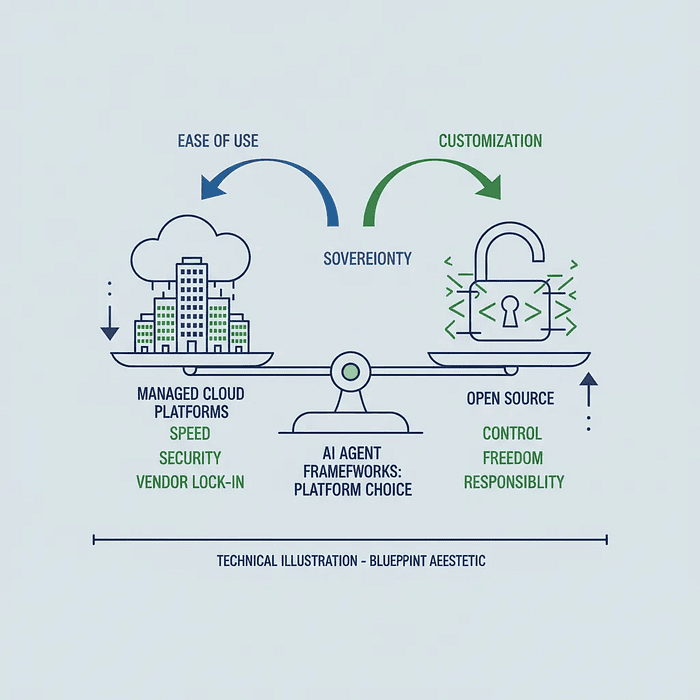 Balance scale diagram showing managed cloud platforms offering speed and security versus open source frameworks offering control and freedom
Cloud platforms offer speed and security versus open source frameworks which offer control and freedom.
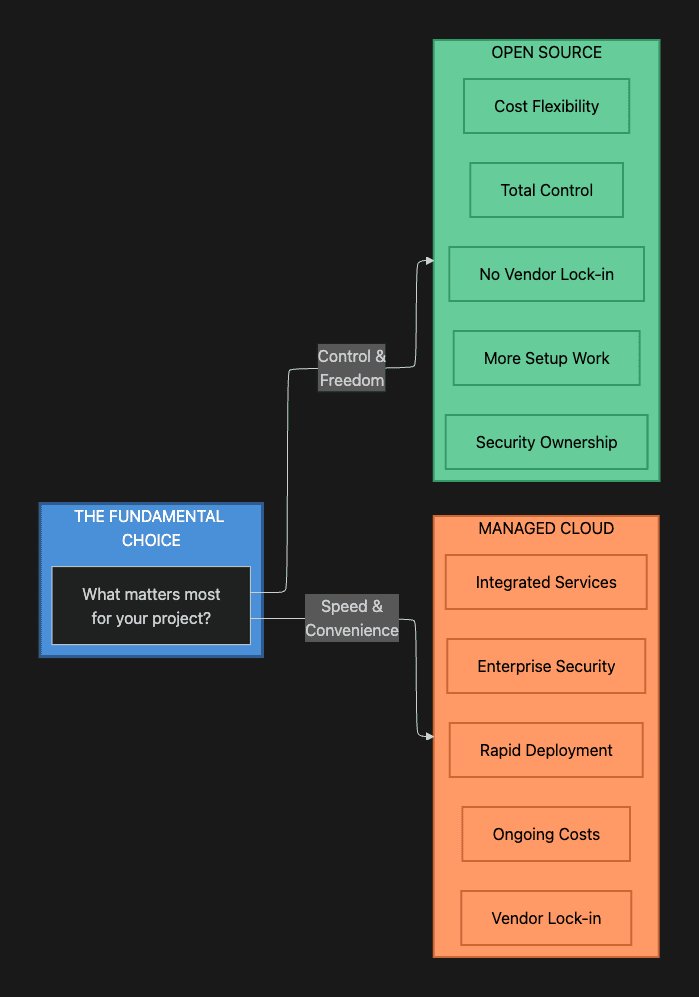
This is the bedrock choice: speed or sovereignty. Neither answer is universally correct. The right path depends entirely on your constraints, your team's capabilities, and your strategic objectives.
Managed cloud means buying speed and convenience. You get enterprise-grade security configurations, integrated monitoring, automatic scaling, and a clear support contract. The trade-off? You pay monthly costs that scale with usage, and you couple your architecture to a specific vendor's ecosystem.
Open source means buying freedom and control. You choose your deployment environment, your cost structure, and your upgrade timeline. You can self-host on bare metal or orchestrate across multiple clouds. The trade-off? You own the operational complexity, the security configuration, and the integration work.
Neither path is a trap. Both can succeed. But you must choose intentionally.
The Cloud Native Front: Enterprise Speed at Vendor Cost
If you're already invested in a major cloud ecosystem, your framework choice becomes a platform allegiance. The three major players (Google, AWS, and Microsoft) have each made significant strategic moves in 2025. Understanding their positions helps you align your technical decisions with their roadmaps.
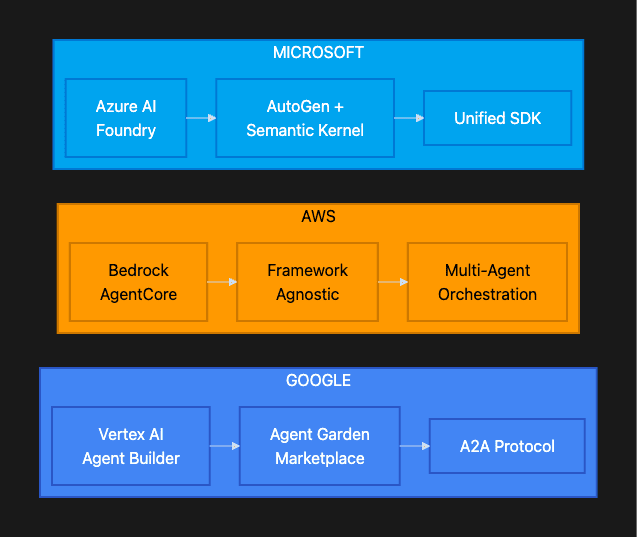 Autogen vs. Bedrock AgentCore vs. Vertex AI Agent Builder
Google: Building the Agent App Store
Google positioned Vertex AI Agent Builder as the "app store for agents." The game-changing moment came in November 2025 with the launch of Agent Garden and the A2A (Agent-to-Agent) protocol.
What makes A2A transformative:
- Universal discovery: Any agent can publish to the marketplace, regardless of the framework used to build it
- Runtime capability negotiation: Agents query each other's capabilities dynamically, enabling flexible orchestration
- Shared context preservation: Context flows across agent interactions without manual marshaling
- Built-in governance: Enterprise security, compliance controls, and audit trails are protocol-level features
This isn't a walled garden strategy. Google is positioning Vertex AI as an open marketplace where agents from different frameworks, builders, and vendors can discover and collaborate.
The strategic bet: Agent interoperability becomes the standard, and Google's infrastructure becomes the universal runtime.
Best for: Teams already committed to Google Cloud who want the fastest path from concept to production with built-in cross-framework interoperability.
AWS: Maximum Flexibility, Minimum Opinions
AWS Bedrock's entire identity is flexibility without constraints. Unlike Google's marketplace approach, Bedrock is completely framework-agnostic. Build your agent with LangGraph, CrewAI, custom code, or anything else. Bedrock provides the runtime.
Core capabilities:
- True framework agnosticism: No vendor preference, no framework lock-in
- Native multi-agent orchestration: First-class support for supervisor/worker patterns and complex agent topologies
- Enterprise network isolation: Full VPC integration and PrivateLink support for air-gapped deployments
- Serverless autoscaling: Automatic resource provisioning without capacity planning
The strategic bet: Developers want infrastructure, not opinions on frameworks. Let them bring their own architecture.
Best for: Organizations that need maximum flexibility in agent design while maintaining tight integration with AWS services and enterprise security boundaries.
Microsoft: The Consolidation Play
Microsoft made a decisive move in October 2025 by shipping the Microsoft Agent Service. This unified platform merged the multi-agent conversational capabilities of AutoGen with the enterprise orchestration backbone of Semantic Kernel.
What consolidation delivers:
- One coherent SDK: Instead of choosing between AutoGen (conversational) and Semantic Kernel (orchestration), you get a single unified development experience
- Azure-native integration: Deep hooks into Azure identity, governance, monitoring, and compliance infrastructure
- Open source foundations with managed convenience: The code is open, the runtime is managed, giving you the best of both worlds
The strategic bet: Framework fragmentation hurts adoption. Developers want one clear path.
Best for: Azure-committed organizations seeking a single, well-integrated agent development platform without ecosystem confusion.
The Open Source Front: Control and Freedom at Operational Cost
For teams that prioritize control, cost flexibility, and freedom from vendor dependency, open source frameworks offer powerful, production-ready alternatives.
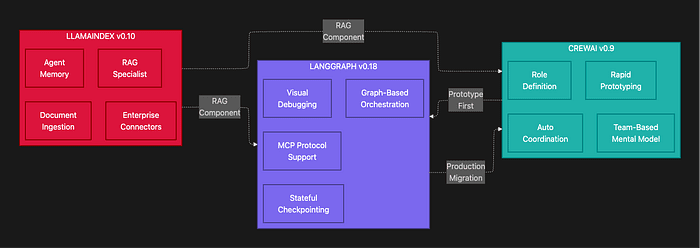 LlamaIndex vs. LangGraph vs. CrewAI
LangGraph: The Production Power Tool
Current version: v0.18.0 (November 2025) | GitHub | Documentation
LangGraph isn't for simple, linear workflows. You reach for LangGraph when you need complex, stateful, production-grade agent systems. These are agents that maintain context across sessions, loop through multi-step decision processes, branch based on runtime conditions, and pause for human approval.
Core strengths:
- Graph-based orchestration: Define agent workflows as directed graphs with explicit state transitions
- Stateful checkpointing: Agents save and restore full conversation state, enabling long-running processes
- Visual debugging with LangGraph Studio: Inspect workflow execution, state changes, and decision paths in real time
- Native MCP support: First-class integration with the Model Context Protocol for tool interactions
The typical pattern: LangGraph becomes your production framework when you've outgrown simpler alternatives and need precise control over agent behavior, error handling, and state management.
When to choose: Production systems with complex multi-step workflows, human-in-the-loop requirements, or mission-critical reliability needs.
LangChain: The Original Framework Foundation
Current version: v0.3.x (November 2025) | GitHub | Documentation
Before LangGraph, CrewAI, and the ecosystem explosion, there was LangChain. It remains the foundational framework that introduced many of the core concepts the agent ecosystem now takes for granted: chains, prompt templates, memory management, and tool abstractions.
Core strengths:
- Mature ecosystem: The largest collection of integrations, tools, and community resources
- Simple linear workflows: Perfect for straightforward chains of LLM calls with predictable patterns
- Extensive documentation: Years of community knowledge, tutorials, and production battle stories
- Foundation for other frameworks: LangGraph is built on LangChain primitives, making migration seamless
The evolution story: LangChain dominated 2023-2024 as the way to build LLM applications. As agent architectures grew more complex, the ecosystem evolved specialized tools (LangGraph for state machines, specialized frameworks for teams). But LangChain's core abstractions remain valuable for simpler use cases.
When to choose: Linear workflows, proof-of-concept projects, or when you need the broadest possible ecosystem of integrations and don't require complex multi-agent orchestration.
The typical pattern: Many teams start with LangChain for rapid development, then selectively adopt LangGraph for specific workflows that need stateful complexity, while keeping LangChain for simpler components.
CrewAI: The Prototyping Speedrun
Current version: v0.9.x (November 2025)
CrewAI takes a radically different approach. Instead of graphs and state machines, you build teams. Define agents with roles like "researcher," "analyst," or "writer." Give them a shared goal. CrewAI handles the coordination, task handoff, and collaboration patterns automatically.
Core strengths:
- Intuitive team-based mental model: Think in terms of roles and responsibilities, not graph edges
- Unmatched prototyping speed: Get from concept to working demo faster than any other framework
- Minimal boilerplate: Configure agents in YAML or Python with almost no setup code
- Automatic coordination: CrewAI infers communication patterns and task dependencies
The typical migration path: Start with CrewAI because it's fast for validation. Once you've proven product-market fit, migrate critical workflows to LangGraph for production-grade control and observability.
When to choose: Rapid prototyping, proof-of-concept demos, or early-stage startups validating ideas before investing in production infrastructure.
LlamaIndex: The RAG Specialist
Current version: v0.10.3 (November 2025)
If your agent's primary job involves reasoning over documents, databases, or proprietary knowledge bases (the pattern known as Retrieval Augmented Generation, or RAG), then LlamaIndex is the purpose-built toolkit.
Core strengths:
- Best-in-class RAG pipeline: Industry-leading document ingestion, chunking, embedding, indexing, and retrieval
- Sophisticated memory management: Context window optimization and conversation history handling
- Enterprise data connectors: Pre-built integrations for common data sources (SharePoint, Confluence, databases)
- Framework interoperability: Works as a standalone RAG solution or integrates cleanly with LangGraph and CrewAI
The typical use case: Customer support agents grounded in product documentation. Internal knowledge assistants querying company wikis. Document analysis tools processing legal contracts or research papers.
When to choose: Any agent that must ground its responses in your specific, proprietary data rather than relying solely on pre-trained knowledge.
Anthropic Claude Agent SDK: The Safety-First Production Framework
Current version: v1.x (November 2025) | GitHub | Documentation
The Claude Agent SDK represents Anthropic's answer to a critical question: how do you build powerful, general-purpose agents that can perform complex workflows while maintaining strict safety boundaries, proper error handling, and human oversight?
This is the successor to the Claude Code SDK, evolved from a coding-focused tool into a comprehensive framework for building production-grade agents capable of research, data analysis, system automation, and complex multi-step workflows.
Core strengths:
- Subagents for specialized tasks: Decompose complex workflows into focused, manageable sub-agents with clear responsibilities
- Runtime hooks and interception: Intercept and modify agent behavior at runtime for debugging, monitoring, and safety checks
- Background task management: Handle long-running operations without blocking primary workflows
- Persistent context management: Maintain conversation state across sessions with intelligent context window handling
- Checkpointing and recovery: Save and restore agent states for resilience against failures
The agent loop architecture: Claude Agent SDK follows a structured four-step cycle: gather context -> take action -> verify work -> repeat. This deliberate verification step is what distinguishes safety-first frameworks from move-fast alternatives.
Built-in tools and extensibility:
- Core tools: Read, Write, Bash, WebSearch included out of the box
- Custom tools via @tool decorator: Define your own tools with type safety and validation
- MCP integration: Use the Model Context Protocol for standardized tool integration, both in-process and external servers
Security and permission model:
- Sandboxed execution: Agents run in isolated environments with controlled system access
- Fine-grained permissions: Choose from default, plan, acceptEdits, or bypassPermissions modes
- Human-in-the-loop controls: Built-in approval workflows for sensitive operations
Production deployment: The SDK integrates cleanly with GitHub Actions for CI/CD automation, VS Code extensions for IDE-native workflows, and custom integrations via REST APIs, webhooks, and message queues.
Available in Python and TypeScript: The Python SDK is open source (Python 3.10+), installable via pip install claude-agent-sdk. TypeScript support enables web and Node.js deployments.
The strategic bet: Safety and reliability aren't optional features for production agents. They're foundational requirements that should be built into the framework, not bolted on later.
When to choose: Production systems where agent failures have real consequences, regulated industries requiring audit trails and human oversight, or any deployment where "move fast and break things" isn't an acceptable strategy.
Best for: Organizations prioritizing safety, reliability, and operational control over rapid prototyping speed. Works with Google Vertex AI, AWS Bedrock, and Azure AI Foundry for enterprise deployment.
The Decision Framework: Matching Capability to Mission
Choosing a framework isn't about feature checklists. It's about aligning technical capabilities with your specific mission, constraints, and strategic objectives.
Start Here: What Is Your Primary Mission?
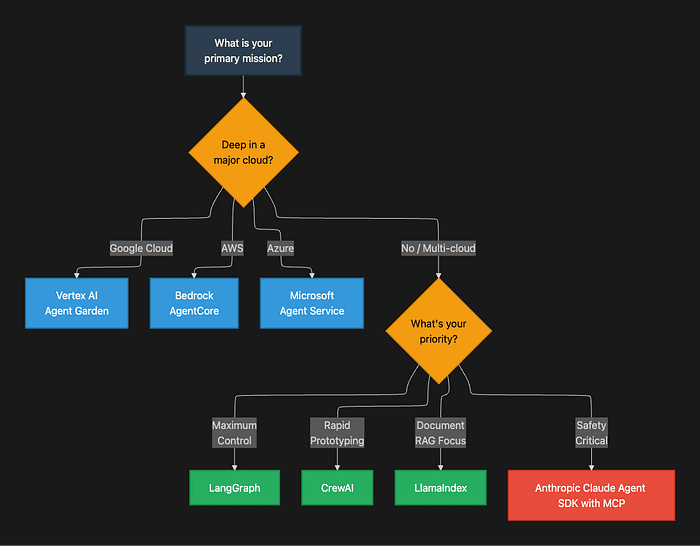
Decision Matrix: Priority-Based Selection
| If Your Priority Is... | Recommended Framework | Strategic Rationale |
|---|---|---|
| Deep Google Cloud integration | Vertex AI Agent Garden | Native A2A protocol, managed infrastructure, Google service ecosystem |
| AWS ecosystem with maximum flexibility | Bedrock AgentCore | Framework-agnostic deployment, enterprise network isolation |
| Azure-native with unified developer experience | Microsoft Agent Service | Consolidated AutoGen + Semantic Kernel with Azure governance |
| Maximum control, production-grade orchestration | LangGraph | Graph-based workflows, stateful checkpointing, visual debugging |
| Fastest path to working prototype | CrewAI | Team-based abstraction, minimal setup, rapid iteration |
| Document/data-heavy RAG workflows | LlamaIndex | Purpose-built ingestion, indexing, and retrieval pipelines |
| Safety-critical applications with strict boundaries | Anthropic Claude Agent SDK | Constrained tool access, strong operational guardrails, runs with Google Vertex or AWS Bedrock or Azure Foundry |
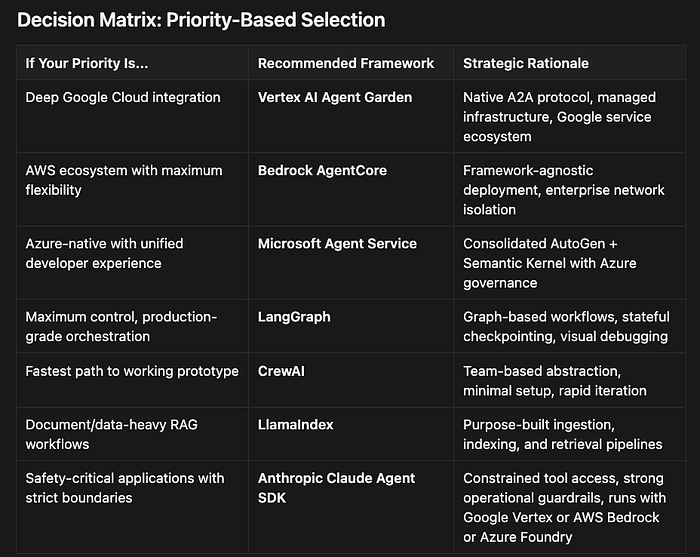 Decision Matrix for Agent Frameworks
Pro tip: Don't over-index on feature lists. Choose based on your team's existing expertise, your infrastructure commitments, and your risk tolerance for vendor lock-in.
The Economics Factor: Why Model Costs Drive Architecture
Your framework choice isn't purely technical. It's a financial decision with profound implications for project viability.
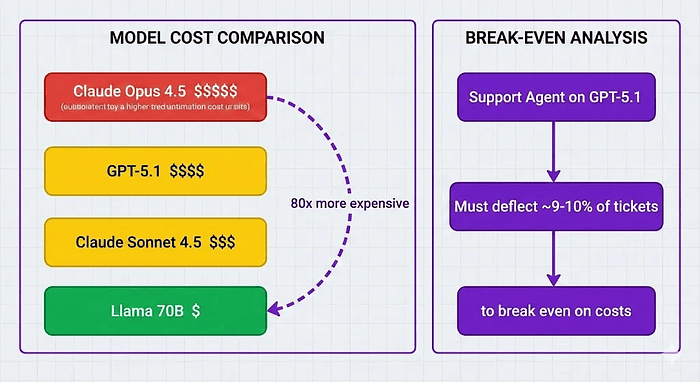
The brutal reality: Running top-tier proprietary models like Claude Opus 4.5 can cost 80x more per token than powerful open source alternatives like Llama 70B (especially when self-hosted). 80x cheaper does not mean viable if it does not work for your use case. It is often about picking the right tool for the job.
This isn't a minor line item. It's an architectural constraint that determines whether your project is financially sustainable.
Real-World Economics: The Support Agent Case Study
Consider a typical customer support agent built on GPT-5.1 or similar frontier models. For most software companies, this agent needs to deflect approximately 9-10% of human support tickets just to break even on its operational cost.
Think about that threshold. If your agent can't achieve a 10% deflection rate, you're losing money on every customer interaction. If it achieves 20% deflection, you've doubled your ROI. If it hits 40%, you've fundamentally changed your unit economics.
This single metric, deflection rate, becomes the difference between a failed experiment and a transformative cost reduction.
Cost Optimization Strategies That Actually Work
- Model tiering by complexity: Use small, fast models (Gemini 3 Flash, Claude Haiku 4.5 or open source models) for classification and routing. Reserve expensive models for complex reasoning where quality justifies cost.
- Aggressive caching for repeated queries: If 30% of your queries are semantically similar, caching can reduce costs by 30% immediately. Understand token cache.
- Self-hosted open source for high-volume workloads: For latency-tolerant, high-throughput use cases, self-hosting Llama 70B can reduce inference costs by 10-50x.
- Dynamic model selection: Route requests to the cheapest model capable of solving the task. Simple queries get Haiku 4.5. Complex reasoning gets Opus 4.5.
The framework implication: Some frameworks make model switching trivial (LangGraph, Bedrock). Others are tightly coupled to specific model providers. Choose accordingly.
The Future: Convergence Through Protocols
After exploring the competitive landscape (cloud platforms versus open source, framework wars, and feature battles), where is this actually heading?
The most significant trend isn't fragmentation. It's standardization.
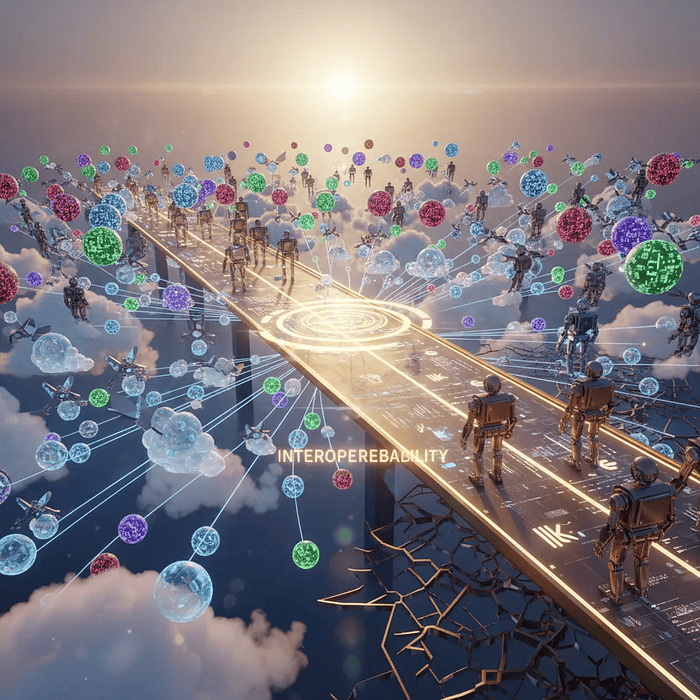 Futuristic visualization of AI agents from different frameworks converging through shared protocols toward interoperability
The agentic frameworks world, frameworks and standards, are constantly evolving.
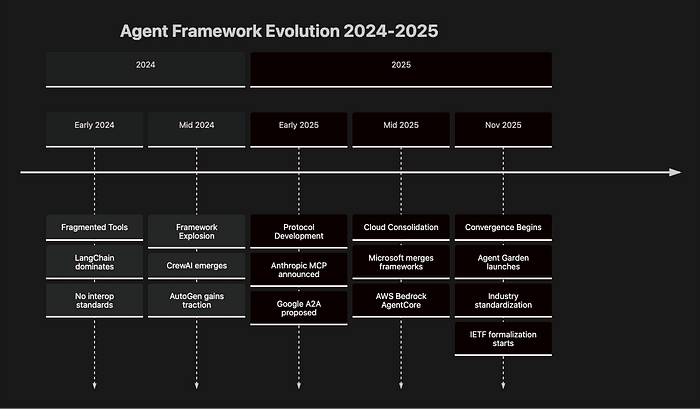
The Protocol Revolution That Changes Everything
In just twelve months, the AI agent ecosystem transformed from scattered, incompatible tools to major players aligning around common standards:
Anthropic's MCP (Model Context Protocol): Defines how agents interact with external tools, maintain context boundaries, and respect operational constraints. Think of it as OAuth for AI tool access.
Google's A2A (Agent-to-Agent): Enables cross-framework agent discovery, capability negotiation, and collaboration. An agent built with CrewAI can discover and transparently delegate to an agent built with LangGraph. If your field is heavily regulated, consider working with the Claude Agent SDK, where precision and safety are key. If you have simpler needs and wish to avoid the complexity of LangGraph, consider LangChain.
Both protocols are now undergoing formal standardization. While not yet ratified as official IETF standards, the broad industry alignment (Google, Microsoft, AWS, Anthropic, and major open-source projects) suggests that convergence is inevitable.
What Protocol Convergence Means for Your Architecture Decisions
The emergence of interoperability protocols fundamentally changes the decision calculus:
Reduced lock-in risk: If agents can communicate across frameworks via standard protocols, switching costs drop dramatically. You're not locked into a vendor. You're participating in an ecosystem.
Hybrid architectures become viable: Use the best tool for each job without integration hell. LlamaIndex for RAG, LangGraph for orchestration, Vertex AI for deployment, Claude Agent SDK for precision, all speaking the same protocol.
Focus shifts from framework features to domain expertise: When interoperability is guaranteed, framework choice matters less than building agents that solve real problems effectively.
The Strategic Question: Will Framework Wars Even Matter?
As these protocols mature and gain adoption, the framework wars may become less relevant than we think. The future could be a collaborative ecosystem of specialized agents: some cloud-hosted, some self-hosted, some built with LangGraph, others with CrewAI, all discovering each other, negotiating capabilities, and collaborating through standard protocols.
The smartest long-term bet: Choose based on today's constraints and capabilities, but architect for tomorrow's interoperability. Pick the framework that solves your immediate problem most effectively, but ensure your agents can participate in the emerging protocol ecosystem.
Build for convergence, not isolation.
Practical Recommendations: Decision Playbooks by Team Type
For Startups and Small Teams
Primary objective: Validate product-market fit before infrastructure becomes a distraction.
- Start with CrewAI or Claude Code Agent SDK for fastest prototype-to-demo cycles
- Use managed cloud services to minimize operational overhead
- Focus relentlessly on proving value before optimizing costs
- Plan migration to LangGraph only after validating core workflows
Key risk: Don't over-engineer. Speed to market beats architectural purity.
For Enterprise Organizations
Primary objective: Align with existing infrastructure while maintaining governance and compliance.
- Choose your existing cloud provider's native solution (Vertex AI for GCP, Bedrock for AWS, Azure Agent Service for Microsoft, Claude Agent SDK for implementation)
- Prioritize built-in governance, audit trails, and compliance certifications
- Plan for hybrid architectures as protocol standardization matures
- Invest in internal platform teams to abstract framework details from application developers
Key risk: Avoid framework proliferation. Standardize on one primary stack.
For Platform and Infrastructure Teams
Primary objective: Build abstraction layers that survive ecosystem evolution.
- Invest in LangGraph for maximum flexibility and production-grade orchestration
- Build internal APIs that abstract framework-specific details
- Consider LlamaIndex as a specialized component for RAG-heavy workloads
- Design for protocol interoperability from day one
Key risk: Don't build abstractions prematurely. Let requirements emerge before generalizing.
Universal Recommendations for Everyone
Watch the protocol developments: MCP and A2A standardization will reshape the ecosystem. Stay informed.
Don't over-optimize for current features: The landscape is moving fast. Framework features that matter today may be commoditized tomorrow.
Build with interoperability in mind: Ensure your agents can participate in cross-framework protocols. Isolation is a liability.
Test economic assumptions early: Validate model costs and ROI metrics before scaling. A 10x cost surprise at scale can kill a project.
Key Terminology
| Term | Definition |
|---|---|
| A2A | Agent-to-Agent protocol enabling cross-framework agent communication and capability negotiation |
| MCP | Model Context Protocol defining standardized agent-tool interaction boundaries |
| RAG | Retrieval Augmented Generation: grounding LLM responses in specific, proprietary data sources |
| Agent Garden | Google's marketplace for discovering, deploying, and collaborating with agents across frameworks |
| AutoGen | Microsoft's multi-agent conversation framework (now consolidated into Azure Agent Service) |
| Semantic Kernel | Microsoft's enterprise AI orchestration SDK (now consolidated into Azure Agent Service) |
The Bottom Line
The AI agent framework landscape will continue evolving rapidly. The frameworks dominating today may merge, fork, or be superseded by entirely new approaches.
What remains constant: The need to make informed choices based on your specific requirements, team capabilities, and strategic direction.
Choose deliberately. Build for interoperability. And remember: the best framework is the one that ships working agents solving real problems.
The battlefield is real. But you don't have to navigate it blind.
What's Your Framework Bet?
I want to hear from you. What AI agent framework is your team betting on in 2025, and why? Are you going all-in on a cloud platform, or building with open source for maximum control?
Drop a comment below sharing:
- Your current framework choice
- The biggest factor driving that decision
- Any surprises you've encountered along the way
The best insights often come from the trenches. Let's learn from each other.
#AIAgents #LangGraph #CrewAI #LlamaIndex #VertexAI #AWSBedrock #AzureAI #MCP #A2A #AIFrameworks #MachineLearning #DevOps #TechStrategy #AIEngineering #AgentOrchestration
About the Author
I am Rick Hightower, a seasoned professional with experience as an executive and data engineer at a Fortune 100 financial technology organization. My work there involved developing advanced Machine Learning and AI solutions designed to enhance customer experience metrics. I maintain a balanced interest in both theoretical AI concepts and their practical applications in enterprise environments.
My professional credentials include TensorFlow certification and completion of Stanford's Machine Learning Specialization program, both of which have significantly contributed to my expertise in this field. I value the integration of academic knowledge with practical implementation. My professional experience encompasses work with supervised learning methodologies, neural network architectures, and various AI technologies, which I have applied to develop enterprise-grade solutions that deliver measurable business value. I recently obtained several certificates from Anthropic on using Claude SDK with Vertex AI, Claude SDK with Amazon Bedrock, using Claude Tools, MCP, etc. Three certificates so far from Anthropic, and quite a few more here and there as I love to learn new tricks. I have built projects with LangChain, LlamaIndex, ChatGPT Native API, Lite-llm, and more on AWS, Azure and GCP. Lately, I have been working a lot lately with Claude Code, OpenCode and Claude Agent SDK to build agentic solutions. I use Gemini CLI, Claude Code, OpenCode, Github CoPilot CLI and pretty much all of the LLMs and tools.
Connect with Richard on LinkedIn or Medium for additional insights on enterprise AI implementation.
Community Extensions & Resources
The Claude Code community has developed powerful extensions that enhance its capabilities. Here are some valuable resources from Spillwave Solutions:
Integration Skills
- Notion Uploader/Downloader: Seamlessly upload and download Markdown content and images to Notion for documentation workflows
- Confluence Skill: Upload and download Markdown content and images to Confluence for enterprise documentation
- JIRA Integration: Create and read JIRA tickets, including handling special required fields
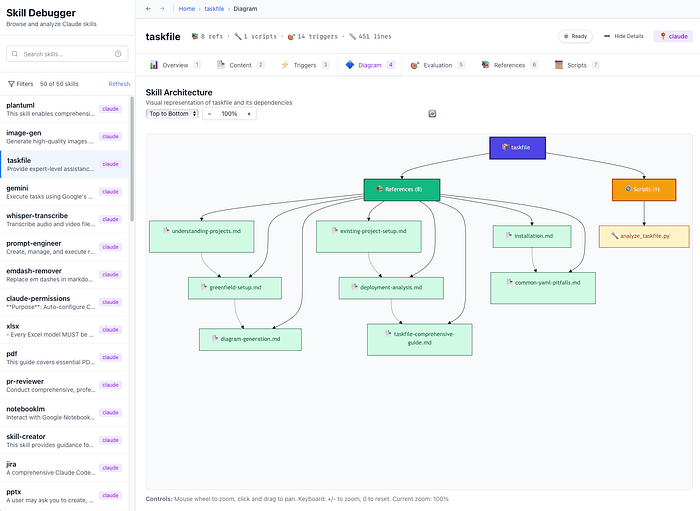
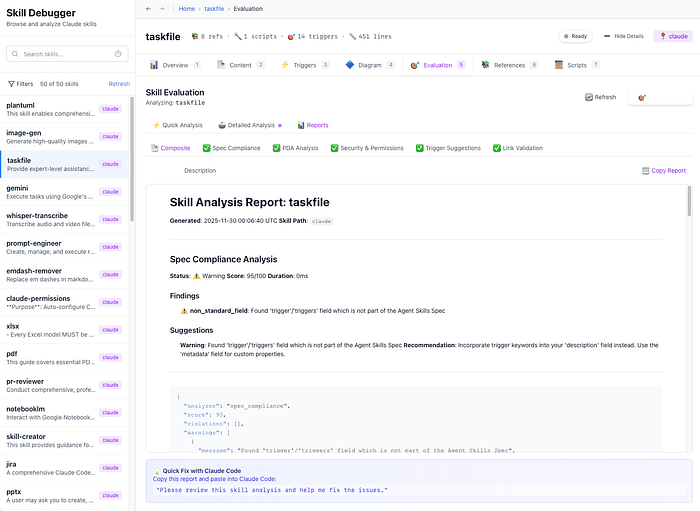
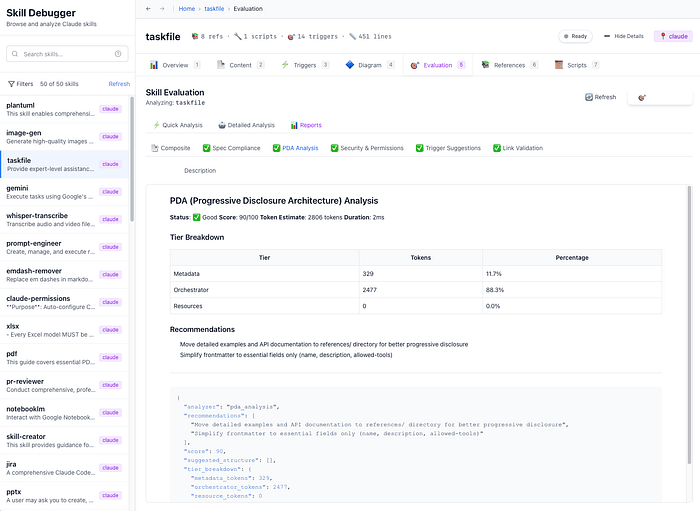
Recently, I wrote a desktop app called Skill Viewer to evaluate Agents skills for safety, usefulness, links and PDA.
Advanced Development Agents
- Architect Agent: Puts Claude Code into Architect Mode to manage multiple projects and delegate to other Claude Code instances running as specialized code agents
- Project Memory: Store key decisions, recurring bugs, tickets, and critical facts to maintain vital context throughout software development
- Claude Agents Collection: A comprehensive collection of 15 specialized agents for various development tasks
Visualization & Design Tools
- Design Doc Mermaid: Specialized skill for creating professional Mermaid diagrams for architecture documentation
- PlantUML Skill: Generate PlantUML diagrams from source code, extract diagrams from Markdown, and create image-linked documentation
- Image Generation: Uses Gemini Banana to generate images for documentation and design work
- SDD Skill: A comprehensive Claude Code skill for guiding users through GitHub's Spec-Kit and the Spec-Driven Development methodology.
AI Model Integration
- Gemini Skill: Delegate specific tasks to Google's Gemini AI for multi-model collaboration
- Image_gen: Image generation skill that uses Gemini Banana to generate images.
Explore more at Spillwave Solutions -- specialists in bespoke software development and AI-powered automation.