Claude Agent SDK vs. OpenAI AgentKit: A Developer's Guide to Building AI Agents
A comprehensive comparison of two leading frameworks for building AI agents, released within days of each other in fall 2025
Originally published on Medium.
A comprehensive comparison of two leading frameworks for building AI agents, released within days of each other in fall 2025
Last Updated: October 12, 2025 | Both frameworks are newly released and actively evolving. Check official documentation for the latest features.
In October 2025, AI agent development reached an inflection point. OpenAI launched AgentKit on October 6, and just days earlier, on September 29, Anthropic released the Claude Agent SDK alongside Claude Sonnet 4.5. Both represent mature, production-ready approaches to building AI agents, but with fundamentally different philosophies.
Which framework fits your needs? This guide provides a detailed, objective comparison to help you evaluate both options.
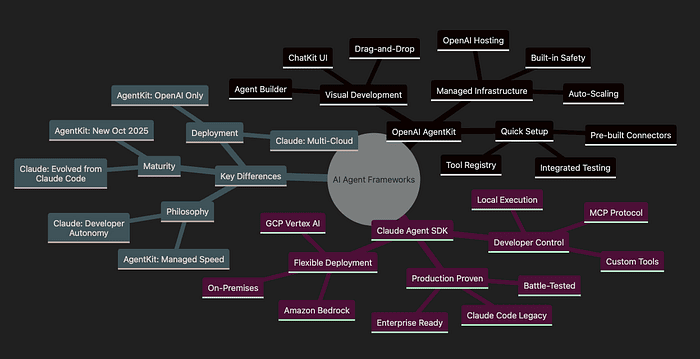
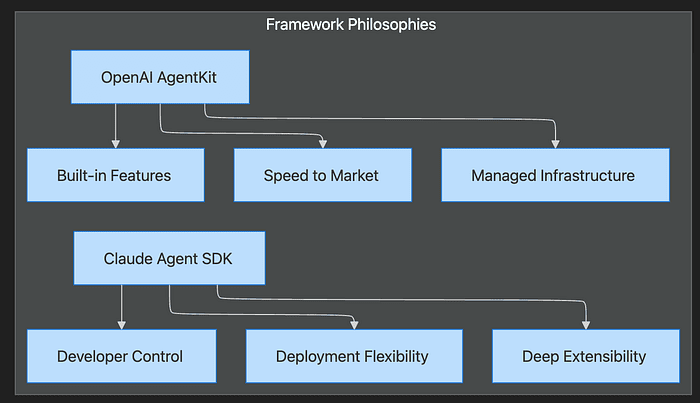
This mindmap shows the core distinctions between the two frameworks. AgentKit prioritizes speed with managed infrastructure, while Claude Agent SDK emphasizes developer control with flexible deployment options.
Understanding the Frameworks
This section explores what each framework offers and how they approach agent development differently.
OpenAI AgentKit
AgentKit is OpenAI's comprehensive platform for building AI agents, featuring:
- Agent Builder: Visual canvas for designing agent workflows
- ChatKit: Embeddable UI components for chat interfaces
- Connector Registry: Pre-built integrations with popular services
- Evals & Guardrails: Built-in testing and safety frameworks
The platform runs on OpenAI's managed infrastructure, making it product-ready out of the box.
Claude Agent SDK
The Claude Agent SDK (formerly Claude Code SDK) is Anthropic's developer-first framework providing:
- Core primitives for tool usage, file operations, and shell commands
- Model Context Protocol (MCP) for custom tool integration
- Local and enterprise-hosted execution options
- Full programmatic control over agent workflows
- Cloud deployment flexibility: Works with Amazon Bedrock and GCP Vertex AI for enterprise-scale deployments or with Claude subscription
Available in both Python and TypeScript, with support for Claude 3+ models including Sonnet 4.5.
A Critical Distinction: Production Maturity
Before diving into feature comparisons, there's a meaningful context that shapes how you should evaluate these frameworks.
Claude Agent SDK represents the evolution of Claude Code, Anthropic's command-line agent tool that has been deployed in production environments since early 2025. When Anthropic rebranded Claude Code to Claude Agent SDK on September 29, 2025, they weren't launching new technology. They were expanding and formalizing a system that had already been battle-tested by thousands of developers across millions of agent interactions.
This means the core agent loop, tool coordination, error recovery, and context management you're evaluating have already survived real-world production stress testing. Companies have been running Claude Code-based workflows in regulated industries, processing production codebases, and automating critical business processes for months before the official SDK announcement.
OpenAI AgentKit launched on October 6, 2025, less than a week before this article was published. While leveraging OpenAI's extensive experience with the Assistants API and ChatGPT, and incorporating cutting-edge thinking about agent development, it hasn't yet accumulated the same breadth of edge-case discoveries and production deployments that come from widespread field usage.
This distinction matters significantly if production stability, risk mitigation, or regulatory compliance are factors in your decision. The rest of this comparison will explore features objectively, but keep this maturity difference in mind as you evaluate which framework fits your constraints.
Quick Comparison: Pros & Cons
OpenAI AgentKit
Pros:
- Fastest time to prototype
- Built-in UI components
- Minimal infrastructure setup
- Integrated testing & safety tools
- Rich connector ecosystem
Cons:
- Vendor lock-in to OpenAI
- Less granular execution control
- Provider-managed data storage
- Limited customization depth
- Single model provider
- Newer to market (Oct 2025)
Claude Agent SDK
Pros:
- Local/on-premises deployment
- Full compliance control
- Highly extensible via MCP
- Multiple model support per task
- Deep customization capability
- Amazon Bedrock & GCP Vertex AI support
- Growing MCP server ecosystem
- Battle-tested through Claude Code
Cons:
- Steeper learning curve
- More infrastructure responsibility
- No native UI (requires custom builds)
- Requires MCP server setup
- Manual state management
Feature-by-Feature Deep Dive
This section breaks down how each framework handles key aspects of agent development.
Setup & Onboarding
OpenAI AgentKit offers a visual Agent Builder with drag-and-drop workflow creation. You can have a working agent in minutes with minimal infrastructure. Early adopters like Ramp reported reducing development cycles by 70%.
Claude Agent SDK requires SDK installation (Python or TypeScript) and CLI setup, along with configuring MCP servers. While more explicit in its requirements, this approach supports local and offline deployments from the start. As Claire from Skywork.ai notes in her hands-on comparison: "Claude's SDK demands more upfront work, but that investment pays dividends when you need to ship agents that integrate with proprietary systems or run in air-gapped environments."
Tool Integration
AgentKit features a built-in tool registry including:
- Web search and browsing
- File operations
- Code execution
- Pre-built connectors for services like Google Drive, Notion, and Slack
Claude Agent SDK uses the Model Context Protocol (MCP) for tool integration, which provides several advantages:
Extensive MCP Server Ecosystem: Access to a rapidly growing collection of pre-built MCP servers for common services including:
- Database connectors (PostgreSQL, MySQL, SQLite)
- Cloud services (AWS, Google Cloud, Azure)
- Development tools (GitHub, GitLab, Linear, Jira)
- Productivity apps (Google Drive, Slack, Notion)
- Data sources (APIs, file systems, web scrapers)
- Web Search (context7, Perplexity, Brave Search)
Custom Tool Development: Explicit schemas and permissioning enable custom integrations with private infrastructure and proprietary tools
Community Contributions: The open MCP specification allows developers to build and share custom servers, creating a decentralized tool ecosystem that continues to expand
While requiring more initial setup than AgentKit's plug-and-play approach, MCP's flexibility becomes invaluable for enterprise scenarios requiring bespoke tool integrations.
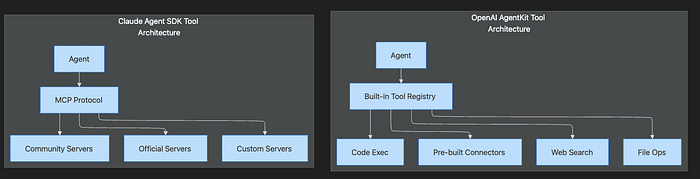
This diagram illustrates the architectural difference in tool integration. AgentKit uses a centralized registry with pre-built tools, while Claude Agent SDK leverages the decentralized MCP protocol, allowing official, custom, and community-contributed tool servers.
Execution Environment
AgentKit runs on OpenAI's managed infrastructure with an embeddable chat UI via ChatKit. This provider-managed approach handles scaling, monitoring, and reliability automatically.
Claude Agent SDK offers exceptional deployment flexibility:
- Local Development: Run entirely on your machine for development and testing
- Enterprise On-Premises: Deploy to your own servers for complete data control
- Buy Claude tokens or use Claude subscription
- Amazon Bedrock: Leverage AWS's fully managed service for scalable, secure Claude deployments with enterprise features like VPC isolation and AWS IAM integration
- GCP Vertex AI: Deploy on Google Cloud's AI platform for seamless integration with Google Cloud services and enterprise-grade security
- Hybrid Architectures: Mix local tool execution with cloud-based model inference
The execution loop is developer-controlled, offering flexibility for custom deployment scenarios and air-gapped environments. This multi-cloud approach prevents vendor lock-in while maintaining the same SDK interface across all deployment options.
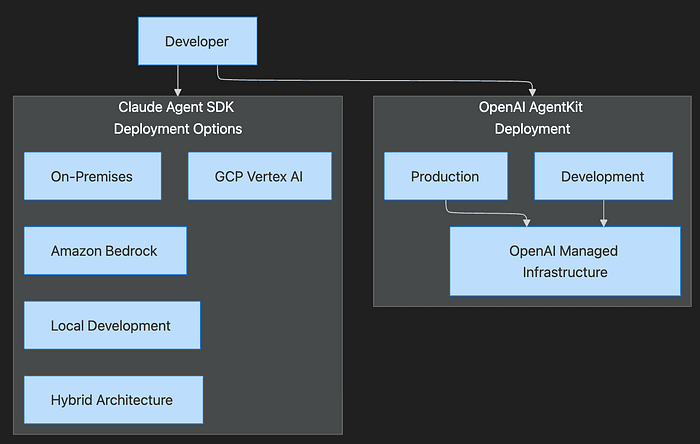
This deployment comparison shows AgentKit's single managed path versus Claude Agent SDK's multiple deployment options. Developers using Claude can choose local, on-premises, or cloud deployments, while AgentKit users rely on OpenAI's infrastructure.
💡 Why This Matters: Real-World Validation
Unlike newly launched frameworks, the Claude Agent SDK carries production validation from its Claude Code predecessor:
✓ Months of field testing across diverse use cases
✓ IDE integrations deployed to millions of developers
✓ Enterprise deployments via Bedrock/Vertex AI
✓ Edge cases discovered and resolved in production
✓ MCP ecosystem matured through community usage
This heritage means you're not adopting beta technology. You're leveraging a proven system that's been refined through real-world usage at scale.
Memory & State Management
AgentKit provides integrated conversation memory within the ChatGPT API, enabling persistent, stateful experiences without additional engineering.
Claude Agent SDK places state management in the developer's hands, handled locally or via MCP resources. This requires custom logic but ensures complete data sovereignty and enables sophisticated state management strategies tailored to your application.
User Interface
AgentKit offers ChatKit for embeddable chat interfaces with built-in components for familiar patterns (message threads, file uploads, typing indicators).
Claude Agent SDK is CLI-focused with hooks for building custom interfaces. Community integrations exist, such as the JetBrains IDE plugin, but require separate implementation. This approach enables UI designs tailored to your application, rather than being constrained by pre-built components.
Custom Logic & Extensibility
AgentKit uses visual workflows with programmatic hooks for custom behavior. The Evals framework enables systematic testing of agent responses.
Claude Agent SDK provides complete programmatic control:
- Explicit tool call handling
- Custom agent delegation patterns
- Context compaction strategies
- Integration hooks at every level
Plugins & Extensions
AgentKit features a connector registry with growing third-party integrations. Adding new connectors is streamlined, following platform conventions.
Claude Agent SDK leverages the MCP ecosystem for extensibility:
- Official MCP Servers: Maintained by Anthropic and the community, covering popular services and use cases
- Custom MCP Server Development: Create proprietary tool servers for internal systems
- Plugin Architecture: Build reusable components that extend agent capabilities
- Subagent Systems: Compose multiple specialized agents with different tool access and models
The decentralized nature of MCP enables the tool ecosystem to grow organically through community contributions, with servers ranging from simple utilities to complex enterprise integrations. This architecture scales from small projects to large organizations with hundreds of custom tools.
Security & Governance
AgentKit provides centralized safety evaluation and guardrails with a preview mode for testing. Data flows through OpenAI's infrastructure, which may raise compliance concerns for regulated industries.
Claude Agent SDK uses typed schemas and tool permissioning with host-side control. Combined with deployment options like Amazon Bedrock's security features (encryption at rest, VPC endpoints, CloudTrail logging) or GCP Vertex AI's compliance certifications (HIPAA, SOC 2, ISO 27001), this enables on-premises data governance critical for regulatory requirements.
Model Support & Pricing
AgentKit uses OpenAI models (GPT-4o, o1-mini, and GPT-4 Turbo) exclusively. Pricing follows standard OpenAI API rates with no additional platform fees. Currently in beta with some features still rolling out.
Claude Agent SDK supports Claude 3+ models, including Sonnet 4.5, with per-subagent model selection. The SDK is free; you pay for model usage through:
- Direct Anthropic API calls (standard rates)
- Amazon Bedrock pricing (per-token with enterprise volume discounts)
- GCP Vertex AI pricing (flexible pricing with committed use discounts)
MCP architecture theoretically supports mixing different models for different tasks, enabling cost optimization by using smaller models for simple operations and larger models for complex reasoning.
Primary Use Cases
AgentKit excels at:
- Rapid prototyping and customer-facing bots
- General-purpose agents for support and knowledge management
- Product teams needing fast deployment with built-in UI
Claude Agent SDK is optimized for:
- Developer-first scenarios: code agents, file processing, research
- Enterprise automations with custom integrations
- Regulated environments requiring on-premises deployment
- Multi-cloud deployments leveraging AWS or GCP infrastructure
Getting Started: Code Examples
This section provides practical code samples to help you understand how each framework operates in real development scenarios.
OpenAI AgentKit
from openai import OpenAI
client = OpenAI()

# Create an agent with built-in tools
agent = client.agents.create(
    name="Customer Support Agent",
    instructions="You help customers with product questions",
    tools=[
        {"type": "web_search"},
        {"type": "file_search"},
        {"type": "connector", "connector_id": "zendesk_connector"}
    ],
    model="gpt-4o"
)

# Deploy with ChatKit UI
chat_response = client.agents.run(
    agent_id=agent.id,
    messages=[{"role": "user", "content": "How do I reset my password?"}]
)
This AgentKit example demonstrates the platform's simplicity. The code creates an agent with three built-in tools (web search, file search, and a Zendesk connector), then runs it with a single method call. The visual Agent Builder handles workflow design, while ChatKit provides the UI automatically.
Claude Agent SDK (Direct API)
from claude_agent_sdk import Agent, Tool
import anthropic

# Define custom tools via MCP
class DatabaseTool(Tool):
    def __init__(self):
        super().__init__(
            name="query_database",
            description="Query the customer database",
            parameters={
                "query": {"type": "string", "description": "SQL query"}
            }
        )

    def execute(self, query: str) -> str:
        # Your custom logic with full control
        return self.run_query(query)

# Create agent with local control
agent = Agent(
    model="claude-sonnet-4-5-20250929",
    tools=[DatabaseTool()],
    system="You are a customer support agent with database access"
)

# Run locally or on your infrastructure
response = agent.run("Find orders for [email protected]")
This Claude Agent SDK example shows the developer-first approach. You define custom tools as Python classes with explicit schemas, then create an agent with full programmatic control. The code runs locally or on your infrastructure, giving you complete control over execution and data flow.
Claude Agent SDK (via Amazon Bedrock)
import boto3
from claude_agent_sdk import Agent

# Use Claude via Bedrock for enterprise deployment
bedrock = boto3.client('bedrock-runtime', region_name='us-east-1')

agent = Agent(
    model="anthropic.claude-sonnet-4-5-v1:0",
    client=bedrock,
    tools=[DatabaseTool()],
    system="You are a customer support agent with database access"
)

# Benefits: VPC isolation, AWS IAM, CloudTrail logging
response = agent.run("Find orders for [email protected]")
This Bedrock example demonstrates enterprise deployment. The code uses AWS's managed service for Claude, providing VPC isolation, IAM integration, and CloudTrail logging. The same SDK interface works across all deployment options, from local development to enterprise cloud.
Key Philosophical Differences
This section explores the fundamental design philosophies that distinguish these frameworks and how those differences affect your development experience.
The frameworks represent distinct philosophies about agent development:
OpenAI AgentKit prioritizes speed and ease of use with a centralized platform. It's designed for teams wanting managed infrastructure, built-in safety tools, and rapid deployment. The trade-off is less control over execution, data management, and tool customization.
Claude Agent SDK emphasizes developer autonomy and composability. It's built for teams needing deep customization, local execution, or regulatory compliance. The extensive MCP server ecosystem and multi-cloud deployment options (Bedrock, Vertex AI) provide flexibility while maintaining a consistent development experience. The trade-off is a steeper learning curve and more infrastructure responsibility.
Neither approach is inherently better. They optimize for different constraints and priorities.
Production Readiness: The Claude Code Legacy
While both frameworks are powerful, there's an essential distinction in their maturity and real-world validation.
Claude Agent SDK: Battle-Tested Through Claude Code
The Claude Agent SDK didn't emerge from a vacuum. It represents the evolution and expansion of Claude Code, Anthropic's developer-focused command-line tool that has been in developers' hands since early 2025. This lineage provides several advantages:
Proven Track Record: Claude Code gained significant adoption among developers for:
- Automated code refactoring and bug fixing
- Large-scale codebase analysis and migration
- Development workflow automation
- Technical documentation generation
The September 2025 transformation into Claude Agent SDK expanded these capabilities beyond coding to include research, data processing, personal assistance, and enterprise automation, all while maintaining the battle-tested core that developers relied on.
Real-World Usage at Scale: Before the official SDK release, developers were already building production systems using Claude Code's agent capabilities:
- IDE Integrations: JetBrains' Claude Agent integration demonstrates real-world usage across millions of developers
- Enterprise Deployments: Companies using Claude via Bedrock or Vertex AI have been running agent-like workflows for months
- Open Source Ecosystem: The MCP server repository shows active community development predating the formal SDK announcement
Iterative Refinement: The rebranding from Claude Code to Claude Agent SDK was more than just a name change. It reflected lessons learned from thousands of developers using the system in production. Common pain points were addressed:
- Improved context management based on real usage patterns
- Enhanced subagent coordination from enterprise feedback
- Streamlined MCP server setup informed by community contributions
- Better error handling derived from production debugging
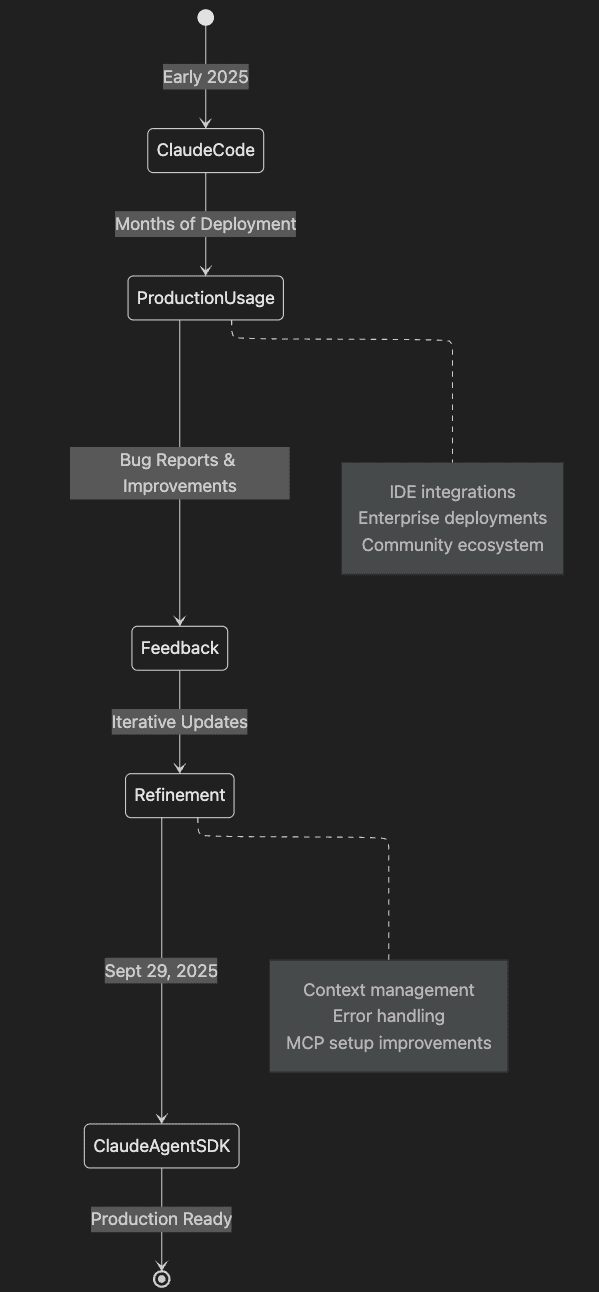
This evolution diagram illustrates Claude Agent SDK's journey from Claude Code through production usage, feedback cycles, and iterative refinement. The September 2025 release represents not new technology, but proven technology expanded and formalized.
AgentKit: Powerful But New
OpenAI's AgentKit launched on October 6, 2025, less than a week before this article was written. Although it leverages OpenAI's extensive API experience and incorporates best practices from ChatGPT, it hasn't yet accumulated the same breadth of production deployments and edge-case discoveries that come with widespread field testing.
This doesn't diminish AgentKit's capabilities. OpenAI's track record with GPT models and the Assistants API demonstrates their ability to ship production-ready products. Early adopters should expect:
- Rapid iteration as the platform matures
- Evolving best practices as the community discovers optimal patterns
- Potential API changes as features move from beta to general availability
What This Means for Your Decision
If production stability is paramount: Claude Agent SDK's heritage as Claude Code provides confidence that the core agent loop, tool handling, and error recovery have been stress-tested across diverse real-world scenarios. The architecture has already proven itself at scale.
If cutting-edge features matter more: AgentKit's visual builder and integrated tooling represent the latest thinking in agent development UX. Being newer means it incorporates recent advances in agent orchestration and may offer capabilities that weren't priorities when Claude Code was designed.
For risk-averse enterprises: The Claude Agent SDK's proven lineage, combined with deployment options like Bedrock (which itself has been running Claude models in production since 2023), provides a lower-risk path for mission-critical agent deployments.
For fast-moving startups: AgentKit's rapid development path and managed infrastructure might outweigh the benefits of battle-testing, especially if your timeline favors speed over extensive production validation.
Both frameworks are production-ready, but Claude Agent SDK's evolution from Claude Code gives it a meaningful advantage in production maturity. It's not just new technology being launched, but proven technology being expanded and formalized.
Decision Framework
This section helps you map your specific requirements to the framework that best fits your constraints.
💡 Why This Matters: Real-World Validation
Unlike newly launched frameworks, the Claude Agent SDK carries production validation from its Claude Code predecessor:
✓ Months of field testing across diverse use cases
✓ IDE integrations deployed to millions of developers
✓ Enterprise deployments via Bedrock/Vertex AI
✓ Edge cases discovered and resolved in production
✓ MCP ecosystem matured through community usage
This heritage means you're not adopting beta technology. You're leveraging a proven system that's been refined through real-world usage at scale.
Choose AgentKit if you:
- Need to ship a prototype or MVP quickly
- Want visual development tools and built-in UI components
- Prefer provider-managed infrastructure and scaling
- Are comfortable with data flowing through OpenAI's systems
- Value integrated testing and safety frameworks
- Are already invested in the OpenAI ecosystem
- Can accept evolving APIs as the platform matures
Choose the Claude Agent SDK if you:
- Require on-premises or air-gapped deployment
- Need granular control over data flow and storage
- Work in regulated industries (healthcare, finance, government)
- Want deep integration with proprietary infrastructure
- Prefer code-first development with maximum flexibility
- Need custom tool definitions beyond standard connectors
- Already use AWS or GCP infrastructure and want native integration
- Value the growing MCP server ecosystem for extensibility
- Prioritize production-proven stability from the Claude Code heritage
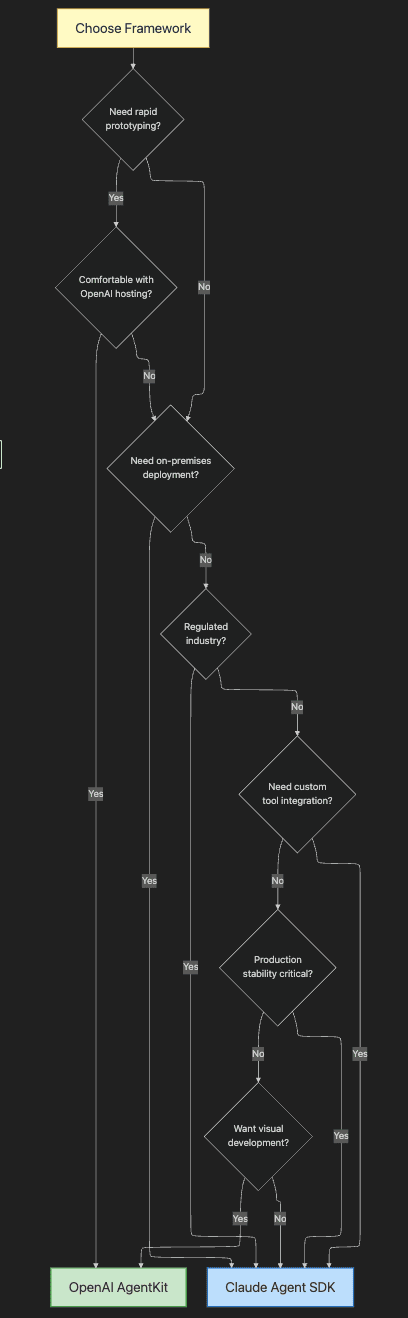
This decision flowchart guides you through key questions to determine which framework fits your needs. Start with your primary constraint (rapid prototyping, on-premises deployment, regulated industry) and follow the path to your optimal choice.
Real-World Applications
Both frameworks have demonstrated success across various domains.
AgentKit Success Stories
- Ramp: Reduced agent development cycles by 70% for internal tooling
- Customer Support: Fast deployment of context-aware helpdesk bots
- Knowledge Management: Quick integration with document repositories
Claude Agent SDK Applications
- Code Agents: Refactoring, bug fixing, and feature development in JetBrains IDEs, inherited directly from Claude Code's proven capabilities
- Research Agents: Deep analysis of documents and codebases with battle-tested context management
- Enterprise Automation: Custom workflows with proprietary data sources, leveraging months of production refinement
- Multi-Cloud Deployments: Organizations leveraging Bedrock or Vertex AI for scalable, compliant agent infrastructure
The Bottom Line
Both frameworks support sophisticated agentic workflows, but differ significantly in governance, hosting philosophy, production maturity, and target use cases.
AgentKit offers a more streamlined path for teams prioritizing speed to market, built-in features, and managed infrastructure. It's particularly well-suited for customer-facing products where OpenAI's infrastructure meets compliance requirements. As a newly launched platform, it represents the latest thinking in agent development but is still accumulating real-world validation.
Claude Agent SDK may be a better fit for organizations requiring flexible deployment options (local, Bedrock, Vertex AI), deep customization through the MCP ecosystem, or strict data governance. It excels in regulated industries and scenarios where proprietary tool integration is essential. Its evolution from Claude Code provides production-proven reliability that has already been validated across thousands of real-world deployments.
The right choice depends on your specific constraints: compliance requirements, development resources, deployment timeline, existing cloud infrastructure, risk tolerance, and control preferences.
Next Steps
To explore AgentKit:
- Visit the official AgentKit page
- Read the API documentation
- Try the Agent Builder in your OpenAI dashboard
To get started with Claude Agent SDK:
- Review the official engineering guide
- Explore the Python SDK on GitHub
- Browse available MCP servers
- Check out Claude Code plugins
- Learn about deployment on Amazon Bedrock or GCP Vertex AI
We'd love to hear from you: Which framework are you using? What challenges have you encountered?
Note: Both frameworks are actively evolving. Features and capabilities may change. Always consult official documentation for the most current information.
About the Author
My professional credentials include TensorFlow certification and completion of Stanford's Machine Learning Specialization program, both of which have significantly contributed to my expertise in this field. I value the integration of academic knowledge with practical implementation. My professional experience encompasses work with supervised learning methodologies, neural network architectures, and various AI technologies, which I have applied to develop enterprise-grade solutions that deliver measurable business value.
Connect with Richard on LinkedIn or Medium for additional insights on enterprise AI implementation.