Claude Certified Architect: The Complete Guide to Passing the CCA Foundations Exam
Everything You Need to Know to Ace the CCA Foundations Exam on Your First Try -- Article 1 of 8
Originally published on Medium.
Everything You Need to Know to Ace the CCA Foundations Exam on Your First Try -- Article 1 of 8
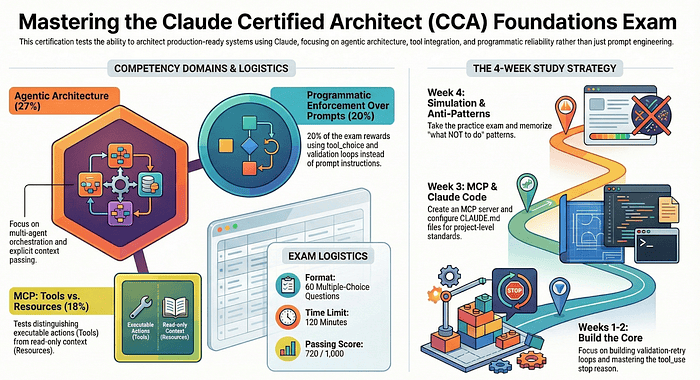
On March 12, 2026, Anthropic launched the Claude Certified Architect (CCA) Foundations exam. The AI industry finally has a professional certification that tests whether you can actually build production systems with Claude. Not whether you can write clever prompts. Not whether you watched a tutorial. Whether you can architect real software that runs in production.
If you are preparing for the Claude Certified Architect exam and want to pass on your first attempt, this is the guide. This is article 1 in an eight-part series. I am going to walk you through everything you need to pass on your first attempt: the exam format, all five competency domains, the six production scenarios, the mental models that separate passing candidates from failing ones, and a week-by-week study plan built around where people actually lose points. The remaining seven articles deep-dive the hardest scenarios so you can dissect each one before exam day.
Let me be direct about what you are signing up for. Anthropic calls this:
"301-level exam designed for seasoned professionals with at least 6 months of direct hands-on experience building with Claude."
The questions are scenario-based, the distractors are plausible, and the exam tests what NOT to do as much as what to do. If you have been building with the Claude API and Claude Code for a while, you already know most of this material. The exam tests whether you know it precisely enough to pick the right answer under time pressure.
The exam tests what NOT to do as much as what to do.
Why the CCA Matters Right Now
Anthropic backed this certification with a $100 million Claude Partner Network investment. Let that number land for a moment, because it tells you exactly what this credential is worth. A $100M commitment does not come without enterprise demand at scale.
Look at the partner commitments Anthropic announced alongside that investment. Accenture trained 30,000 professionals and launched a dedicated Anthropic Business Group. Cognizant gave 350,000 associates Claude access. Deloitte put 470,000 associates on the platform. Infosys stood up a Center of Excellence. These are not pilot programs. These are workforce transformations measured in hundreds of thousands of people.
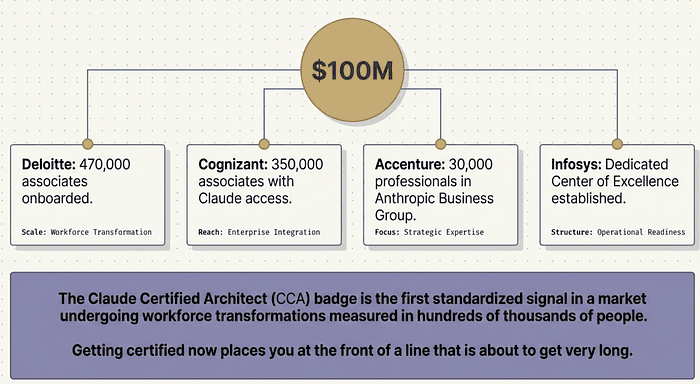
Here is the implication for you: every one of those organizations needs people who can architect Claude-based systems at a professional level. The credential gives hiring managers a standardized signal in a market that currently has no standardized signal. You showing up with a CCA badge while the market is still forming is a different proposition than showing up two years from now when everyone has one.
The CCA is the first certification Anthropic has ever offered. Additional certifications for sellers, architects, and developers are planned for later in 2026. Getting certified now, while the community is small and the credential is fresh, puts you at the front of a line that is about to get very long.
There is also a more personal reason to pursue it: the preparation process alone will close gaps in your knowledge that you did not know existed. Even if you have been building with Claude for months, the exam will surface edge cases in your understanding of tool design, context management, and agentic architecture that hands-on work alone does not reveal.
You showing up with a CCA badge while the market is still forming is a different proposition than showing up two years from now when everyone has one.
Exam Format: What You Are Walking Into
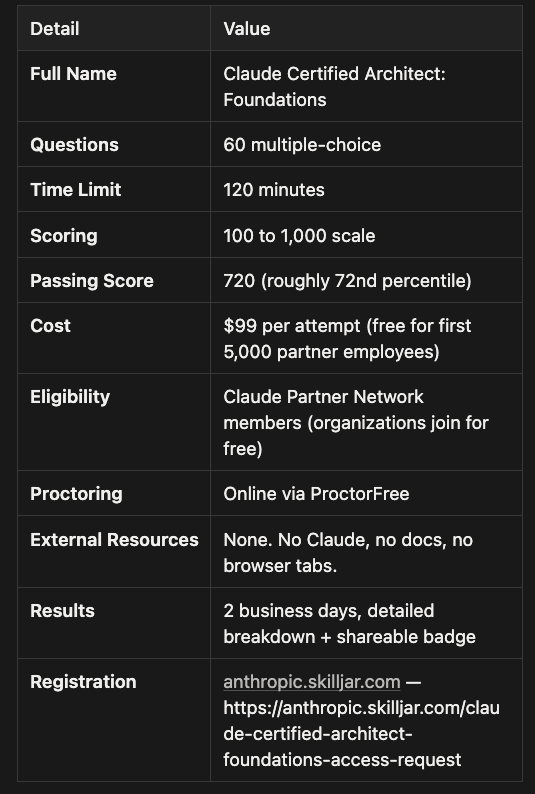
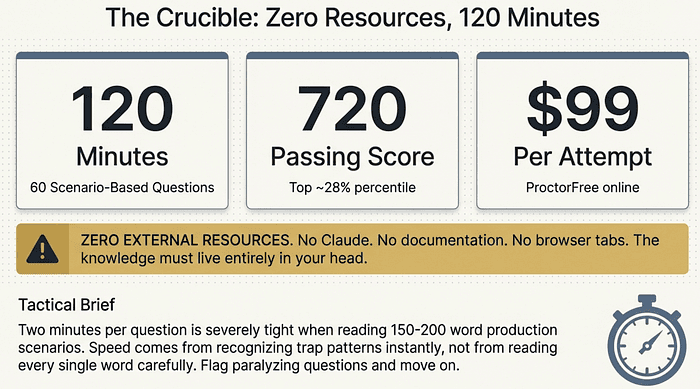
Here is everything you need to know about logistics before you start studying.
A few things matter here more than the table suggests.
Two minutes per question is tight when the question is a paragraph. These are not vocabulary questions. Each question describes a production scenario, sometimes in 150-200 words, and then asks you to choose the best architectural decision. You need to read fast and pattern-match faster. Candidates who score in the 900s report that their speed came from recognizing trap patterns instantly, not from reading every word carefully.
You cannot pause the exam once it starts. Handle your logistics beforehand. Quiet room, water, bathroom break, a machine that will not run out of battery. It is proctored so the assumption is that you will use their equipment (the company that is doing the proctoring).
Four of six production scenarios appear on your exam. The four scenarios are drawn randomly, so you cannot skip any scenario during preparation. Every scenario is fair game. Study all six.
You are completely on your own. No Claude, no documentation, no external tools. The exam tests internalized knowledge. This is why building real systems during your study period matters so much: the knowledge has to live in your head, not in a browser tab.
Time management strategy from early test-takers: do a quick first pass and flag any question that makes you pause. Answer the ones you know cold. Then return to the flagged questions with your remaining time. Do not burn five minutes on a single question when 58 others need attention.
The 5 Competency Domains
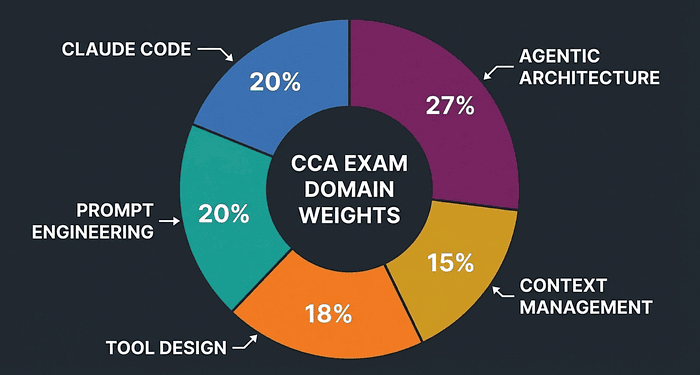
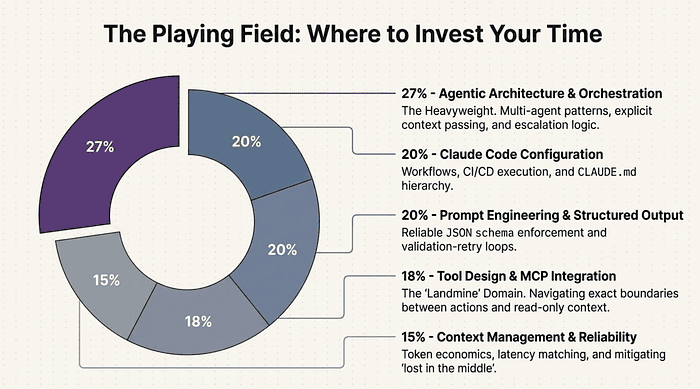
Every question maps to one of five domains. The weights tell you exactly where to invest your study time. Do not treat all five domains equally. Domain 1 alone is worth more than Domain 5. Start there.
Domain 1: Agentic Architecture and Orchestration (27%)
This is the heavyweight. More than a quarter of the exam tests your ability to design multi-agent systems. If you underinvest here, you cannot make it up elsewhere.
What you need to know:
- Multi-agent patterns: the coordinator-subagent pattern (coordinator delegates tasks to specialized subagents and synthesizes their results) and hub-and-spoke (parallel independent tasks with no dependencies between them). Know when each is appropriate and when each fails.
- The critical rule that trips most candidates: subagents do NOT inherit context automatically. When a coordinator spawns a subagent, the subagent starts with a blank context. You must explicitly pass everything it needs. This sounds obvious written down, but the exam tests it in scenarios where candidates assume context flows naturally between agents. It does not.
- Session state management: how to maintain conversation context across turns in an agentic loop. Where does state live? How do you prevent context from growing unbounded?
- Task decomposition: breaking complex requests into discrete subtasks that individual agents can handle. The exam tests your ability to identify the right granularity.
- Agentic loop design: the cycle of receiving input, reasoning, calling tools, evaluating results, and deciding whether to continue or return. Know every step.
- Escalation logic: when and how an agent should hand off to a human or a more capable system. The exam rewards deterministic escalation rules over model-driven escalation.
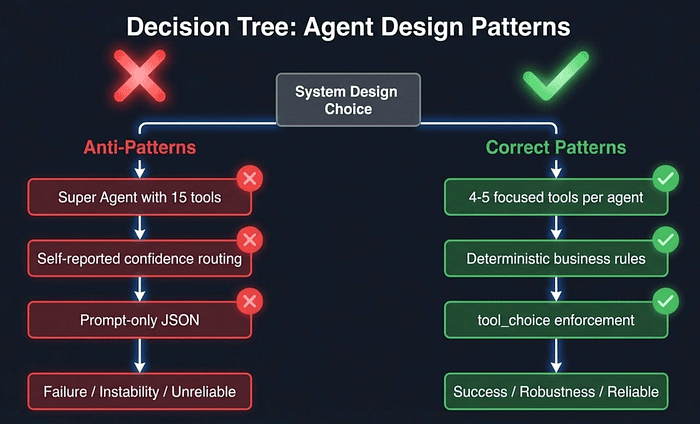
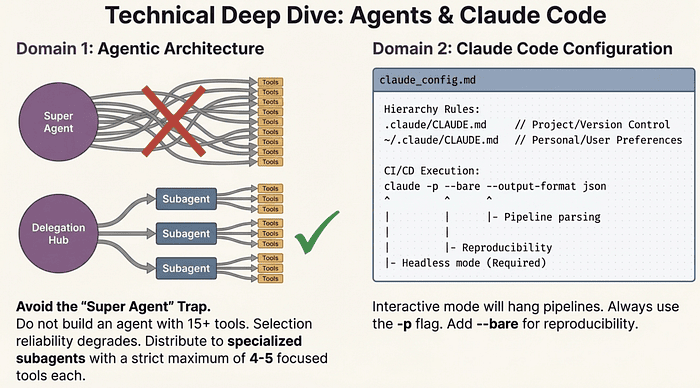
Exam Tip: The most common Domain 1 trap is the "super agent" anti-pattern: one agent with 15+ tools instead of 3-4 specialized agents with 4-5 tools each. When you see an answer choice that consolidates everything into a single powerful agent, that answer is almost always wrong.
Study strategy: Build a small multi-agent system using the Claude Agent SDK. Have a coordinator spawn two subagents, pass them different contexts explicitly, and synthesize their results. When you struggle to pass context correctly in real code, you will never forget the rule on the exam.
Domain 2: Claude Code Configuration and Workflows (20%)
One-fifth of the exam covers Claude Code, Anthropic's agentic coding tool.
What you need to know:
- CLAUDE.md hierarchy: project-level (.claude/CLAUDE.md, shared via version control) versus user-level (~/.claude/CLAUDE.md, personal, not shared). Think of the project-level CLAUDE.md as the "tech lead" file that sets project standards for the whole team. User-level is your personal customizations. The exam tests whether you know which file belongs in version control.
- Custom slash commands and skills: how to create reusable workflows as markdown-based skills. Know the structure, not just that they exist.
- Plan mode versus direct execution: plan mode is for complex, multi-step tasks where you want Claude to lay out the approach before touching anything. Direct execution is for well-defined, lower-risk tasks. The exam tests your judgment about which mode is appropriate for a given scenario.
- CI/CD integration: the -p (or --print) flag for non-interactive pipelines. Forgetting the -p flag in CI/CD is a heavily tested anti-pattern. The flag switches Claude Code from interactive to headless mode.
- The --bare flag: for scripted CI/CD calls, --bare skips auto-discovery and ensures reproducible behavior. Anthropic's docs say this will become the default for -p in a future release. Know it.
- --output-format json: for structured JSON output from Claude Code, supporting text, json, and stream-json modes. When your CI/CD pipeline needs to parse Claude Code output, this flag is the correct tool.
Exam Tip: The CI/CD questions almost always have a trap answer that involves running Claude Code interactively or without the -p flag. The moment you see a CI/CD context, mentally check whether the -p flag is present. If it is missing from the proposed solution, that solution is wrong.
Study strategy: Set up a CLAUDE.md in a real project. Run Claude Code in a CI/CD pipeline with the -p flag. Create a custom slash command. The exam questions assume you have done these things, not just read about them.
Domain 3: Prompt Engineering and Structured Output (20%)
This domain tests your ability to get reliable, structured output from Claude in production systems. The key word is "reliable." Claude producing JSON most of the time is not good enough for production. The exam tests whether you know the difference between approaches that produce reliable output and approaches that produce unreliable output.
What you need to know:
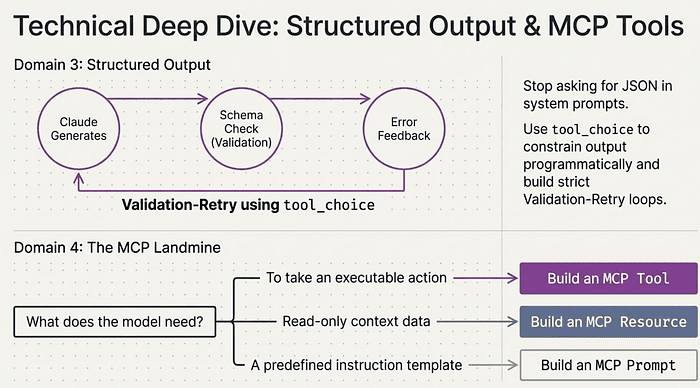
- JSON schema enforcement with tool_choice: using tool_choice with input schemas to force structured output. This is not asking Claude to produce JSON in the system prompt. This is using the API's tool mechanism to constrain the output format programmatically. Learn the difference.
- The structured outputs API: client.messages.parse() with Pydantic models (beta feature, requires anthropic-beta: structured-outputs-2025-11-13 header). Know that this exists and when to use it.
- Few-shot prompting: providing example inputs and outputs to guide Claude's response format. Useful, but not a replacement for programmatic enforcement.
- Validation-retry loops: check the output against your schema. If it fails, send the error back to Claude with instructions to fix it. The tool_use stop reason is your signal to inspect and validate. Build this loop; do not just read about it.
- The core anti-pattern: relying on prompts alone for JSON compliance. "Please respond only in valid JSON" in your system prompt will work most of the time. The exam will give you scenarios where "most of the time" causes failures and ask you to fix them. The correct fix is programmatic enforcement, not a better prompt.
Exam Tip: Any answer choice that says "add instructions to the system prompt" or "include more detailed formatting guidance in the prompt" as the solution to JSON compliance is almost certainly wrong. The exam consistently rewards tool_choice, structured outputs API, and validation-retry loops over prompt-only approaches.
Study strategy: Build a validation-retry loop. Send Claude a schema, get output, validate it, and retry on failure. Then build the same thing using tool_choice. Notice how much more reliable the tool_choice approach is. That experience makes exam questions in this domain feel obvious.
Domain 4: Tool Design and MCP Integration (18%)
The Model Context Protocol (MCP) is Anthropic's open standard for connecting AI systems to external tools and data. Launched in November 2024, MCP has been adopted across the industry; both OpenAI and Google DeepMind have integrated it. This domain is where community feedback says most candidates lose the most unexpected points.
What you need to know:
MCP primitives and when to use each:
- Tools: executable functions the model can invoke. Use for actions: querying a database, calling an API, writing a file.
- Resources: data for ingestion into prompts or RAG pipelines. Use for read-only context: documentation, schemas, knowledge bases.
- Prompts: predefined templates or workflows. Use for reusable instruction patterns.
The exam tests the boundaries between these three. Getting this wrong is the single most common source of lost points on Domain 4.
- Configuration files: .mcp.json is project-level and shared via version control; ~/.claude.json is user-level and personal. This mirrors the CLAUDE.md hierarchy exactly. One pattern to remember both.
- Tool descriptions as routing: the description you write for a tool is the primary mechanism Claude uses to decide which tool to call. Agent names do not matter for routing. Tool names matter less than descriptions. Write tool descriptions as if you are writing documentation for a developer who has never seen your codebase.
- The 4-5 tool rule: Anthropic's official guidance is 4-5 focused tools per agent. When an agent has 18 tools, selection reliability degrades measurably. Distribute excess tools to specialized subagents.
Exam Tip: The tool-versus-resource boundary is the hardest judgment call on this domain. When an exam question asks whether something should be a tool or a resource, ask yourself: does Claude need to invoke it to take an action, or does it just need the data as context? Actions are tools. Context is resources. If it is read-only data that helps Claude understand something, it is a resource. If Claude needs to execute it to make something happen, it is a tool.
Study strategy: Build an MCP server in Python using the official SDK. Expose 3-4 tools and a resource. Connect it to Claude Code. The MCP Mastery course on Anthropic Academy covers this end-to-end. You need to have done this to answer tool boundary questions with confidence.
Domain 5: Context Management and Reliability (15%)
The smallest domain by weight, but it cross-cuts every scenario. Understanding context management poorly means you get questions wrong in Domains 1, 2, 3, and 4 as well. Study this domain more than its 15% weight suggests.
What you need to know:
- The "lost in the middle" effect: Claude and all transformer-based LLMs attend more to information at the beginning and end of the context window. Content buried in the middle receives less attention. Place critical information at the start or end of your context. This is not theoretical; it affects production agent performance in measurable ways.
- Context degradation in long sessions: as conversations grow, earlier context becomes less reliable. The exam tests whether you know how to mitigate this: structured summaries, periodic restatement of critical facts, keeping the most important information anchored at the start.
- Escalation design: when an agent should stop trying and hand off. The exam tests your judgment about escalation thresholds. The pattern is always: deterministic rules trigger escalation, not model self-assessment.
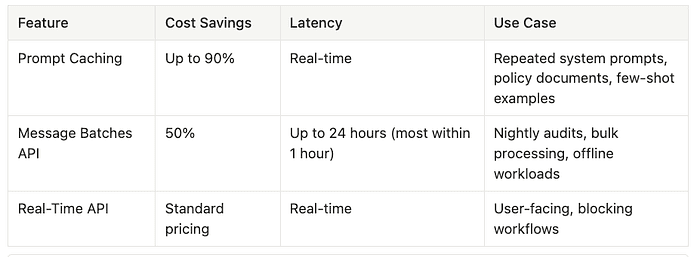
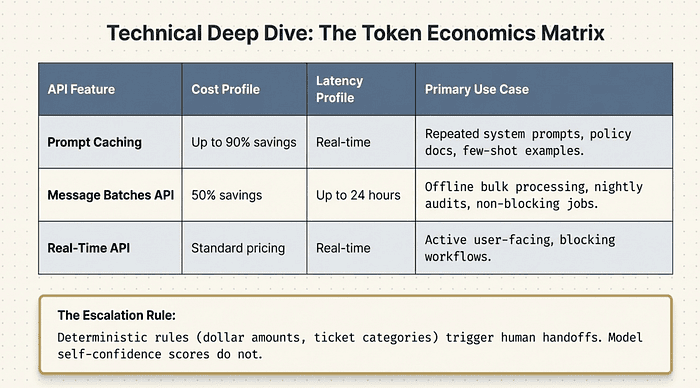
- Token economics: know the differences cold.
Prompt Caching offers up to 90% cost savings with real-time latency, making it ideal for repeated system prompts, policy documents, and few-shot examples. This approach allows you to cache frequently used context and dramatically reduce costs while maintaining immediate response times.
Message Batches API provides 50% cost savings but with latency of up to 24 hours, though most requests complete within 1 hour. This API is designed for nightly audits, bulk processing, and offline workloads where immediate responses are not required.
Real-Time API operates at standard pricing with real-time latency, serving user-facing and blocking workflows where users are actively waiting for responses. This is the default choice when cost optimization cannot come at the expense of user experience.
Using the Batch API for a live user-facing workflow is an anti-pattern. Using the real-time API for overnight bulk processing wastes money. The exam tests your ability to match API to use case.
Exam Tip: When you see a question about cost optimization in a system where users are actively waiting for responses, the answer is never the Batch API. The answer is Prompt Caching for repeated context. When you see a system doing overnight processing or batch audits, the Batch API is almost always the right cost optimization.
Study strategy: Experiment with context window limits. Send Claude a long document with critical information in the beginning, middle, and end. Test whether the responses treat all three sections equally. The difference in behavior will stick with you during the exam.
The 6 Production Scenarios
Every exam draws 4 of these 6 scenarios at random. You cannot predict which four, so you must prepare for all six. Each scenario presents a realistic production situation and tests your architectural judgment across multiple domains.
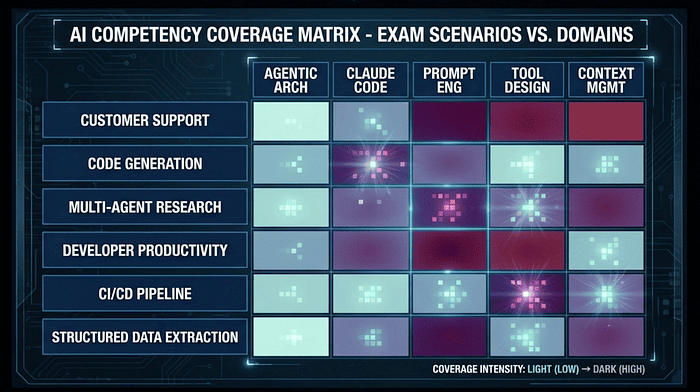
Here is a brief preview of each. The remaining articles in this series go deep on the hardest ones.
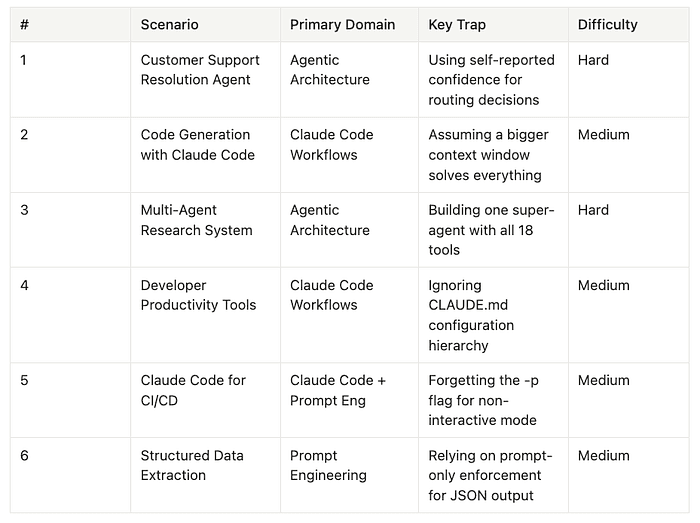
Scenario 1: Customer Support Resolution Agent. You are building a support agent using the Claude Agent SDK that handles high-ambiguity requests: returns, billing disputes, account issues. The scenario tests escalation logic, compliance constraints, and the financial consequences of wrong routing. The biggest trap: using Claude's self-reported confidence score to decide whether to escalate. LLM-generated confidence scores are not calibrated for production routing decisions. Use programmatic rules instead: ticket category, dollar amount, account tier, issue type. These rules live in code, not in prompts.
Scenario 2: Code Generation with Claude Code. You are configuring Claude Code for large codebase navigation and code generation tasks. The scenario tests context degradation awareness and the difference between plan mode and direct execution. The trap is believing that a larger context window solves attention distribution problems. It does not. The "lost in the middle" effect applies regardless of total context size.
Scenario 3: Multi-Agent Research System. You are designing a multi-agent system where a coordinator dispatches research tasks to specialized subagents with iterative refinement loops. The trap is the "super agent" anti-pattern: one agent with all 18 tools instead of distributing 4-5 tools per specialized subagent. This scenario also tests whether you understand that subagents do not inherit coordinator context automatically. You must pass context explicitly.
Scenario 4: Developer Productivity Tools. You are integrating Claude Code into development workflows using custom slash commands and CLAUDE.md configurations. This scenario tests your knowledge of plan mode versus direct execution, the CLAUDE.md hierarchy (project-level vs. user-level), and how to design reusable skills.
Scenario 5: Claude Code for CI/CD. You are integrating Claude into CI/CD pipelines for automated code reviews, test generation, and pull request feedback. The critical tested pattern is the -p flag for non-interactive mode with --bare for reproducibility. The --output-format json flag for structured pipeline output is also tested. The trap is any solution that assumes interactive mode works in a CI/CD pipeline.
Scenario 6: Structured Data Extraction. You are extracting structured data from unstructured documents using JSON schemas, handling edge cases, and integrating with downstream systems. The trap is prompt-only enforcement. The correct approach uses tool_choice with input schemas or the structured outputs API with programmatic validation and retry loops.
Critical Mental Models for the Exam
These are the principles that separate candidates who pass from those who do not. Internalize all five. They are not independent ideas; they are a coherent framework that applies everywhere on the exam.
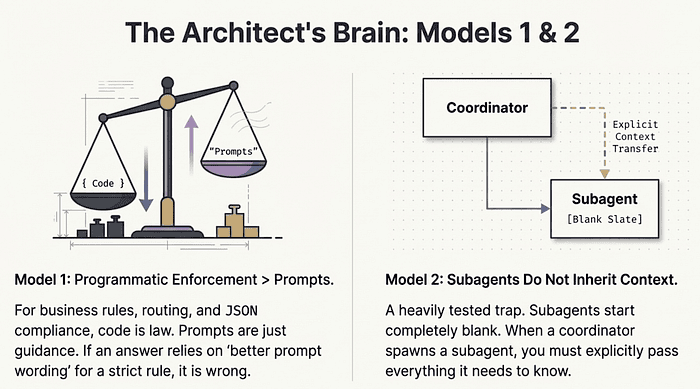
Mental Model 1: Programmatic Enforcement Beats Prompt-Based Guidance
Every time. For business rules, JSON compliance, routing decisions: do not ask Claude to follow rules in a prompt. Enforce them in code.
The mental model to carry into the exam: prompts are guidance. Code is law. When the question asks how to ensure something happens reliably, the answer involves code, not better prompt wording.
Mental Model 2: Subagents Do Not Inherit Context
When a coordinator spawns a subagent, the subagent starts with a blank slate. You must explicitly pass the context it needs. This is one of the most heavily tested concepts on the entire exam because it is counterintuitive. Developers assume that agents operating in the same system share awareness. They do not.
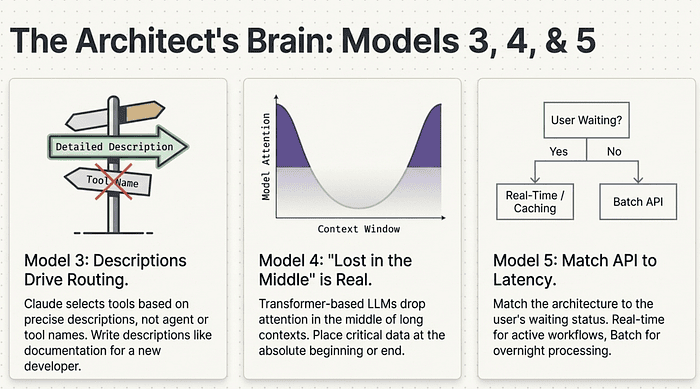
Mental Model 3: Tool Descriptions Drive Routing
Claude does not pick tools based on agent names or tool names. It reads tool descriptions. A poorly written description means the wrong tool gets called. Write descriptions as if you are writing documentation for a developer who has never seen your codebase. Specific, precise, unambiguous.
Mental Model 4: The "Lost in the Middle" Effect Is Real
Place critical information at the beginning or end of your context. Content in the middle of a long context window receives less attention. This affects every scenario involving long context: customer support sessions, large codebase navigation, multi-turn research workflows.
Mental Model 5: Match API to Latency Requirements
The Batch API is for background jobs. The Real-Time API is for user-facing workflows. Prompt Caching is your cost optimization strategy for repeated context with real-time requirements. When you see a cost optimization question, ask first: is anyone waiting for this response? If yes, the answer is Prompt Caching, not the Batch API.
The Anti-Pattern Catalog
The exam tests what NOT to do as much as what to do. Here are the anti-patterns organized by domain, with the exam signal for each.
Domain 1: Agentic Architecture
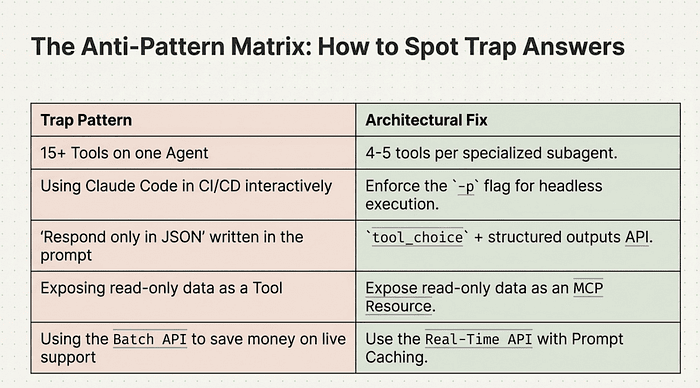
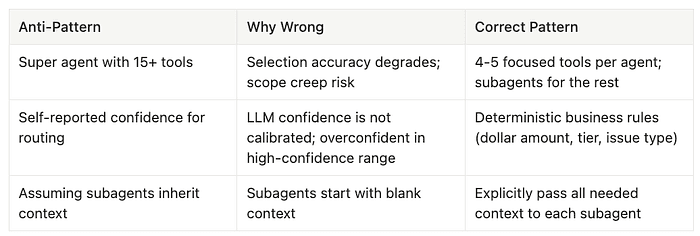
Super agent with 15+ tools: When you build a single agent with 15 or more tools, selection accuracy degrades significantly and scope creep becomes a major risk. The correct pattern is to use 4-5 focused tools per agent and delegate additional functionality to specialized subagents.
Self-reported confidence for routing: Using Claude's self-reported confidence scores to make routing decisions is problematic because LLM confidence is not calibrated for production use and tends to be overconfident in the high-confidence range. Instead, implement deterministic business rules based on concrete factors like dollar amount, account tier, and issue type.
Assuming subagents inherit context: A common misconception is that subagents automatically inherit the context from their coordinator agent. In reality, subagents start with a blank context slate. You must explicitly pass all needed context to each subagent to ensure they have the information required to perform their tasks.
Domain 2: Claude Code
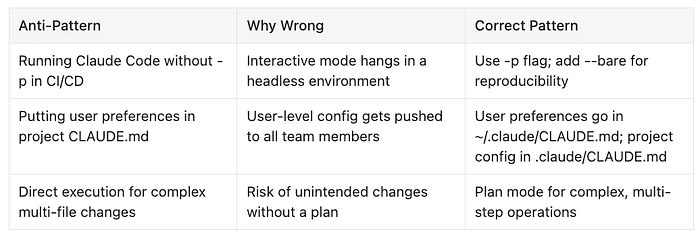
Running Claude Code without -p in CI/CD: When you run Claude Code in a CI/CD pipeline without the -p flag, interactive mode will hang in a headless environment because there's no user to interact with prompts. The correct pattern is to use the -p flag for non-interactive mode and add --bare for reproducibility to ensure consistent behavior in automated environments.
Putting user preferences in project CLAUDE.md: When you place user-level configuration in the project's .claude/CLAUDE.md file, those personal preferences get pushed to all team members through version control, which can override their individual settings and create inconsistent development experiences. The correct pattern is to put user preferences in ~/.claude/CLAUDE.md (the user-level config file) and reserve the project's .claude/CLAUDE.md for team-wide standards and conventions that should apply to everyone working on the codebase.
Direct execution for complex multi-file changes: Using direct execution mode for complex operations that span multiple files creates a risk of unintended changes without a clear plan or opportunity for review. The model might make changes across your codebase without showing you what it intends to do first. The correct pattern is to use plan mode for complex, multi-step operations. This allows Claude Code to present a structured plan of all the changes it will make, giving you the opportunity to review and approve before any files are modified.
Domain 3: Prompt Engineering
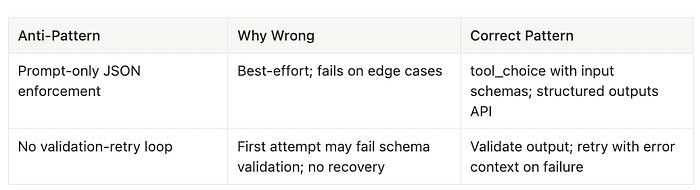
Prompt-only JSON enforcement: Relying solely on prompts to enforce JSON output is a best-effort approach that fails on edge cases. While you can instruct Claude in a prompt to "always return valid JSON," this does not guarantee compliance, especially when handling unusual inputs or complex schemas. The correct pattern is to use tool_choice with input schemas or the structured outputs API, which programmatically enforces the output format and ensures reliable JSON generation.
No validation-retry loop: When you make a single API call without any validation or retry mechanism, the first attempt may fail schema validation, and you have no way to recover from the error. This leaves your system brittle and unable to handle cases where the model's output doesn't quite match your requirements. The correct pattern is to validate the output programmatically after each API call and, if validation fails, retry the request with error context that explains what went wrong. This creates a robust feedback loop that significantly improves reliability.
Domain 4: Tool Design
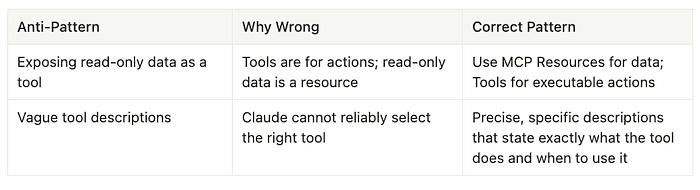
Exposing read-only data as a tool: When you expose read-only data as a tool in your MCP server, you are misusing the tool abstraction. Tools are designed for executable actions that change state or perform operations, not for passive data retrieval. This creates confusion in the model's selection logic and wastes tool call overhead on what should be simple data access. The correct pattern is to use MCP Resources for read-only data and reserve Tools for executable actions. Resources are specifically designed for static or semi-static data that the model needs to read, while tools are for operations that do something.
Vague tool descriptions: When you write vague or generic tool descriptions like "handles customer requests" or "processes data," Claude cannot reliably select the right tool because it lacks the specific information needed to differentiate between similar tools. The model reads tool descriptions to decide which tool to invoke, and ambiguous descriptions lead to incorrect tool selection and routing failures. The correct pattern is to write precise, specific descriptions that state exactly what the tool does, what inputs it expects, and when to use it. Treat tool descriptions as if you are writing documentation for a developer who has never seen your codebase -- be explicit about boundaries, constraints, and use cases.
Domain 5: Context Management
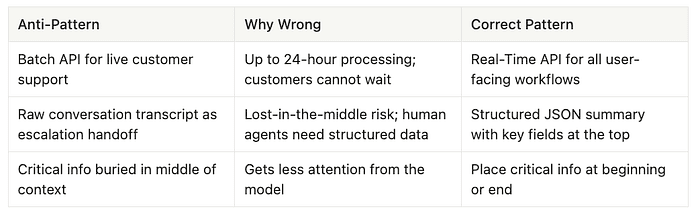
Batch API for live customer support: Using the Batch API for live customer support scenarios is problematic because the Batch API can take up to 24 hours to process requests, and customers in a support interaction cannot wait that long for a response. The Batch API is designed for background jobs and non-urgent workloads where latency is not a concern. The correct pattern is to use the Real-Time API for all user-facing workflows where someone is actively waiting for a response, ensuring immediate interaction and acceptable response times.
Raw conversation transcript as escalation handoff: When you escalate from an AI agent to a human agent by simply passing the raw conversation transcript, you create two problems: first, the "lost in the middle" effect means that critical information buried in a long transcript may be overlooked by the human agent; second, human agents need structured, actionable data to resolve issues quickly, not a wall of unstructured text to parse. The correct pattern is to provide a structured JSON summary with key fields at the top -- customer information, issue category, attempted solutions, current state, and any blocking factors -- so the human agent can immediately understand the situation and take action.
Critical info buried in middle of context: When you place critical information in the middle of a long context window, it receives less attention from the model due to the "lost in the middle" effect, a well-documented phenomenon where language models pay more attention to information at the beginning and end of their context. This can cause the model to miss important details or make decisions without considering key constraints. The correct pattern is to place critical information at the beginning or end of your context, ensuring it receives the attention it deserves and is properly weighted in the model's reasoning process.
Your 4-Week Study Plan
This plan assumes you are already building with Claude. If you are starting from scratch, add 2-4 weeks.
The plan is organized around where candidates lose points, not just around domain weights. Domain 1 and Domain 4 are where most people are surprised by how hard the questions actually are. Build for that.
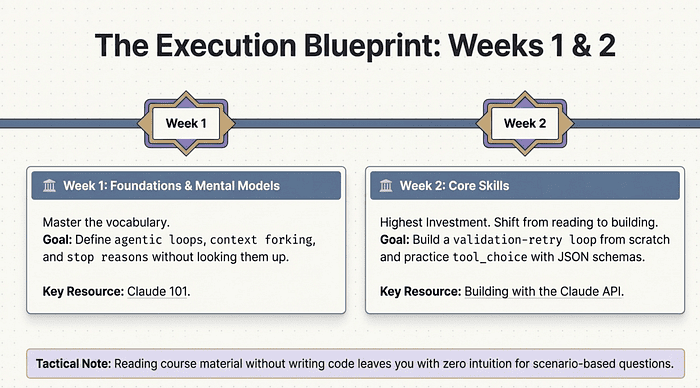
Week 1: Foundations and Mental Models
Courses: Claude 101 and AI Fluency: Framework and Foundations
Goal: internalize the vocabulary and mental models before touching the advanced material.
Learn the AI Fluency Framework (Delegation, Description, Discernment, Diligence). Get comfortable with the core vocabulary: agentic loops, context windows, stop reasons, tool_choice. Do not rush past this. Candidates who struggle with Week 3 material often have vocabulary gaps from Week 1.
By the end of Week 1, you should be able to define without looking anything up: agentic loop, coordinator-subagent pattern, context forking, stop reason, tool_choice, validation-retry loop, and the "lost in the middle" effect.
Week 2: Core Skills (Highest Investment Week)
Course: Building with the Claude API (8-10 hours; this is the single most important course)
Goal: hands-on experience with the patterns the exam tests most heavily.
Work through every exercise. Build a validation-retry loop from scratch. Practice structured output with tool_choice and JSON schemas. Understand the tool_use stop reason and how to inspect tool results programmatically.
Do not skip the exercises. Reading the course material without building anything will leave you with conceptual understanding but no intuition. The exam questions are scenario-based, and intuition built from building is what makes the right answer feel obvious.
By the end of Week 2, you should have working code for: a validation-retry loop, a tool_choice-enforced structured output call, and a simple agent with 3-4 tools.
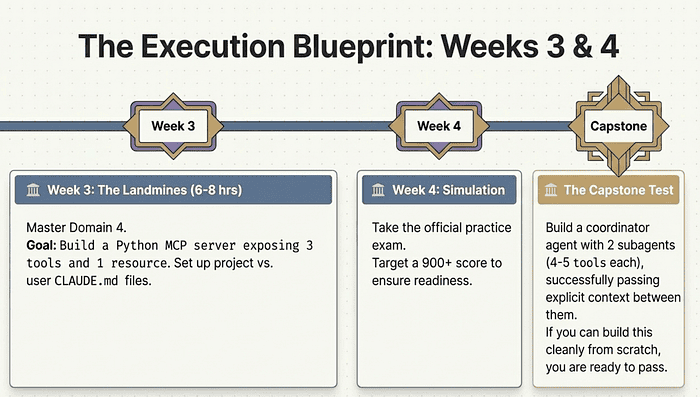
Week 3: Advanced Topics (The Domain 4 Landmine Week)
Courses: MCP Mastery, Claude Code in Action, Introduction to Agent Skills
Goal: close the gaps in MCP tool design and Claude Code configuration that trip up even experienced candidates.
Build an MCP server in Python. Expose 3 tools and 1 resource. Connect it to Claude Code. Pay explicit attention to the boundary between tools and resources: every time you decide whether something should be a tool or a resource, write down your reasoning. That discipline is what makes tool boundary questions answerable on exam day.
Set up a CLAUDE.md file in a real project. Configure it with project standards. Then create a user-level config at ~/.claude/CLAUDE.md and make sure you understand which settings belong in each file. Run Claude Code with the -p flag in a CI/CD pipeline simulation. Create a custom slash command.
By the end of Week 3, you should have: a working MCP server with both tools and a resource, a real project with a properly configured CLAUDE.md, and a successful Claude Code run in headless mode.
Week 4: Practice, Anti-Patterns, and Exam Simulation
Activities: Take the official practice exam. Review every wrong answer. Aim for 900+ before scheduling the real exam.
Goal: convert knowledge into exam-day execution speed.
Take the practice exam under real conditions: no notes, no docs, no browser tabs. Time yourself. When you finish, categorize your wrong answers by domain. If you got more than 2 wrong in any single domain, go back to that week's material and rebuild the concept from the exercise level up.
Build the capstone project: a coordinator agent with two subagents, each with 4-5 tools, passing explicit context between them. If you can build this cleanly from scratch without referencing the documentation, you understand Domain 1 well enough to pass.
Review the anti-pattern catalog above one more time. On exam day, the fastest path to a correct answer is recognizing the trap in the wrong answers before you even read the right answer carefully.
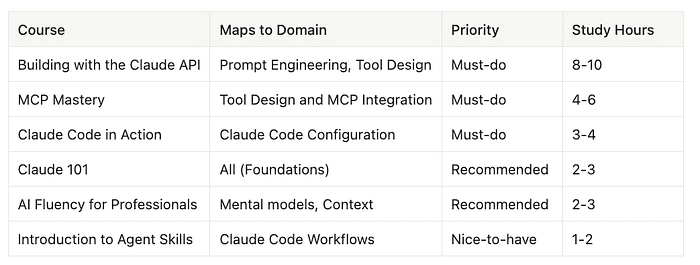
Course Priority Matrix
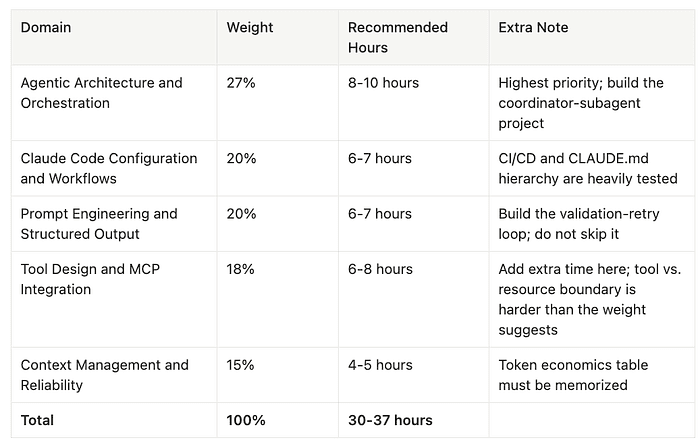
Allocate study time proportionally to domain weight, but add extra time to Domain 4 (Tool Design). The exam weight is 18%, but candidate feedback consistently cites it as the domain where they lose the most unexpected points.
- Agentic Architecture and Orchestration (27%) -- 8-10 hours -- Highest priority; build the coordinator-subagent project
- Claude Code Configuration and Workflows (20%) -- 6-7 hours -- CI/CD and CLAUDE.md hierarchy are heavily tested
- Prompt Engineering and Structured Output (20%) -- 6-7 hours -- Build the validation-retry loop; do not skip it
- Tool Design and MCP Integration (18%) -- 6-8 hours -- Add extra time here; tool vs. resource boundary is harder than the weight suggests
- Context Management and Reliability (15%) -- 4-5 hours -- Token economics table must be memorized
- Total: 100% -- 30-37 hours
Early Candidate Feedback
The exam launched 11 days ago. Here is what early test-takers are reporting.
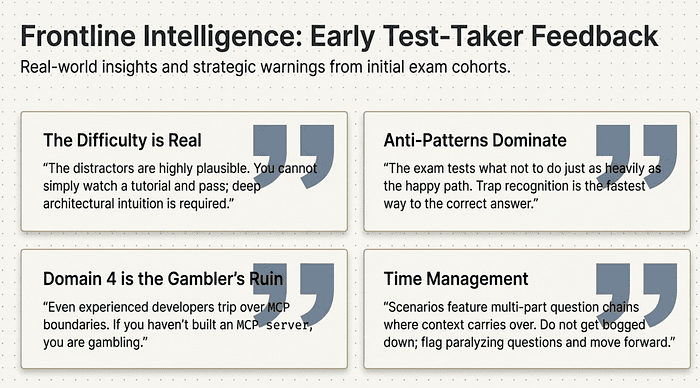
The difficulty is real. Community consensus is that this is "not a watch-a-tutorial-and-pass certification." The depth on agentic architecture, MCP tool integration, and multi-agent orchestration is substantial. One common refrain: "The distractors are very plausible."
Anti-pattern recognition matters as much as knowing the right answers. Multiple candidates report that the exam tests what NOT to do as heavily as what to do. If you only study the happy path, you will miss questions about common mistakes. The anti-pattern catalog in this article is not optional study material.
MCP tool boundaries trip people up more than any other topic. Domain 4 (Tool Design and MCP Integration) is consistently cited as where people lose the most unexpected points. Knowing when to use a tool versus a resource versus a prompt requires judgment you can only build through practice. If you have not built an MCP server by the time you take the exam, you are gambling on this domain.
Time management is critical, especially on scenario chains. Some scenarios have multi-part question chains where context from one question carries into the next. Read those chains carefully. Do not get stuck. Flag and move on.
One candidate posted 985/1000 on Reddit. So perfect scores are possible. The passing score is 720, which gives you meaningful room for error. You do not need to know everything perfectly. You need to know the critical patterns reliably and recognize the traps quickly.
Key Terminology Glossary
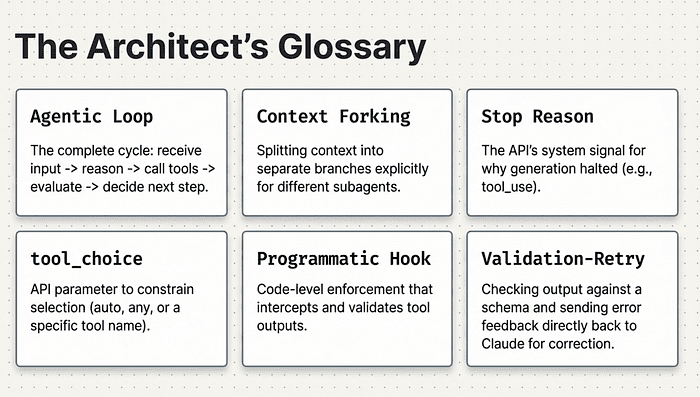
These terms are testable. Know them precisely, not just approximately.
- Agentic Loop: The cycle: receive input, reason, call tools, evaluate results, decide next step
- Context Forking: Splitting context into separate branches for different subagents
- Coordinator-Subagent Pattern: A coordinator agent delegates to specialized subagents and synthesizes results
- Programmatic Hook: Code-level enforcement (e.g., PostToolUse) that validates or transforms tool outputs
- Stop Reason: The API's signal for why generation stopped (e.g., tool_use, end_turn, max_tokens)
- tool_choice: API parameter controlling tool selection: auto (model decides), any (must use a tool), or specific tool
- Validation-Retry Loop: Check output against schema; on failure, send error back to Claude for correction
- MCP Resources: Data catalogs/schemas exposed for ingestion (read-only context)
- MCP Tools: Executable functions the model can invoke to take actions
- MCP Prompts: Predefined instruction templates or workflows
Preparation Resources
Official Anthropic Resources
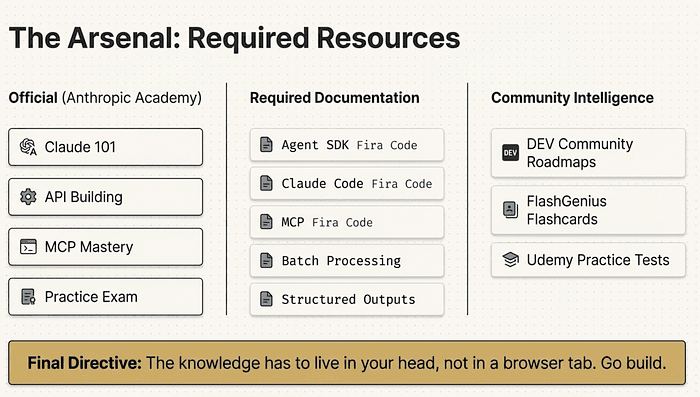
- Anthropic Academy: anthropic.skilljar.com (13 courses, FREE for everyone; no partner access needed)
- CCA Exam Guide: Official exam guide on SlideShare
- Practice Exam: Available through Anthropic Academy (benchmark: score 900+ before taking the live exam)
- Exam Registration: Access request form
Official Documentation to Study
- Claude Agent SDK Documentation
- Claude Code Documentation
- MCP Documentation
- Advanced Tool Use (Anthropic Engineering)
- Batch Processing Documentation
- Structured Outputs Documentation
Community Resources
- DEV Community: Inside the CCA Program
- DEV Community: CCA Preparation Roadmap
- FlashGenius: CCA Flashcards and Guide
- Claude Certifications Study Site
- Udemy: CCA Practice Tests
About the Author
Rick Hightower is a technology executive and data engineer who led ML/AI development at a Fortune 100 financial services company. He created skilz, the universal agent skill installer, supporting 30+ coding agents including Claude Code, Gemini, Copilot, and Cursor, and co-founded the world's largest agentic skill marketplace. Connect with Rick Hightower on LinkedIn or Medium. Check out SpillWave, your source for AI expertise.
Rick has been actively developing generative AI systems, agents, and agentic workflows for years. He is the author of numerous agentic frameworks and developer tools and brings deep practical expertise to teams looking to adopt AI.