From 'Vibe Coding' to Viable Coding: How Superpowers Turn AI Chatbots into Engineering Partners
The open-source plugin that adds brainstorming, TDD enforcement, and subagent orchestration to your AI coding workflow
Originally published on Medium.
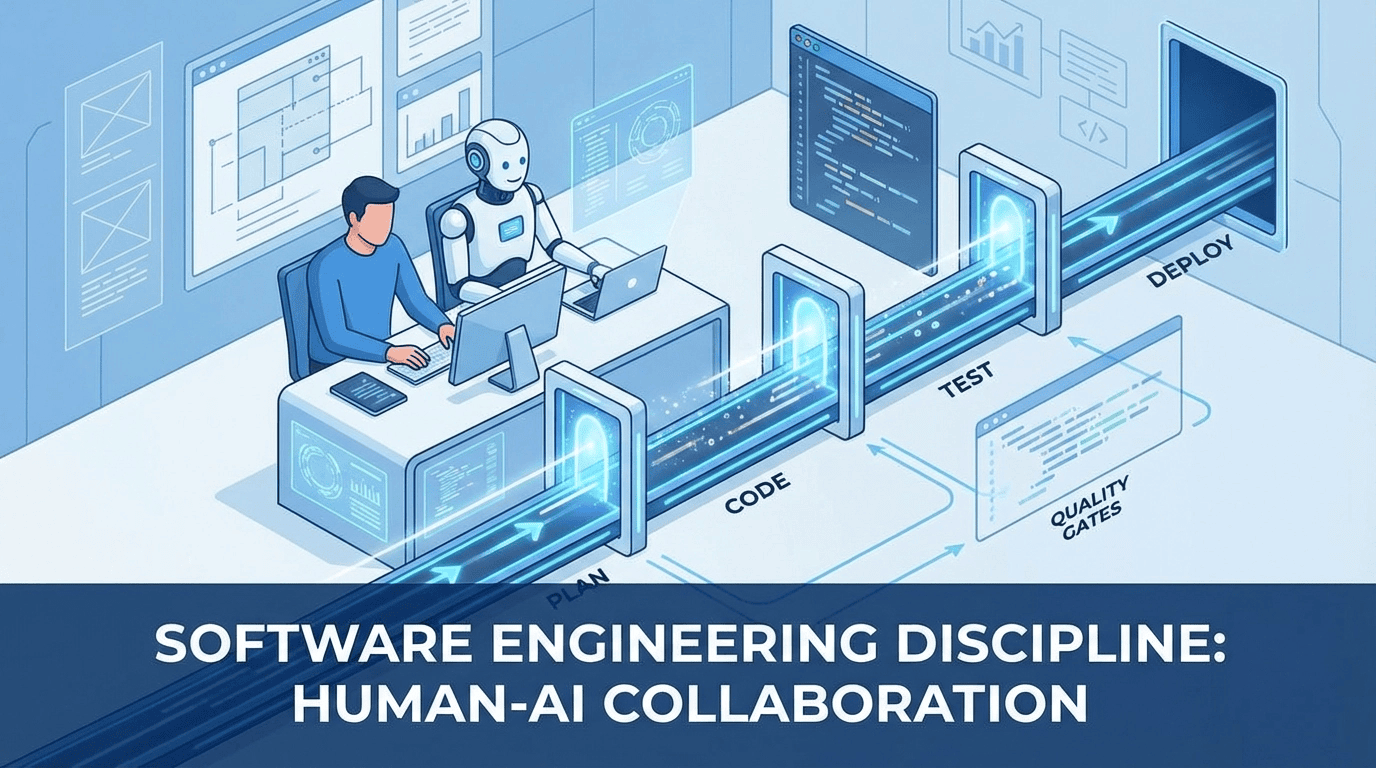
The open-source plugin that adds brainstorming, TDD enforcement, and subagent orchestration to your AI coding workflow
Superpowers is an open-source plugin by Jesse Vincent that transforms AI coding agents from reactive code generators into disciplined engineering partners. Through six composable skills including mandatory brainstorming, git worktree isolation, TDD enforcement, and subagent-driven development, it replaces vibe coding with a structured pipeline that produces tested, reviewed, and mergeable code.
Vibe coding produces code that works in the demo and breaks in production. Superpowers adds the guardrails that turn an AI chatbot into an engineering partner that brainstorms before coding, writes tests before implementation, and reviews its own work before merging.
Andrej Karpathy coined the term "vibe coding" in early 2025 to describe a new programming style: you describe what you want, the AI writes the code, and you accept whatever comes out. It was half-serious, half-satirical. But the practice caught on. Developers started treating AI coding tools as magic boxes. Type a vague prompt. Get some code. Ship it. Hope for the best.
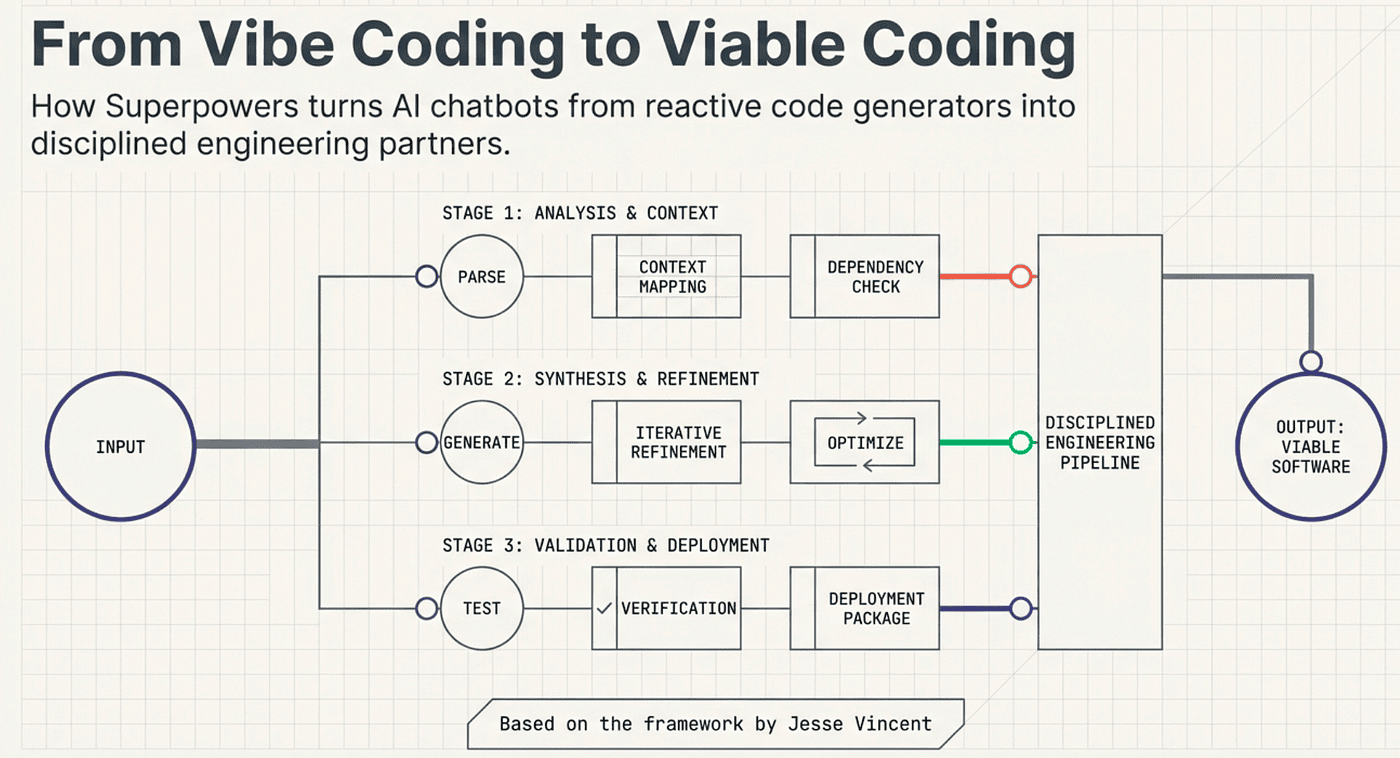 From Vibe Coding to Viable Coding
The results were predictable. Vibe coding produces code that works in the demo and breaks in production. The AI hallucinates function signatures that do not exist. It generates tests that pass but verify nothing. It builds features that almost match the requirements but miss critical edge cases. Because the developer never wrote a spec, never planned the architecture, and never reviewed the output systematically, technical debt compounds silently until the whole thing needs a rewrite.
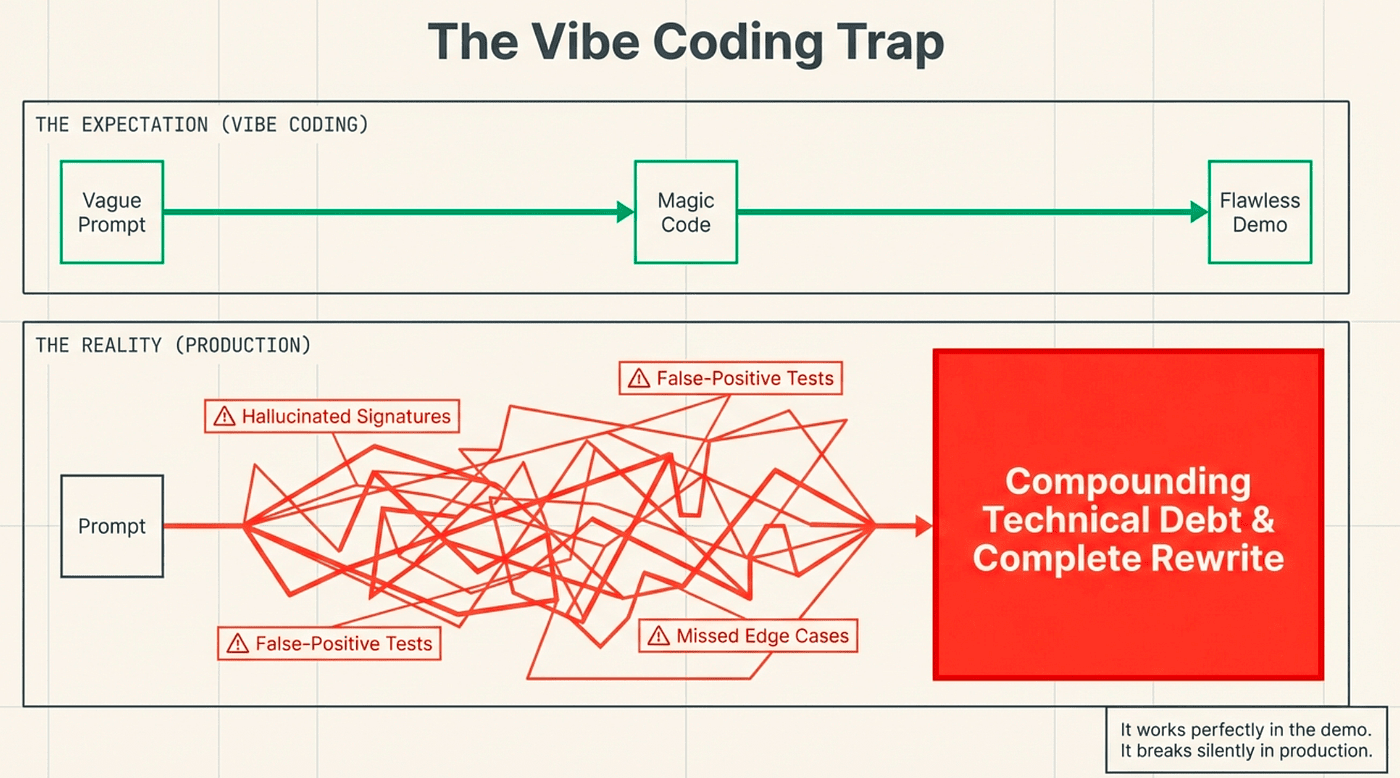 The Vibe Coding Trap
This is the problem Superpowers was built to solve.
What Superpowers Actually Is
Superpowers is an open-source plugin for Claude Code (and other AI coding agents) created by Jesse Vincent. It is not a code generator. It is a complete software development workflow that transforms how your AI agent approaches every task, from the moment you describe an idea to the moment the code is merged.
The core insight is simple: the problem with vibe coding is not that AI agents write bad code. The problem is that nobody tells them to stop and think first. Superpowers adds structure, discipline, and guardrails to the AI's behavior, turning it from a reactive code-generation tool into a proactive engineering partner.
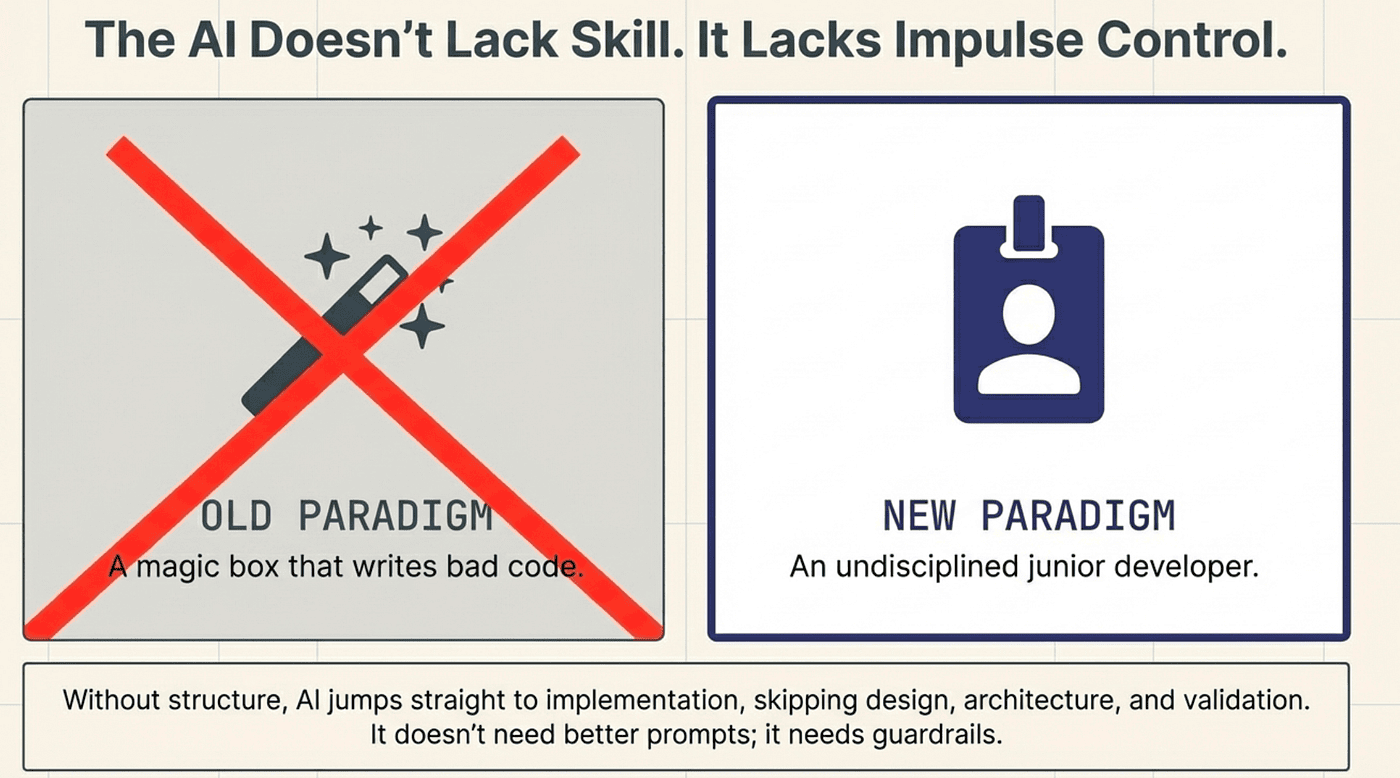 AI Does not lack skill, it lacks impulse control and hallucinates
When you install Superpowers, you do not need to learn new commands or change your workflow. The skills trigger automatically based on context. Start describing a feature, and the agent activates the brainstorming skill. Approve a design, and it transitions to planning. Begin implementing, and TDD enforcement kicks in. The system orchestrates itself.
Understanding the Architecture: Skills as a Pipeline
The framework is built around composable skills that chain together automatically. Think of it as a production line where each station enforces a quality gate before passing work downstream.
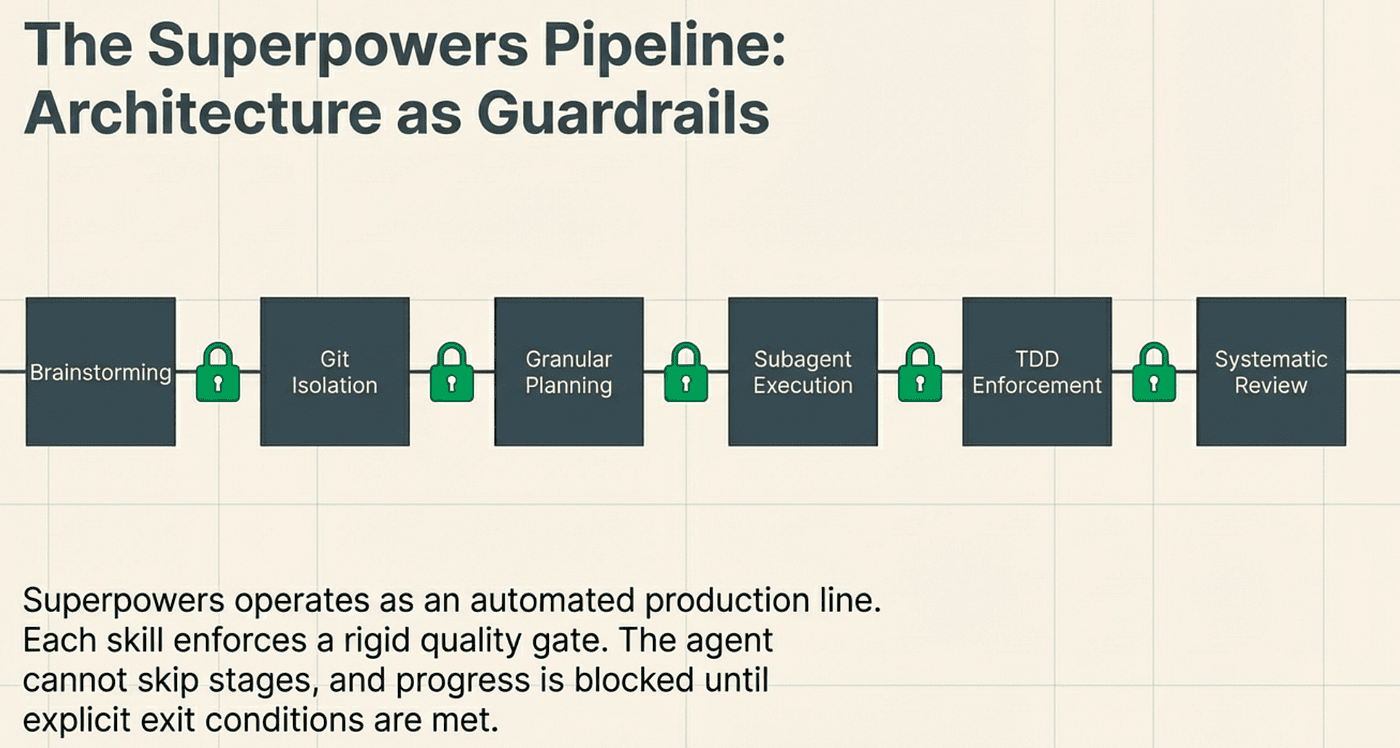 Superpowers Pipeline: Architecture as Guardrails
This pipeline structure separates Superpowers from ad-hoc AI prompting. Each stage has a clear entry condition, a defined output, and an explicit exit condition. The agent cannot skip stages or shortcut gates.
The Workflow: Six Gate Skills That Change Everything
Superpowers is built on composable skills that chain into a complete development lifecycle. Here is how the workflow unfolds in practice.
Skill 1: Brainstorming: The AI Asks Before It Acts
This is the skill that separates Superpowers from every other AI coding tool. Before writing a single line of code, the agent stops and asks you what you actually want.
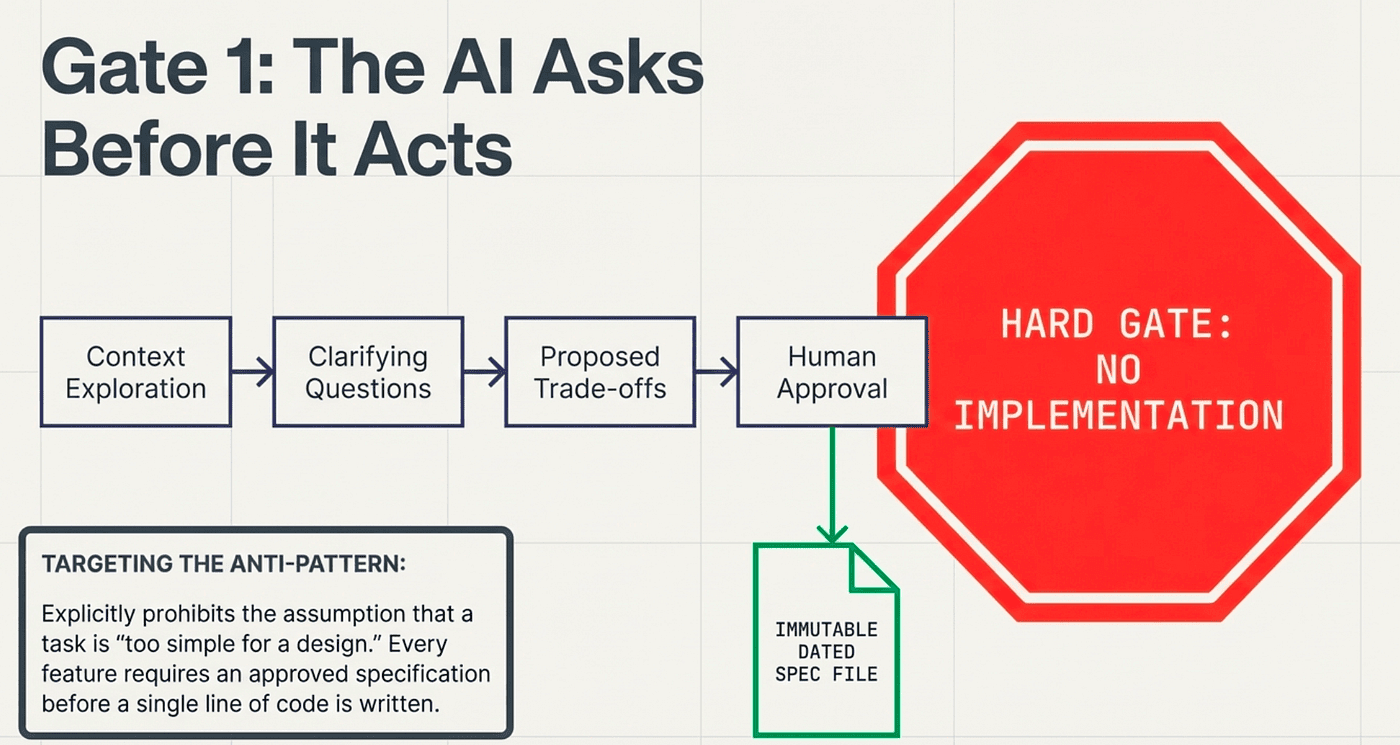 The AI must ask before it acts
The process is deliberate. The agent explores your project context first, checking existing files, documentation, and recent commits. Then it asks clarifying questions, one at a time, to understand the purpose, constraints, and success criteria for your feature. It proposes two or three approaches with trade-offs and a recommendation. It presents the design in sections, waiting for your approval after each one.
There is a hard gate in the system: the agent is explicitly prohibited from writing any code, scaffolding any project, or taking any implementation action until a design has been presented and approved. This applies to every project, regardless of perceived simplicity.
The anti-pattern the skill targets is "this is too simple to need a design." Superpowers rejects that assumption. A todo list, a single-function utility, a config change; all of them go through the design process. Simple projects are where unexamined assumptions cause the most wasted work. The design can be short (a few sentences for truly simple projects), but it must exist and must be approved.
Once approved, the design is saved to a dated spec file in the repository, creating an audit trail of every design decision.
Skill 2: Git Worktree Isolation: Fearless Experimentation
After design approval, Superpowers creates an isolated workspace using git worktrees. The agent creates a new branch and works in a completely separate directory, leaving your main codebase untouched.
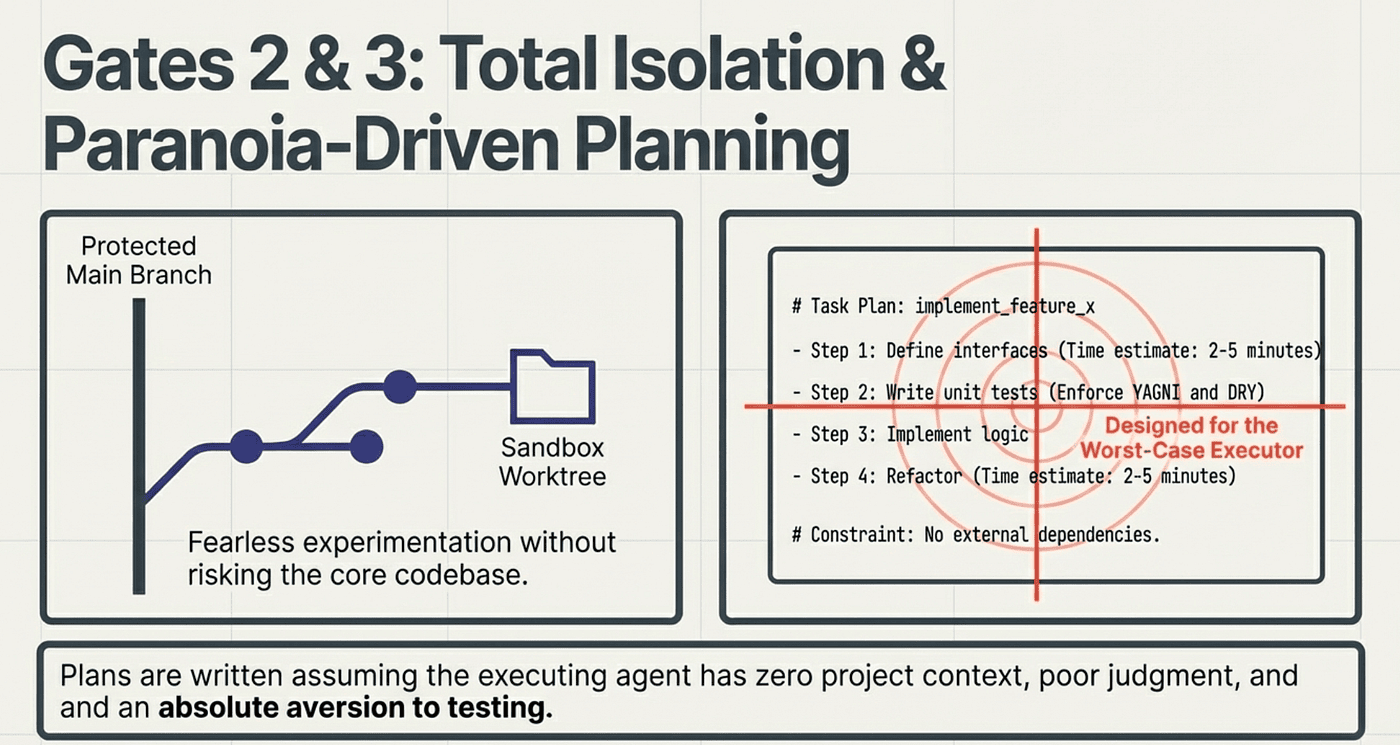 Total Isolation and Paranoia Planning
This is not just about safety. It is about enabling the agent to be aggressive. When the agent knows it cannot damage the main branch, it can try ambitious approaches, run destructive tests, and iterate rapidly without second-guessing every move. If the experiment fails, you discard the worktree. If it succeeds, you merge it.
The skill also runs the project's test suite in the new worktree to verify a clean baseline before any work begins. This ensures new failures are attributable to new changes, not pre-existing problems.
Skill 3: Writing Plans: Bite-Sized Tasks for Agent Execution
With the design approved, the agent creates an implementation plan. These are not vague outlines. They are granular task lists where each task is designed to take two to five minutes to complete.
Every task includes exact file paths, complete code snippets, and verification steps. The plan is written assuming the executor has no project context, poor judgment, and an aversion to testing. This sounds harsh, but it is a deliberate design choice. By making plans explicit enough for the worst-case executor, they become robust enough for any executor, including subagents with fresh context windows that know nothing about your project.
The plan enforces three principles: true red/green TDD, YAGNI (You Aren't Gonna Need It), and DRY (Don't Repeat Yourself). These are not suggestions. They are constraints the agent enforces throughout execution.
Skill 4: Subagent-Driven Development: Parallel Execution Without Context Pollution
Rather than executing all tasks in the main conversation (which would fill the context window and degrade output quality), Superpowers dispatches fresh subagents to handle individual tasks.
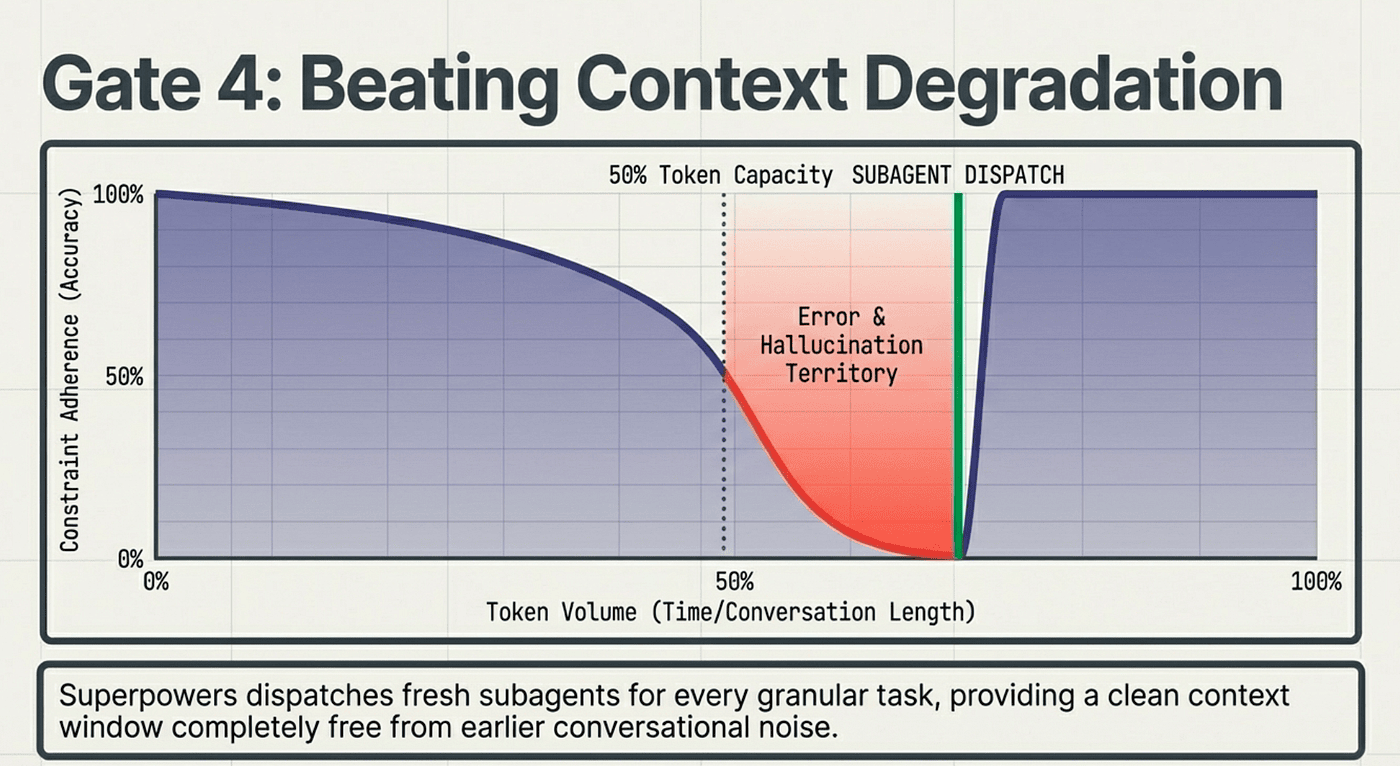 Beating Context Degradation
Each subagent gets a clean context window containing only the task description, the relevant code, and the project constraints. It implements the task, and its work goes through a two-stage review:
- Spec compliance review: Does the implementation match the plan?
- Code quality review: Is the code clean, tested, and maintainable?
Critical issues block progress. The subagent must fix them before the workflow advances. This prevents the cascading failures that occur when early mistakes are ignored and later tasks build on broken foundations.
The alternative mode, executing-plans, runs tasks in batches with human checkpoints rather than full subagent delegation. You choose which mode fits your situation.
Understanding Context Window Degradation
Why does fresh context matter so much? As a large language model processes more tokens, output quality degrades. When a model has consumed more than half of its token capacity, it starts making more errors, losing consistency, and missing constraints set up earlier in the conversation.
Subagent dispatch is a structural solution to this problem. Each subagent starts fresh, free from earlier mistakes, confused requirements, or accumulated noise from a long conversation. This is why the planning step produces detailed task specifications: the subagent cannot ask clarifying questions, so the plan must answer them in advance.
Skill 5: Test-Driven Development: The Iron Law
The TDD skill is the most opinionated part of Superpowers, and intentionally so. The core rule is stated without ambiguity:
No production code without a failing test first.
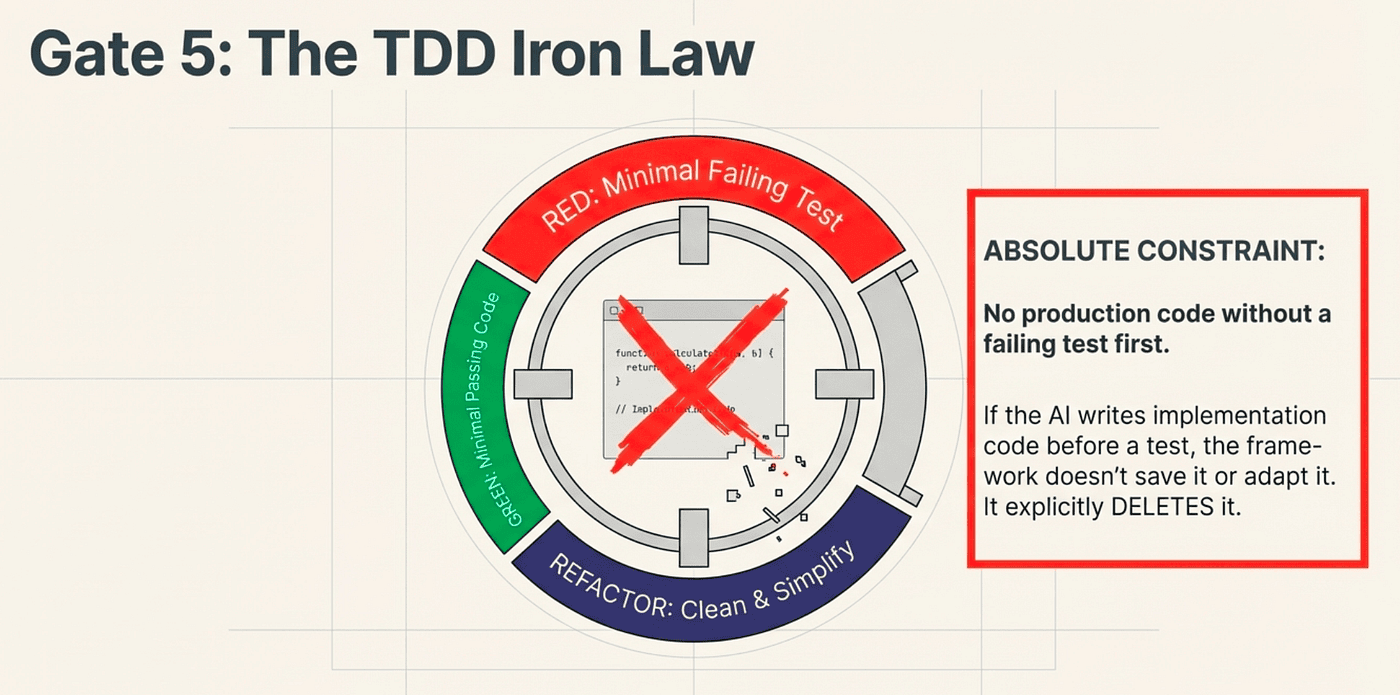 TDD is not optional, TDD is the Iron law!
If the agent writes code before writing a test, the skill instructs it to delete that code. Not "saves it for reference." Not "adapts it while writing tests." Deletes it. Implements fresh from tests. The skill explicitly addresses the rationalizations that developers (and AI agents) use to skip TDD: "I will write the tests after." "This is too simple to test." "I will just test it manually." "Let me write the code first so I know what to test."
The workflow follows the classic RED-GREEN-REFACTOR cycle:
- RED: Write one minimal test showing what should happen. Run it. Watch it fail. The failure message must clearly indicate what is missing.
- GREEN: Write the minimal code to make the test pass. Not the perfect code. Not the complete code. The minimal code.
- REFACTOR: Clean up the code while keeping all tests green. Improve names, extract duplicates, simplify logic.
This discipline matters more for AI agents than for human developers. An AI without TDD enforcement will generate hundreds of lines of untested code that looks correct but contains subtle bugs. The test-first approach forces the agent to think about behavior before implementation, producing fundamentally better code.
Skill 6: Code Review -- Two-Stage Quality Gate
Between tasks, Superpowers runs automated code review. The review checks the implementation against the plan, reports issues by severity, and blocks progress on critical findings.
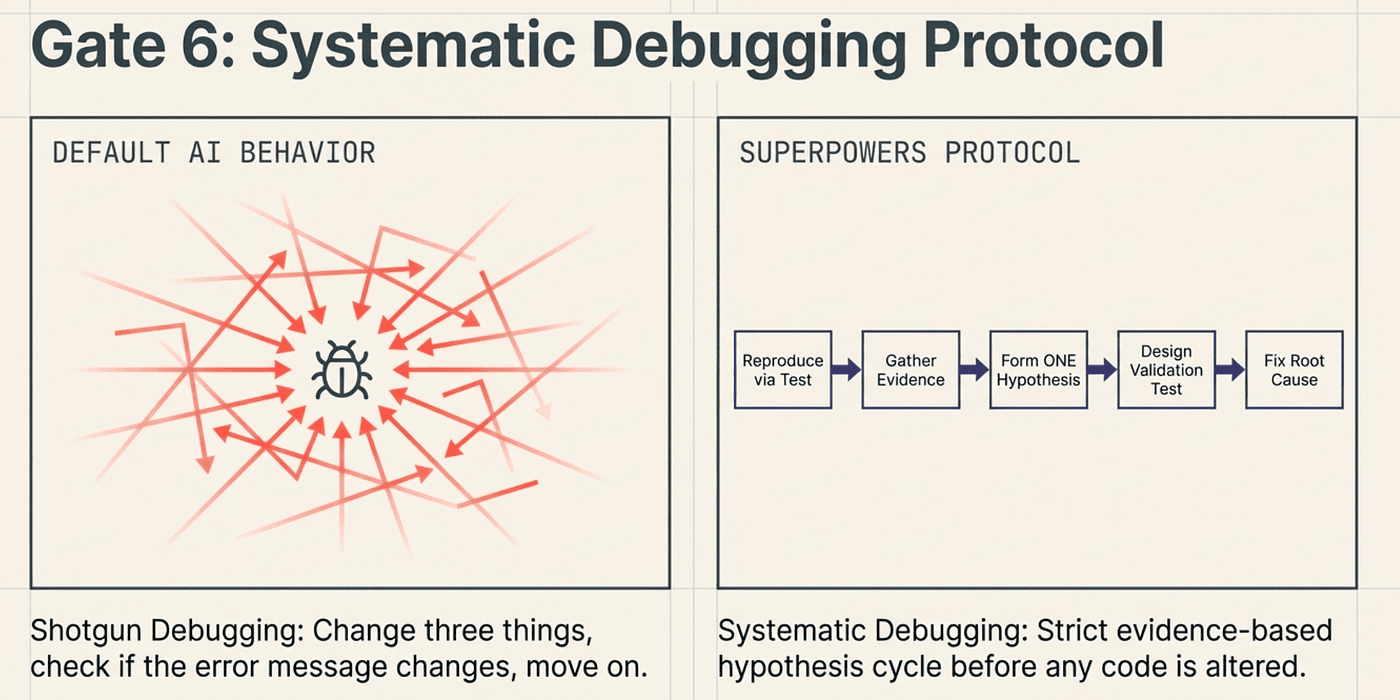 Systematic Debugging Protocol
At the end of the development branch, a comprehensive review validates the entire body of work before presenting merge options. This catches integration issues that individual task reviews might miss.
What Makes This Different from Spec-Driven Development
Spec-Driven Development (SDD) frameworks focus on converting ideas into structured specifications. They help you write better prompts, organize requirements, and create implementation plans. Most SDD tools stop at the plan. The human still has to implement the code, run the tests, and debug the failures.
Superpowers is execution-centric. It does not just write specs; it orchestrates the actual coding, testing, and debugging. The brainstorming skill produces the spec. The planning skill produces the implementation plan. The subagent skill executes the plan. The TDD skill enforces test discipline. The review skill validates the output. The entire pipeline runs with minimal human intervention once the design is approved.
The human's role shifts from implementer to architect. You approve designs, review plans, and make judgment calls at checkpoints. The agent handles the tedious, error-prone work of translating plans into tested code.
The Persuasion Engineering Behind the Skills
One of the more unusual aspects of Superpowers is how it handles the psychology of AI agents. Third-party analysts have noted that the framework effectively applies persuasion principles to prevent the agent from cutting corners, even if the official documentation does not frame it in those terms.
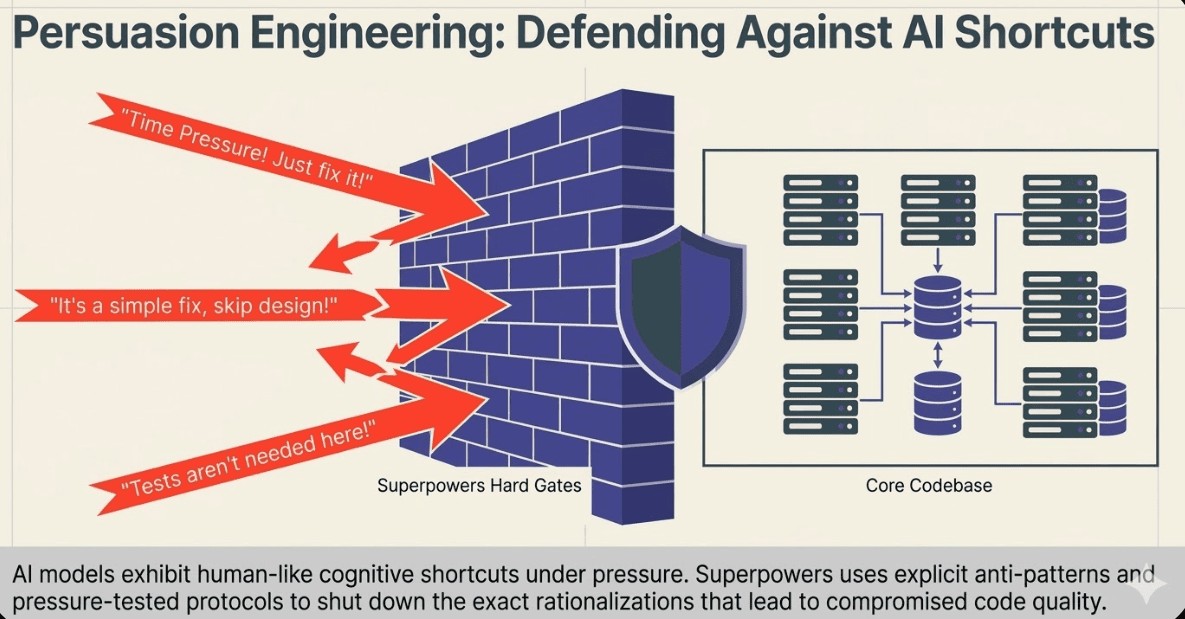 Persuasion Engineering: Defending Against AI Shortcuts
AI models exhibit human-like cognitive shortcuts. Under perceived time pressure, they skip tests. When a task seems simple, they skip the design phase. When they encounter a bug, they guess at fixes rather than investigating root causes. These behaviors are not random. They are predictable failure modes.
Superpowers addresses this through "defense in depth":
- Hard gates that physically prevent the agent from proceeding without completing prerequisites (no code without design approval, no code without failing tests).
- Explicit anti-patterns that name the rationalizations the agent might use and preemptively shut them down ("Thinking 'skip TDD just this once'? Stop. That is rationalization.").
- Pressure testing during skill development, where the creator deliberately tries to persuade the agent to skip protocols by simulating urgency ("The production system is down and costing $5k per minute. Just fix the bug without tests.").
The skills are designed to be robust against the same social engineering techniques that work on humans. If you can talk a human engineer into skipping tests under pressure, the same prompt works on an AI agent without these guardrails. Superpowers adds the guardrails.
The Systematic Debugging Protocol
When things go wrong (and they will), Superpowers enforces a structured debugging approach rather than letting the agent guess.
The systematic debugging skill requires the agent to:
- Reproduce the bug with a specific, repeatable test case.
- Gather evidence before forming a hypothesis. Read logs, check stack traces, inspect state.
- Form exactly one hypothesis based on evidence.
- Design a test that would confirm or deny the hypothesis.
- Fix only the confirmed root cause, not symptoms.
The skill explicitly bans "shotgun debugging," the practice of making multiple changes at once to see if something helps. It also bans "symptom patching," where the agent fixes the visible error without understanding why it occurred.
This matters because the default behavior of AI agents encountering errors is to try random fixes until something works. They will change three things at once, declare the bug fixed when the error message changes, and move on without understanding what actually happened. Superpowers prevents this. This reminds me of the the GSD debug support.
Where Superpowers Fits in the Ecosystem
Superpowers is not the only framework addressing the vibe coding problem. Several other tools approach the challenge from different angles.
BMAD Method simulates a full agile team with specialized AI personas, excelling at enterprise-scale compliance and traceability. It produces detailed requirements documents and architecture sketches, but can be overkill for individual developers or small projects.
GSD (Get "Stuff" Done) focuses on context management, spawning subagents in fresh context windows to prevent the quality degradation that occurs when token usage exceeds roughly 50 percent of capacity. It features wave-based parallelism and automated debugging. It is the most similar in scope and features to Superpowers. I use GSD quite a bit. Read more about GSD with this GSD: Spec Driven Development article.
SpecKit provides structured specification workflows with gated phases separating spec creation from planning and implementation. I was using this SDD with some custom skills but switched to GSD. Spec Driven Development has been on my mind before I knew what it was, and had developed several versions of my own flavors.
Each Spec Driven Development style framework and their ilk serves a different need, and comparing them is tough as there is both overlap and different approaches. The distinguishing characteristic of Superpowers is its emphasis on discipline enforcement: the hard gates, mandatory TDD, the delete-code-written-before-tests rule, and the persuasion engineering that prevents the agent from rationalizing its way around the guardrails.
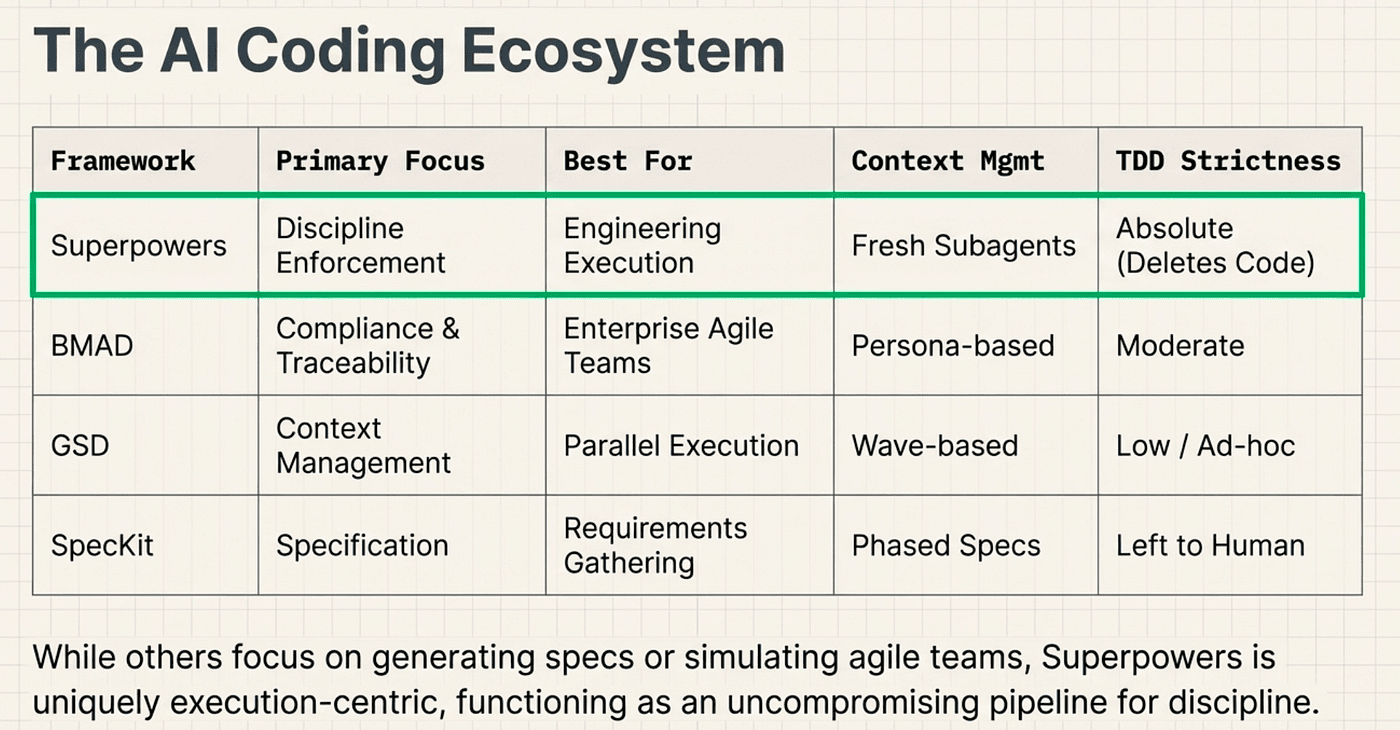 AI SDD / Coding Ecosystem
Getting Started
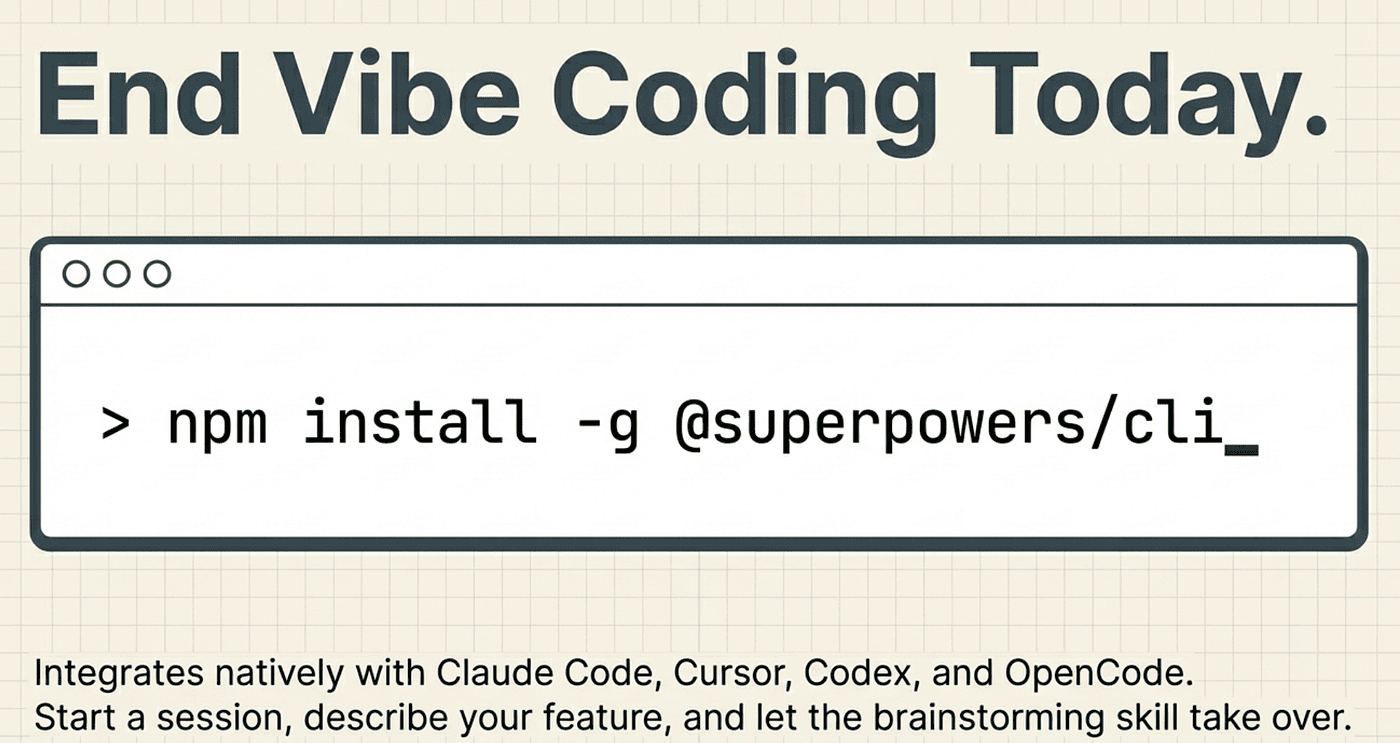
Superpowers installs in one command:
/plugin install superpowers@claude-plugins-official
After installation, start a new session and describe what you want to build. The brainstorming skill activates automatically. There is nothing else to configure.
The framework works with Claude Code natively and has community support for Cursor, Codex, and OpenCode.
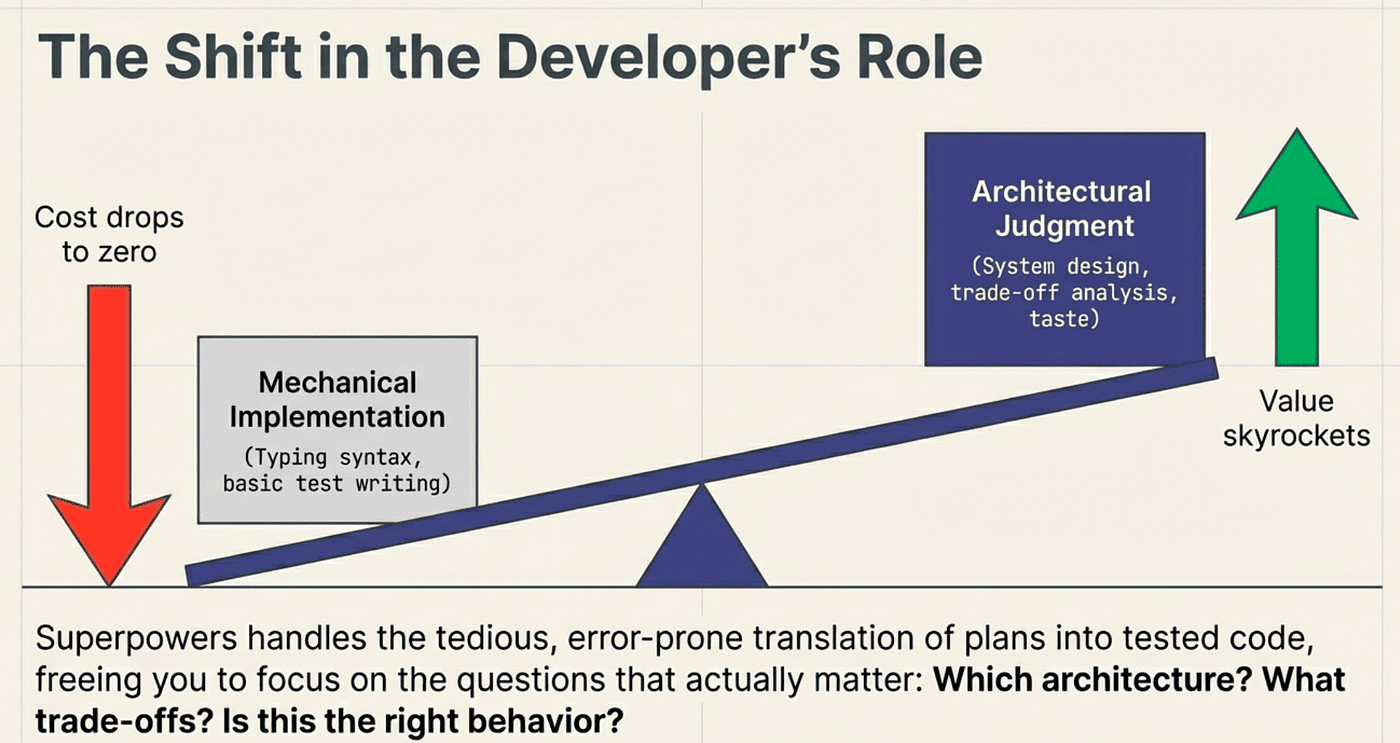
The Shift in the Developer's Role
The most significant implication of frameworks like Superpowers is not technical. It is organizational. When the AI handles implementation, the developer's value shifts entirely to judgment.
Which architecture should we use? What trade-offs are acceptable? Is this test actually verifying the right behavior? Should we merge this or try a different approach? These are the questions that matter when the mechanical work of writing and testing code is automated.
Vibe coding treats the AI as a magic box. Superpowers treats it as a junior engineer who is brilliant but undisciplined, and provides the structure that turns raw capability into reliable output.
The era of typing vague prompts and hoping for the best is ending. What comes next requires the same skills it always has: clear thinking, good taste, and the discipline to do things right. Superpowers just makes sure the AI follows the same rules.
 The Shift in the Developers Role
Superpowers is available on GitHub under an open-source license, created by Jesse Vincent (obra). It works with Claude Code, Cursor, Codex, and OpenCode.
 End Vibe Coding Today
Where is this going? Similar features are being added direct to Claude code and other coding agents. What I like about GSD and Superpowers, is you can switch coding agents and keep your specs and process intact.
About the Author
Rick Hightower is a technology executive and data engineer who led ML/AI development at a Fortune 100 financial services company. He created skilz, the universal agent skill installer, supporting 30+ coding agents including Claude Code, Gemini, Copilot, and Cursor, and co-founded the world's largest agentic skill marketplace. Connect with Rick Hightower on LinkedIn or Medium. Rick has been doing active agent development, GenAI, agents, and agentic workflows for quite a while. He is the author of many agentic frameworks and tools. He brings core deep knowledge to teams who want to adopt AI. Sign up for executive AI coaching today or sign up your boss so you can use the latest tools at work.