Harness Engineering: Mechanical Sympathy for AI Agents
Your AI Demo Isn't a Product: Harness engineering is the missing discipline that turns impressive agents into reliable systems.
Originally published on Medium.
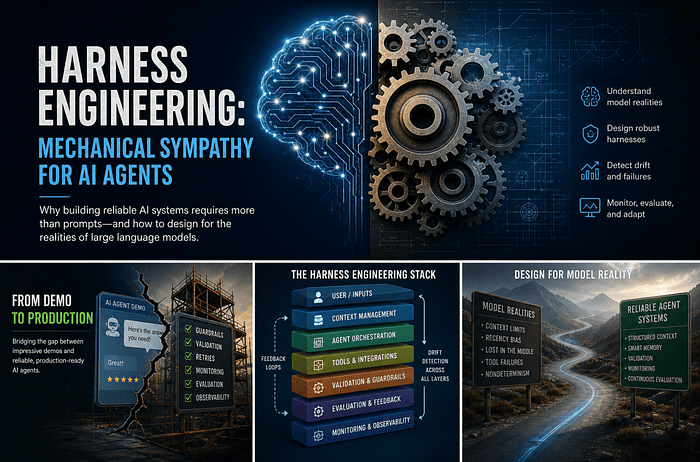
Your AI Demo Isn't a Product: Harness engineering is the missing discipline that turns impressive agents into reliable systems.
Harness Engineering as Mechanical Sympathy for AI Agents
Your AI Demo Isn't a Product
Harness engineering is a useful way to describe the work of making AI agents reliable in the real world, not just impressive in a demo. The clearest analogy is mechanical sympathy: just as engineers optimize code for the realities of caches, memory layout, storage, and processor behavior, harness engineers optimize agent systems for the realities of large language models, including context limits, recency effects, tool failures, and behavior.
Harness engineering is a useful way to describe the work of making AI agents reliable in the real world, not just impressive in a demo.
From prompt engineering to harness engineering
Prompt engineering is mostly about telling a model what to do in a single interaction. Harness engineering is broader: it shapes the entire execution environment around the model, including context selection, tool interfaces, validation layers, retries, evaluation hooks, and monitoring.
Prompt engineering is optimizing how to tell a model what to do. Harness engineering is putting guardrails around agents to ensure they won't do certain things and to guide them on what to do.
That difference matters because a strong demo can still mask a weak system. An agent may appear capable in a controlled run, but if it cannot handle shifting inputs, long-running tasks, changing prompts, or tool errors, it is still functioning as a demo rather than as production software.
Mechanical sympathy for LLMs
Mechanical sympathy in software means understanding how the machine actually behaves and writing code that works with those constraints rather than against them. Harness engineering applies the same mindset to LLMs: design the system based on what models do well and poorly, rather than on what users wish they would do.
In practice, that means treating context as a scarce, structured resource. Research on long-context behavior shows that models often focus more on the beginning and end of long prompts, while information buried in the middle can be missed, a pattern sometimes described as "lost in the middle." When an LLM senses it is running out of context space, it can enter a kind of "context panic," rushing and missing important details. A production harness therefore does not dump everything into context. It places stable rules and role definitions up front, current goals and constraints near the end, and compresses history into summaries rather than forwarding every raw interaction.
The line between demo and production
The difference between a demo and production is not just scale; it is the presence of feedback loops. These loops include GAN-style adversarial agents that judge and grade output, and orchestrator agents that coordinate the feedback. Production systems include evaluation-driven design, structured checks, and monitoring that continue after launch, rather than assuming that a successful run in testing will generalize forever.
This is where drift detection becomes essential. LLM systems can experience input drift, output drift, and harness drift as user behavior changes, prompts evolve, tools are modified, or model quality shifts over time. Without those sensors, an agent may remain persuasive while gradually becoming less correct, less aligned with specifications, or less efficient. That is why drift detection helps define the boundary between an agent that is merely demo-worthy and one that is genuinely production-ready.
If you add a few-shot prompt for a new use case, it may work well, but you may have broken other use cases. If you upgrade a model to the latest version, the new model may behave differently than the previous version. Even if you don't upgrade the model, models have been known to drift and change on their own within a release, depending on the demand and usage of that model. When dealing with nondeterministic systems, drift detection is not optional. It becomes a must. The same could be said for monitoring and observability. While these are important for services, they are essential for AI agents.
What harness engineers optimize
A harness engineer does not just optimize prompts. The work includes choosing what belongs in context, forcing outputs into reliable schemas, limiting tool loops, making retries structured and bounded, and measuring whether the agent still behaves correctly as the environment changes.
Seen this way, harness engineering is the discipline of building model-sympathetic systems. Mechanical sympathy taught software engineers to respect hardware reality. Harness engineering extends that lesson to AI agents by respecting model reality, then building the surrounding scaffolding that turns raw model capability into dependable software.
About the Author

Rick Hightower is a former Senior Distinguished Engineer at a fortune 100 focusing on delivering ML / AI insights to front line applications, and practitioner building multi-agent production systems. Follow him on Medium for more hands-on agent engineering content. You can also book him to speak and train your team: Check out Rick Hightower's SpeakerHub.