Is Claude Code UltraReview and UltraPlan actually Mythos?
Anthropic Just Dropped /ultrareview and /ultraplan for Claude Code: Deceptively Simple, But a Major Platform Play
Originally published on Medium.
Anthropic Just Dropped /ultrareview and /ultraplan for Claude Code: Deceptively Simple, But a Major Platform Play
Anthropic released a new feature for Claude Code, and it looks, well, deceptively simple. It's a command called /ultrareview. You might be thinking, great, another AI code review tool. But hold on. The real story here, the one you won't get from the release notes, is what this command actually represents for the future of AI-powered development.
We're going to break this down step by step: first, the command itself; then the real story -- the infrastructure that makes it all possible; after that, we'll put it head-to-head with the competition; and finally, we'll get super practical about when you should use this, and maybe more importantly, when you absolutely should not.
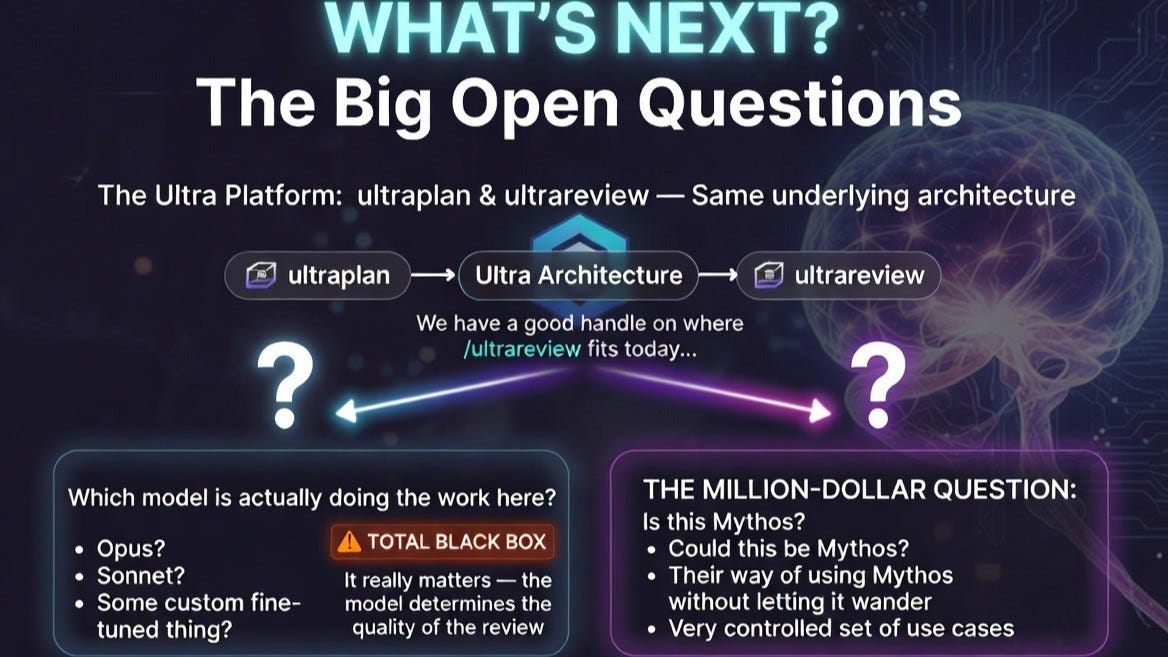
Anthropic hasn't clearly published a "this uses model X" statement for /ultraplan or /ultrareview. And the release times perfectly with Mythos. Is this Mythos?
What /ultrareview Actually Is and What It Does
It all kicks off with one simple command you type into your terminal:
/ultrareview
or
/ultrareview <PR#>
Don't let the simplicity fool you. Its simplicity is hiding a seriously powerful engine running up in the cloud, and that is the key to this whole thing.
To be super clear, this isn't just some local linter on your machine. When you hit enter on /ultrareview, you're firing off a whole process in the cloud. And get this: it uses multiple AI agents working together in parallel to analyze your code.
You can think of it like a real peer review. You've got one agent doing the initial analysis, and then a second agent comes in to critique the first one's work. It's like a built-in second opinion.
It supports two invocation modes:
- Review the current branch against base (
*/ultrareview*) - Fetch & review a specific GitHub PR by number (
/*ultrareview* <PR#>)
If you like this article and want to see more coverage of this topic check out: Claude Code Ultrareview vs CodeRabbit vs Greptile: Comparing the Trade-offs of /ultrareview, CodeRabbit, and Greptile Post v2.1.111.
The Real Story: They Built the Platform First
This feature didn't just appear out of thin air. It's the first major signal of what appears to be a much bigger strategy Anthropic is playing. They didn't build a shiny feature and then scramble to prop it up with technology. They did it the other way around: they built a powerful, flexible platform for AI agents first.
This isn't just about shipping one cool feature. It's about showing off their new platform. /ultrareview and /ultraplan are just the first user-facing command that ties all those underlying pieces together.
Just look at this timeline -- it tells the whole story. In just six days, you can literally watch them lay the foundation piece by piece:
Anthropic announced these on different dates:
- Claude Mythos Preview -- Announced April 6, 2026, in an Anthropic blog post / system card describing it as their most powerful model and initially limited-release.
- /ultraplan (Ultra Plan) in Claude Code -- Rolling coverage started very early April; by April 4--6, 2026, blog posts and videos were already "testing" or "reviewing" Ultra Plan, implying it had just launched in the first days of April 2026.
- /ultrareview in Claude Code -- Mentioned as a live feature in organization-admin discussions by April 17, 2026, so it was publicly available by mid-April 2026 (likely released alongside or shortly after /ultraplan).
- April 10th -- v2.1.101: Automatic cloud provisioning (no more manual setup).
- April 13th -- v2.1.105: Worktree isolation (huge -- lets agents work in their own little sandboxes without interference).
- April 14th -- v2.1.108: Agents can now invoke other slash commands (unlocks all sorts of complex workflows).
- April 16th -- v2.1.111: /ultrareview ships, composing all three prior primitives.
It's standing on the shoulders of giants. They built the composable infrastructure for AI agents first. /ultrareview is simply the first command that brings it all together.
Head-to-Head: /ultrareview vs. CodeRabbit vs. Greptile
Let's compare the trade-offs.
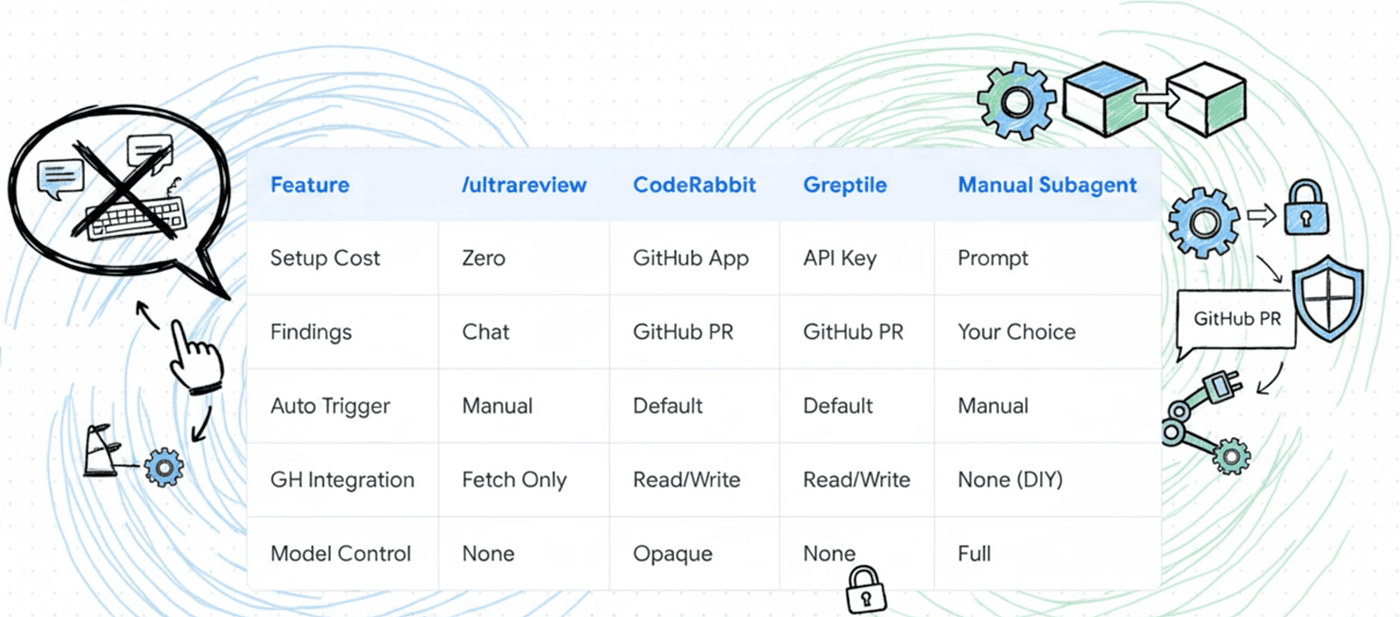
/ultrareview shines with zero friction. No installs, no API keys, no GitHub integration needed. As a Claude Code user, you can review a client's PR by number -- without doing any setup at all. The parallel AI agents (analysis + critique) catch a lot more issues. It's a massive workflow boost for consultants.
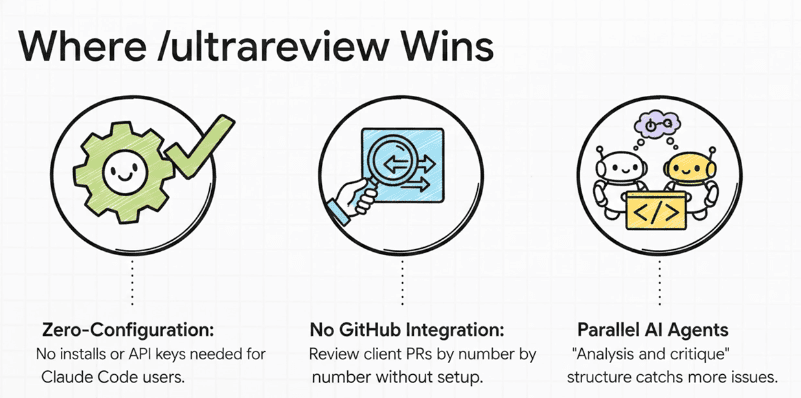
Where ultraview wins
But there's a flip side. The biggest downside, by far, is the lack of inline PR comments. Teams collaborate in the GitHub pull request; that's where the conversation lives, not in your private chat window. Add to that the fact that it's manual only and there's no real audit trail, and it becomes pretty clear this isn't designed to replace the big guys for formal team workloads. Well, not yet anyway.
When to Use It (and When Not To)
With all that in mind, here are the three killer use cases where this thing is perfect:
- Solo pre-push check -- The quickest personal quality gate before you even push your branch.
- Post-human review sanity pass -- Your teammates already approved the PR. Now run /ultrareview to catch those little pattern issues you and they might have skimmed over.
- Consulting -- Quickly assess a new client's codebase by reviewing their recent PRs. No cloning, no switching branches -- just the PR number.
It's the easiest personal quality gate you could ask for.
Of course, it's just as important to know when not to use it. This tool is not a silver bullet.
- If your team absolutely requires automatic reviews on every PR, this isn't for you.
- If you need a persistent audit trail of comments inside GitHub for compliance, you'll need a different tool.
- If you need to tweak the AI model or effort level, you can't do that here.
For those heavy-duty team workloads, you're going to stick with the established players.
What's Next? The Big Open Questions
Could this be Mythos? Perhaps this is their way of using Mythos without letting it wander so it a very controlled set use cases for Mythos. You have ultraplan and ultrareview that build on this same architecture.
Anthropic hasn't clearly published a "this uses model X" statement for /ultraplan or /ultrareview the way they do for normal API endpoints, so there's no official, definitive model ID documented yet. But it does seem coincedental that Mythos came out around the same time. I wonder if they are looking to test out Mythos without letting it completely free to use.
Anthropic hasn't clearly published a "this uses model X" statement for /ultraplan or /ultrareview the way they do for normal API endpoints, so there's no official, definitive model ID documented yet
We have a pretty good handle on where /ultrareview fits today, but there are some massive open questions about where this whole ultra platform is headed.
First off: Which model is actually doing the work here? Opus? Sonnet? Some custom fine-tuned thing? Right now, it's a total black box; and it really matters because the model determines the quality of the review.
And then there's the million-dollar question: Is this Mythos?
Could this be Mythos? Perhaps this is their way of using Mythos without letting it wander so it a very controlled set use cases for Mythos. You have ultraplan and ultrareview that build on this same architecture.
And then a another big question is will it ever post comments back to GitHub? Because if they add that one feature, the game completely changes overnight. It would go from a neat solo tool to a direct, serious competitor to the incumbents.
You can already see the pattern forming. What should you be watching for? More commands that start with ultra. An /ultratest for generating tests is almost inevitable. And of course, keep your eyes peeled for that GitHub write-back feature -- that's the big one.
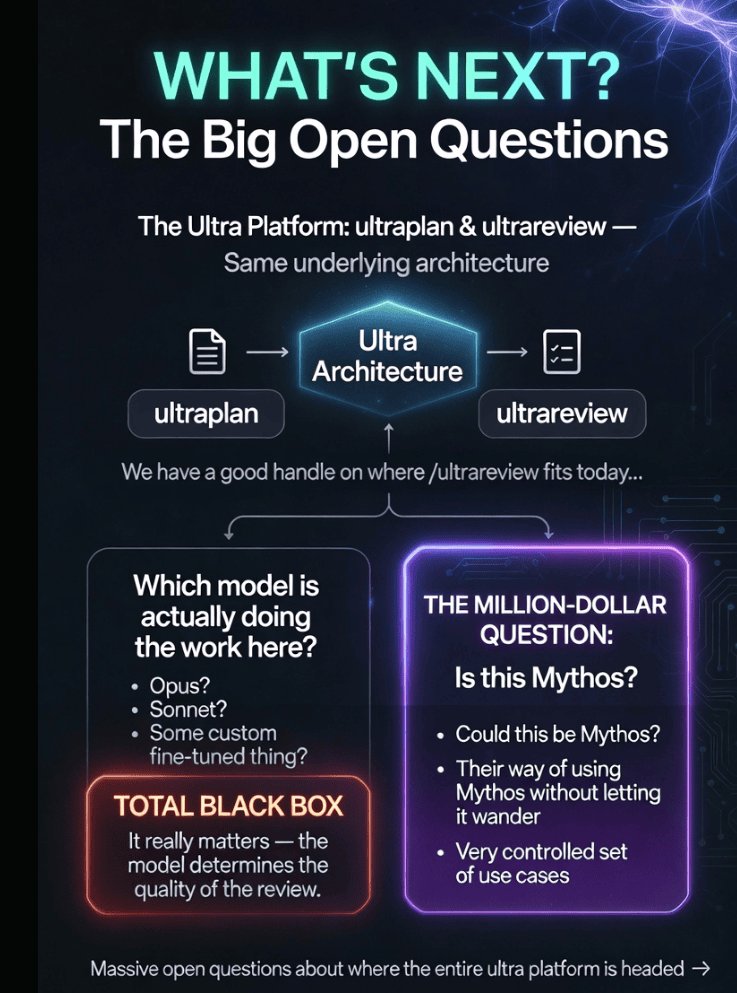
The millions dollar question: Is this Mythos?
The Big Takeaway: It's an Iceberg
Think of this whole thing like an iceberg. /ultrareview and /ultraplan are the tip. We can all see right now; fantastic tools for individual developers. But the real story, the massive platform hiding underneath, is a true game-changer.
As you watch this space evolve, ask yourself: Is shipping standalone features enough to win? Or is building a flexible, composable platform for AI agents, like what Anthropic is doing, the only real path to victory in the race for the AI-powered terminal?
Run this today:
/ultrareview
Then decide: Does the output create enough value to become a habit, or do you need a tool that writes back to GitHub?
Read more about this here: Claude Code Ultrareview vs CodeRabbit vs Greptile: Comparing the Trade-offs of /ultrareview, CodeRabbit, and Greptile Post v2.1.111.
References
- Claude Code Changelog -- (https://github.com/anthropics/claude-code/blob/main/CHANGELOG.md) (v2.1.101--v2.1.111, April 2026)
- Claude Code Release v2.1.111 -- https://github.com/anthropics/claude-code/releases/tag/v2.1.111)
About the Author
Rick Hightower is a former Senior Distinguished Engineer at a fortune 100 focusing on delivering ML / AI insights to front line applications, and practitioner building multi-agent production systems. Follow him on Medium for more hands-on agent engineering content.

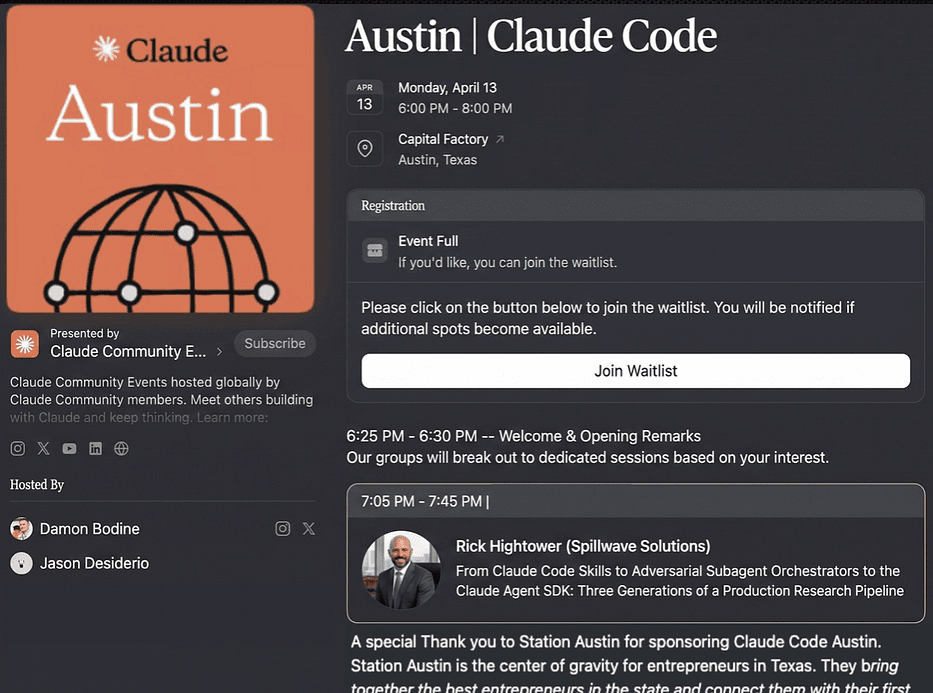
He created skilz, the universal agent skill installer, supporting 30+ coding agents including Claude Code, Gemini, Copilot, and Cursor, and co-founded the world's largest agentic skill marketplace. Connect with Rick Hightower on LinkedIn or Medium. Check out SpillWave, your source for AI expertise.
Rick has been actively developing generative AI systems, agents, and agentic workflows for years. He is the author of numerous agentic frameworks and developer tools and brings deep practical expertise to teams looking to adopt AI. He enjoys writing about himself in the 3rd person.
Rick also wrote a Claude Certified Architect (CCA) series of articles that have a lot of useful information on writing agentic AI systems. A lot of ideas captured in the CCA and the exam prep that Rick wrote echoes what you see in this article. If you want to improve your ability to create well-behaved AI agents, studying for the CCA Exam is a good place to start.
CCA Exam Prep on Agentic Development
- Claude Certified Architect: The Complete Guide to Passing the CCA Foundations Exam
- CCA Exam Prep: Mastering the Code Generation with Claude Code Scenario
- CCA Exam Prep: Mastering the Multi-Agent Research System Scenario
- CCA Exam Prep: Structured Data Extraction
- CCA: Master the Developer Productivity Scenario
- Claude Certified Architect: Master the CI/CD Scenario
- CCA Exam Prep: Mastering the Customer Support Resolution Agent Scenario
Rick also wrote a series on harness engineering and how to improve agentic systems using harness engineering for feedback loops and adversarial agents. These articles also go hand in hand with this article.
Harness Engineering Articles
- The $9 Disaster: What Anthropic's Harness Design Paper Teaches Us About Building Autonomous AI
- Harness Engineering vs Context Engineering: The Model is the CPU, the Harness is the OS
- LangChain Deep Agents: Harness and Context Engineering: Memory, Skills, and Security
- Beyond the AI Coding Hangover: How Harness Engineering Prevents the Next Outage
- LangChain's Harness Engineering: From Top 30 to Top 5 on Terminal Bench 2.0
- Anthropic's Harness Engineering: Two Agents, One Feature List, Zero Context Overflow
- OpenAI's Harness Engineering Experiment: Zero Manually-Written Code