Modern IT Infrastructure Management: Architecture and Strategy for Business Value
Originally published on Medium.
Modern IT Infrastructure Management integrates cloud, edge computing, and on-premises systems to enhance adaptability, sustainability, and developer experience, while employing architectural patterns like Event-Driven Architecture and Data Mesh to drive business value and ensure compliance through innovative governance approaches.
In today’s rapidly evolving technological landscape, IT Infrastructure Management (ITIM) has undergone a profound transformation. No longer just about maintaining operational systems, modern ITIM has become a strategic business enabler that combines cloud services, edge computing, on-premises systems, and platform services into an integrated ecosystem aligned with business objectives and value streams.
The Shifting Focus of Infrastructure Architecture
The architectural focus of ITIM has evolved beyond operational uptime to encompass:
- Adaptability: Creating systems that rapidly respond to changing business needs
- Sustainability: Designing infrastructure that minimizes environmental impact
- Developer Experience: Building platforms that streamline application development
- Regulatory Compliance: Implementing controls that meet complex legal requirements
Technical leaders now face the challenge of navigating this complex landscape while delivering tangible business value through their technology decisions.
Key Architectural Patterns Driving Modern Infrastructure
Several architectural patterns have emerged as foundational to modern ITIM, each addressing specific business needs:
Event-Driven Architecture (EDA)
EDA enables systems to communicate through events rather than direct calls, creating loose coupling and enhanced scalability. When a customer makes a purchase, for example, a single event can trigger inventory updates, customer notifications, and analytics processes independently.
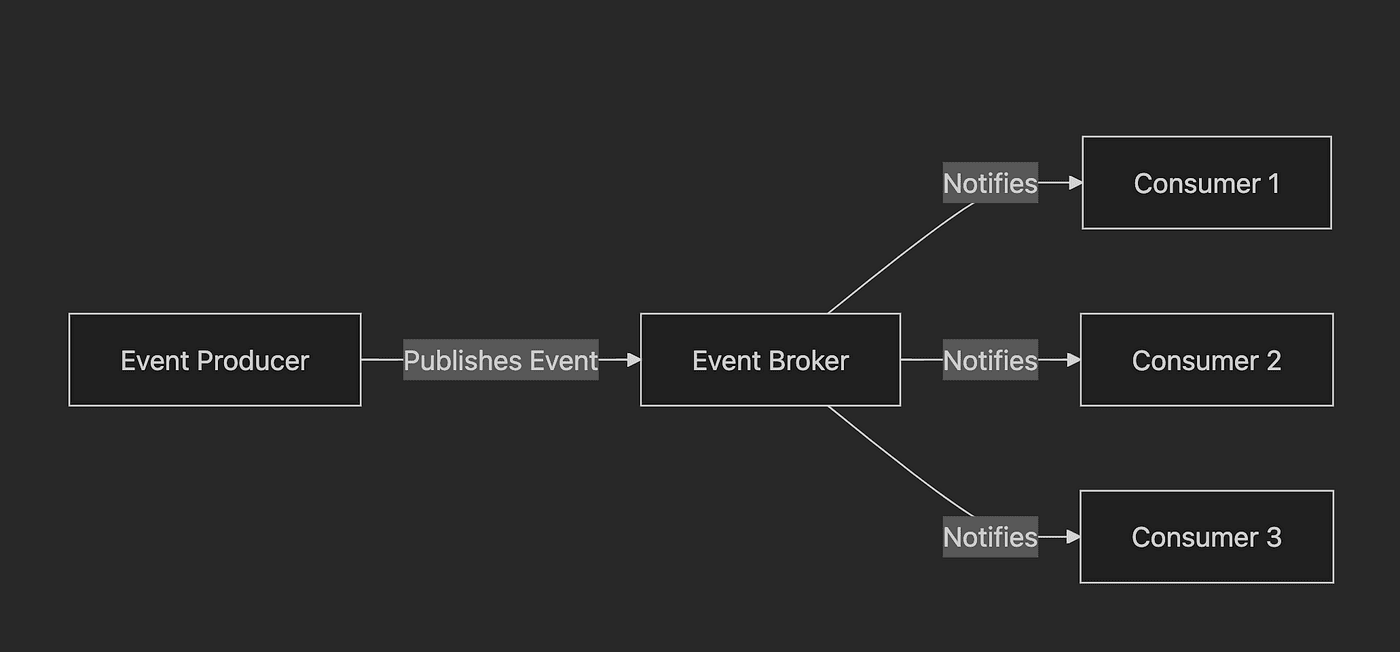
This approach enables real-time, scalable systems, though it introduces complexity in event orchestration.
Data Mesh
The data mesh pattern distributes data ownership across domain teams, treating data as a product with well-defined interfaces. This approach scales data capabilities while keeping domain expertise close to the data.
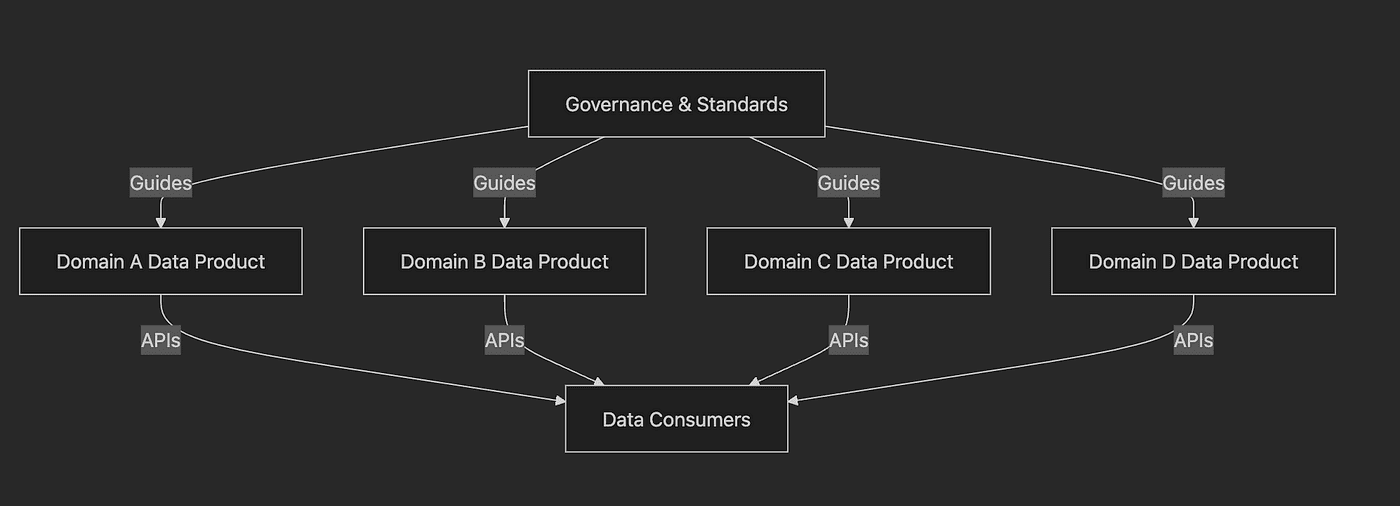
While it enables federated data ownership and greater scalability, data mesh requires strong governance to maintain consistency and quality.
MACH Architecture
MACH (Microservices, API-first, Cloud-native, Headless) architecture breaks applications into specialized services with well-defined APIs, optimized for cloud environments, with frontend and backend separation. This pattern enables agility and rapid innovation but introduces integration and operational challenges.
Platform Engineering
Creating internal developer platforms with standardized tools and services allows product teams to focus on business value. These platforms provide self-service capabilities for deployment, data access, and security. While platform engineering enables developer productivity and consistency, it requires organizational investment and cultural shifts.
Serverless Computing
Serverless approaches enable running applications without managing underlying servers. The platform handles scaling, availability, and resource allocation, reducing operational overhead with pay-for-use pricing. This pattern offers cost optimization but presents challenges with observability and cold starts.
Edge Computing
Moving processing closer to data generation points (IoT devices, retail locations, manufacturing facilities) reduces latency for critical applications and bandwidth requirements. Edge computing provides low latency and local autonomy but introduces distributed management complexity.
Strategic Decision-Making for Infrastructure
Modern ITIM requires evaluating options across multiple dimensions. The following Infrastructure Decision Matrix helps compare different deployment models:
Infrastructure Decision Matrix (2025)
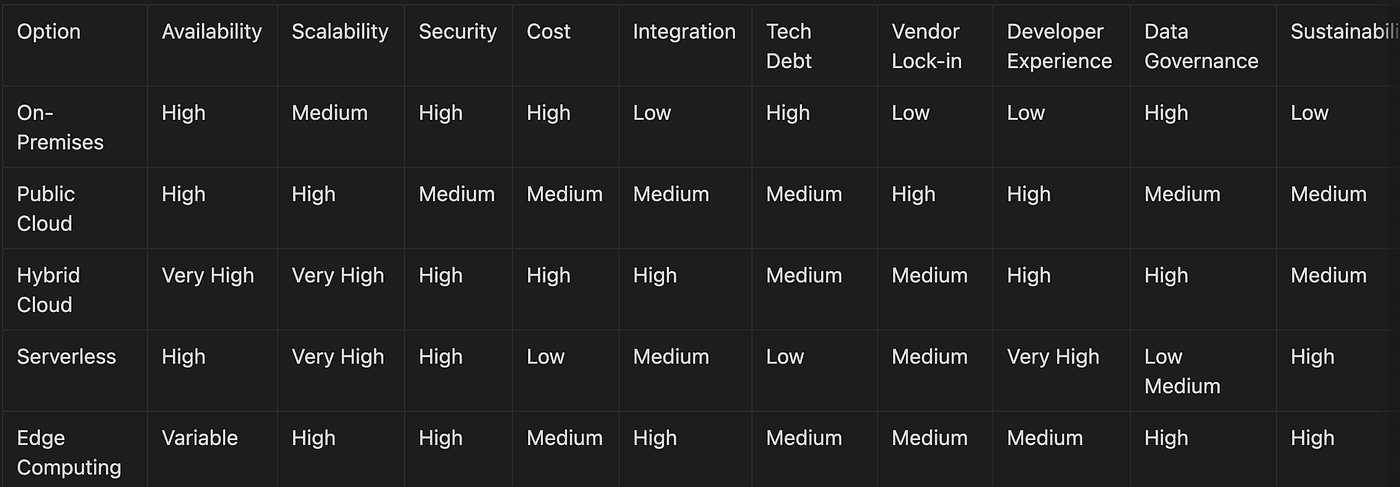
Decision frameworks like Architecture Decision Records (ADRs) help leaders document important decisions and their rationale. Here’s an example:
# Decision: Adopt Platform Engineering and Internal
# Developer Platform (IDP)

## Context
Our organization needs to enable developer
self-service, consistency, and rapid delivery
across our hybrid cloud and edge computing
environments.

## Options Considered
- Traditional Operations with manual processes
- DevOps with ad-hoc automation tools
- Platform Engineering with a comprehensive Internal
  Developer Platform (IDP)

## Decision
We will implement Platform Engineering with an IDP
to improve developer experience, enforce security
and compliance policies as code, and enable
composable application development.

## Consequences
- Positive: Faster application delivery, consistent
  security controls, improved developer satisfaction
- Challenging: Requires investment in platform team
  and cultural shift; will be mitigated by phased
  rollout and strong stakeholder engagement
- Sustainability and Zero Trust security will be
  embedded as platform standards
Modern Governance Approaches
While organizations still leverage established frameworks like ITIL 4, COBIT 2019+, and NIST guidelines, implementation has evolved to support agility through:
- Adaptive and federated governance: Distributing decision authority to teams closest to the work
- Platform teams: Creating specialized groups maintaining internal platforms
- Policy-as-code: Automating compliance and security controls
Today’s governance emphasizes compliance automation, supply chain security, privacy-by-design, standardization through APIs and reference architectures, and sustainability through environmental impact reduction policies.
Governance Responsibility Matrix
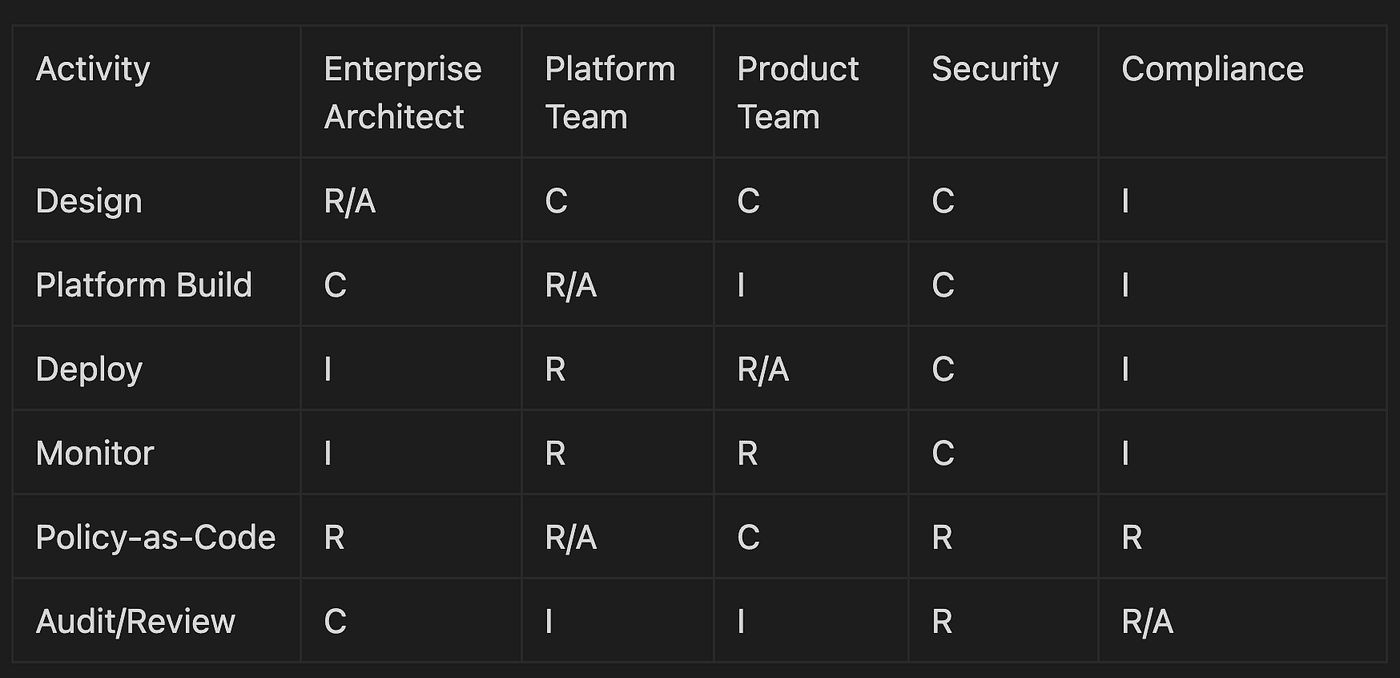
In this RACI matrix:
- R (Responsible): The team performing the work
- A (Accountable): The decision-maker ensuring completion
- C (Consulted): Those providing input before decisions
- I (Informed): Those receiving updates on progress
Policy-as-code using tools like Open Policy Agent (OPA), Kyverno, and cloud-native policy engines enables scalable, real-time enforcement of standards integrated directly into CI/CD pipelines. This ensures infrastructure changes are continuously validated against security, compliance, and sustainability benchmarks.
Organizational Evolution
Modern ITIM blurs traditional boundaries between architecture, platform development, and operations. New organizational structures include:
- Platform teams: Building internal developer platforms as products
- Product-oriented operating models: Organizing around business capabilities
- Federated governance: Distributing decision-making while maintaining standards alignment
These shifts require skill development in automation (Infrastructure as Code), cloud-native technologies, Zero Trust security, and sustainability practices.
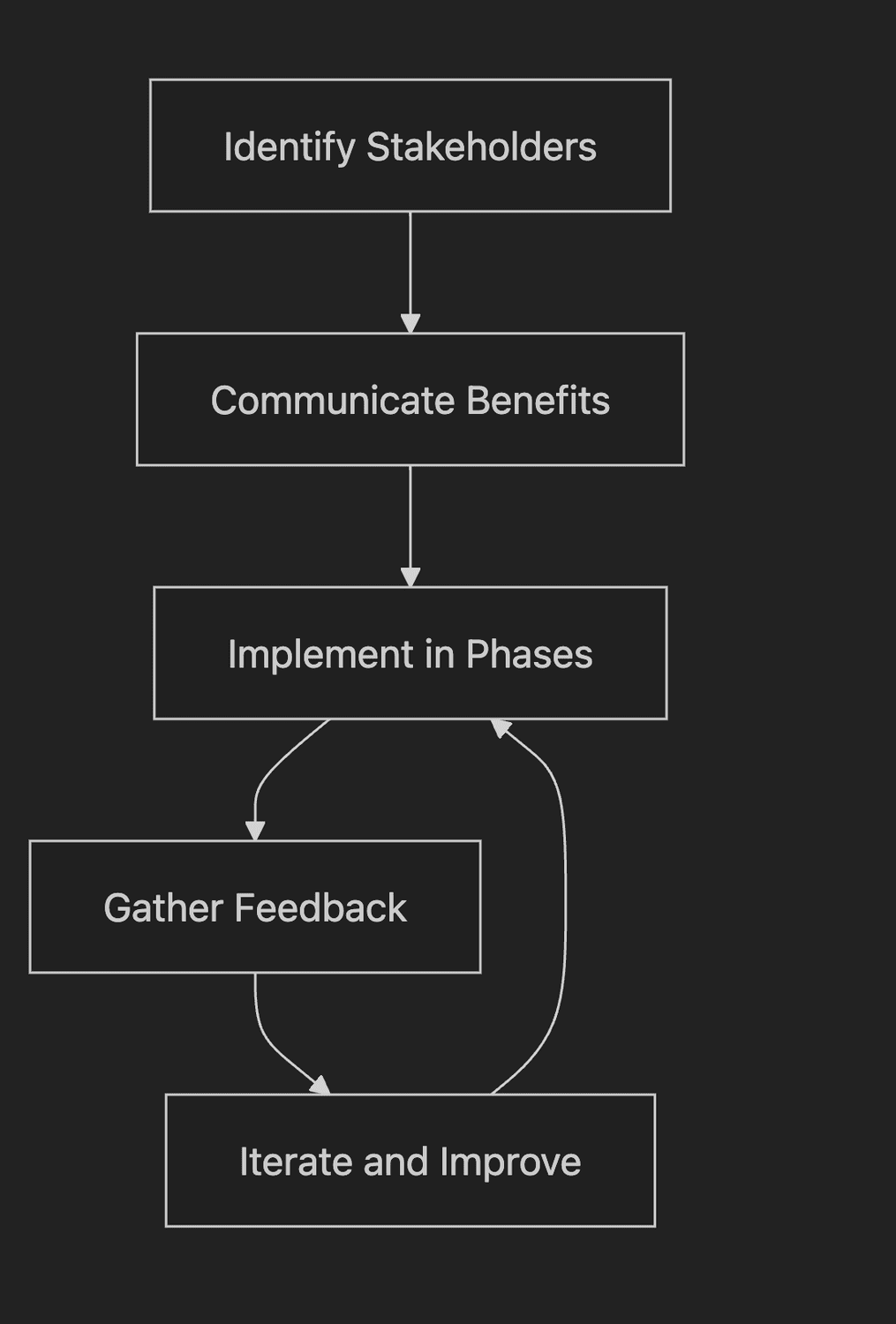
Effective change management includes early stakeholder identification, clear communication of business benefits, data-driven approaches to resistance, and continuous feedback mechanisms.
Core Architectural Principles
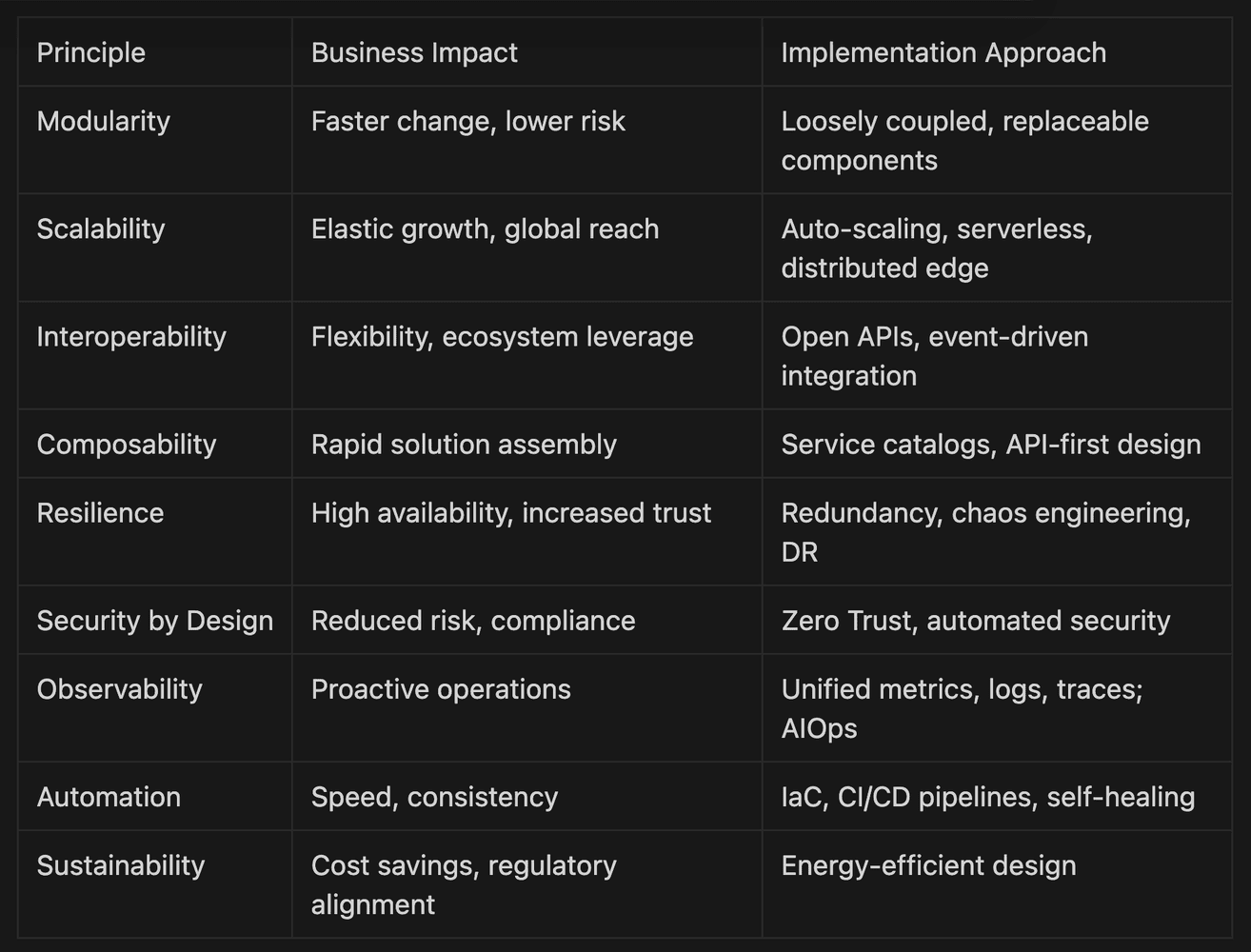
Effective infrastructure balances technical capability with business imperatives:
Core Principles and Their Business Impact
Future-Proofing Infrastructure
To prepare for ongoing change, organizations should:
- Prioritize modularity: Building interchangeable components
- Adopt open standards: Avoiding proprietary technologies
- Implement loose coupling: Minimizing dependencies
- Create extensible platforms: Designing for future capabilities
These approaches help prepare for emerging trends such as AIOps (Artificial Intelligence for IT Operations), generative AI, expanded edge computing, carbon-aware architectures, and Zero Trust security models.
Modern Reference Architecture: Hybrid Cloud-Native
A modern reference architecture integrates diverse environments:
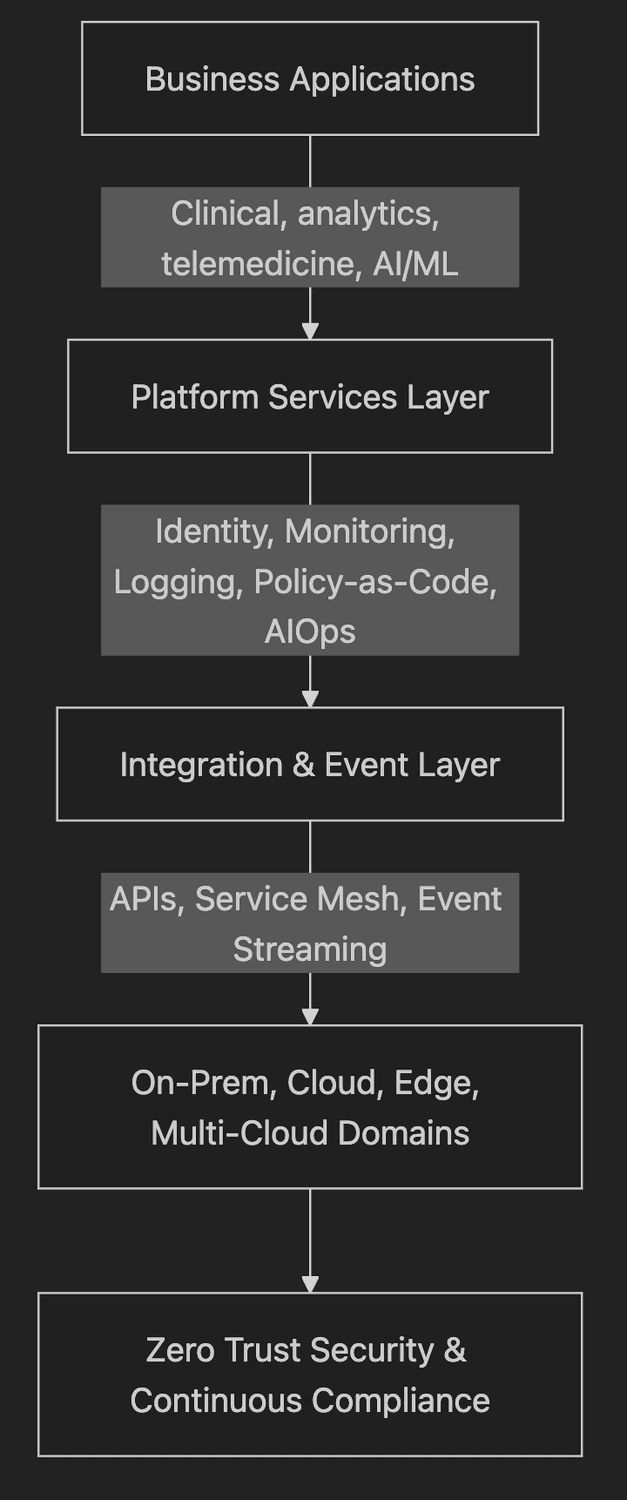
This architecture enables:
- Business capability alignment
- Consistent governance across environments
- Standardized integration patterns
- Automated security and compliance
Conclusion
Modern infrastructure architecture requires balancing technical capabilities with business outcomes, sustainability, and regulatory requirements. The strategic role of ITIM is to architect infrastructure that delivers measurable business value, meets evolving compliance and ethical standards, and adapts continuously to change.
Key considerations for technical leaders include:
- Composable, modular designs for rapid adaptation
- Platform engineering for improved developer experience
- Embedded security, compliance, and sustainability
- Multi-dimensional decision frameworks
- Organizational change management
- Future-proofing through open standards and loose coupling
By applying these principles, organizations can create infrastructure that supports innovation, ensures compliance, and delivers sustainable business value in an increasingly complex technological landscape.
If you enjoyed this article, perhaps you will enjoy this chapter in this book.
About the Author
Rick Hightower is a seasoned technology executive with over 20 years of experience in enterprise architecture and digital transformation. As former executive at a Fortune 100 company, he led strategic initiatives that revolutionized the company’s cloud infrastructure and modernized legacy systems. His expertise spans cloud computing, distributed systems, and enterprise architecture.
Rick has been instrumental in implementing large-scale digital transformation projects and has advised numerous Fortune 500 companies on their technology strategies. He is a frequent speaker at technology conferences and has contributed to several books on enterprise architecture and cloud computing.
Currently, Rick focuses on helping organizations navigate complex technological challenges and build resilient, future-proof infrastructure solutions. His practical experience and strategic insight make him a valued voice in the technology leadership community.