The AI-First Company: Why Everybody with a Computer at Work Is About to Become a Software Factory
AI transforms every employee into a software builder, turning every computer into a productivity multiplier.
Originally published on Medium.
AI transforms every employee into a software builder, turning every computer into a productivity multiplier.
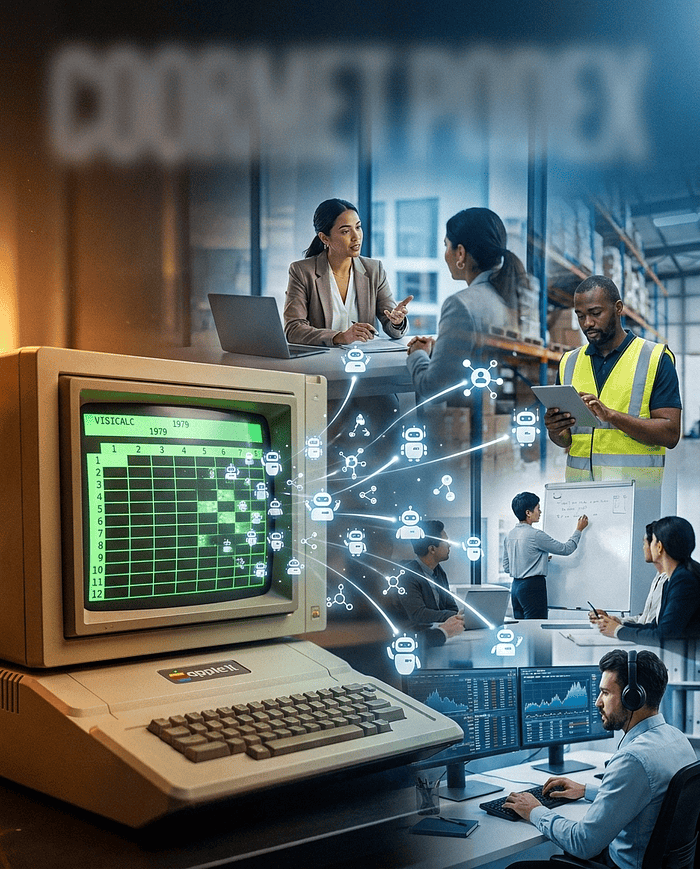
TL;DR. An AI-First company is not a company with a chatbot in a sidebar. It is a company where every employee with a computer, not just engineers, builds their own software using shared AI infrastructure (models plus MCP plus internal platforms). It is the VisiCalc moment repeating at scale. AI is a multiplier for human capability, not a replacement for it. Organizations that get this right turn every knowledge worker into a force multiplier; the winners use that leverage to expand ambition — new products, better service, faster learning, and faster growth.
The VisiCalc Moment, Again
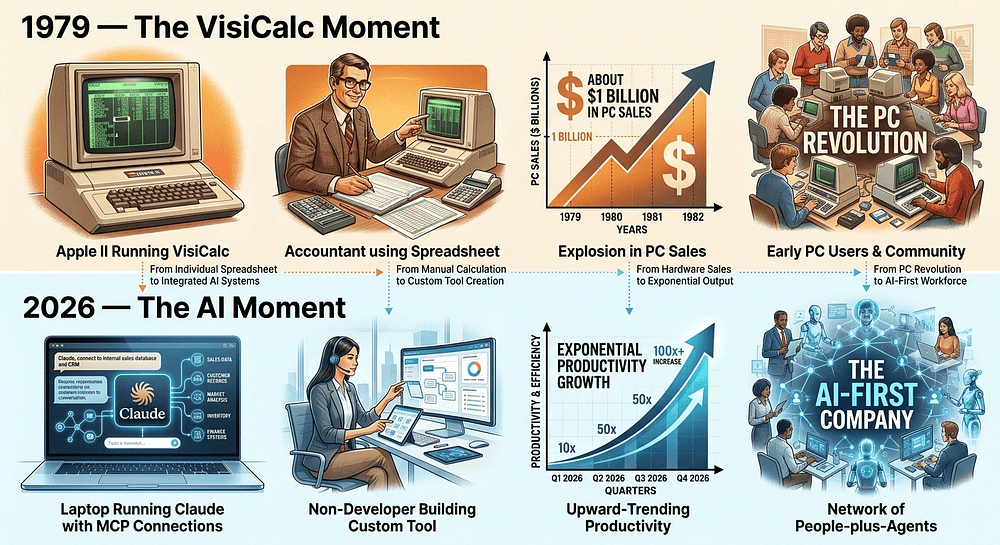
Do you remember what a budget model cost in 1978? Weeks of IT time, a stack of greenbar printouts, and at least one nervous CFO. In 1979, two guys named Dan Bricklin and Bob Frankston released a program called VisiCalc on the Apple II, and that whole economy collapsed overnight.
VisiCalc was the first electronic spreadsheet. If you have ever opened Excel or Google Sheets, you are looking at its grandchild. But the story that matters here is not the grid of cells. It is what the grid did to the workforce.
Before VisiCalc, if an accountant wanted to model a budget scenario, they filed a request with IT. IT wrote a FORTRAN or COBOL program. Weeks passed. The accountant got a printout. If the assumptions changed, the cycle started again. Sometimes IT would politely say no.
VisiCalc removed IT from that loop. An accountant could now sit at an Apple II, type in their own numbers, write their own formulas, ask their own "what if" questions, and watch the answer change in real time. They did not need a programmer. They became the programmer. VisiCalc was the power to the business domain experts.
I have watched this pattern repeat in real companies, long after the original VisiCalc moment which was before my time. Early in my career, I saw a semiconductor fab run lot prediction and production planning out of one massive spreadsheet. It worked so well, and carried so much implicit business logic, that years later, when teams had to reverse engineer it and canonicalize it into "real systems," everyone was surprised by how much decisioning had been hiding in plain sight.
Later, I saw a different version of the same phenomenon: business analysts using spreadsheets to operationalize a sophisticated algorithm for entertainment talent investing, so complex that documenting the logic produced something like a 30-page document filled with mathematical formulas. No traditional "programming," yet the spreadsheet was the program.
That is what spreadsheets did: they let domain experts encode judgment, models, and workflows without waiting on a centralized group. Now imagine the next step: Anthropic Cowork, Office Copilot, and Google Workspace Studio Gems. These managed prompts from Anthropic, Microsoft, and Google, connected to real enterprise data through MCP, turning the spreadsheet user into a business developer who can ship whole workflows and whole new outputs (reports, forecasts, recommended actions) that become reusable inputs and signals for other teams. This is how innovation spreads: one person's automation becomes another team's starting point. Quit thinking about reduction alone and start thinking about multiplication.
Within a few years, VisiCalc helped drive roughly $1 billion in PC sales. It is still widely cited as the first killer app for personal computers. But ==the PC revolution was not really about the PC. It was about the moment when the bottleneck for solving computer problems moved out of the IT department and into the hands of the people who actually had the problems.==
We are living through that moment again. This time it is bigger.

The unit of work is no longer a spreadsheet row. It is a business process. Marketing, sales, logistics, warehouse operations, HR, finance, customer support, legal: every role that touches a computer can now build its own automations, query its own data, draft its own documents, orchestrate its own fleet of agents, and compound its own output. The IT department is not disappearing. Its job is changing. Engineering no longer ships more product faster. Engineering builds the substrate that lets every other function become dramatically more productive.
That is what an AI-First company actually is. Not a company with a chatbot in a sidebar. Not a company with Copilot seats on an engineering license plan. A company where every employee with a computer is treated as a potential software builder, and where the moat is no longer the product. The moat is the organization's ability to turn every person into a force multiplier.
AI is a multiplier, not a replacement. One person plus one hundred agents produces more output than one person alone. If the economics work, that output turns into revenue, which turns into more hiring for higher-leverage work. ==Companies that use AI mainly for short-term cost cutting are going to lose to companies that use AI to expand throughput and unlock new revenue.== You can quote me on that.
If you run a company with more than a hundred employees, the question is no longer whether to adopt AI. You already did. The question is whether you are adopting it like an AI-Powered company or an AI-First company. The difference decides whether your next five years feel like compounding or like treading water.
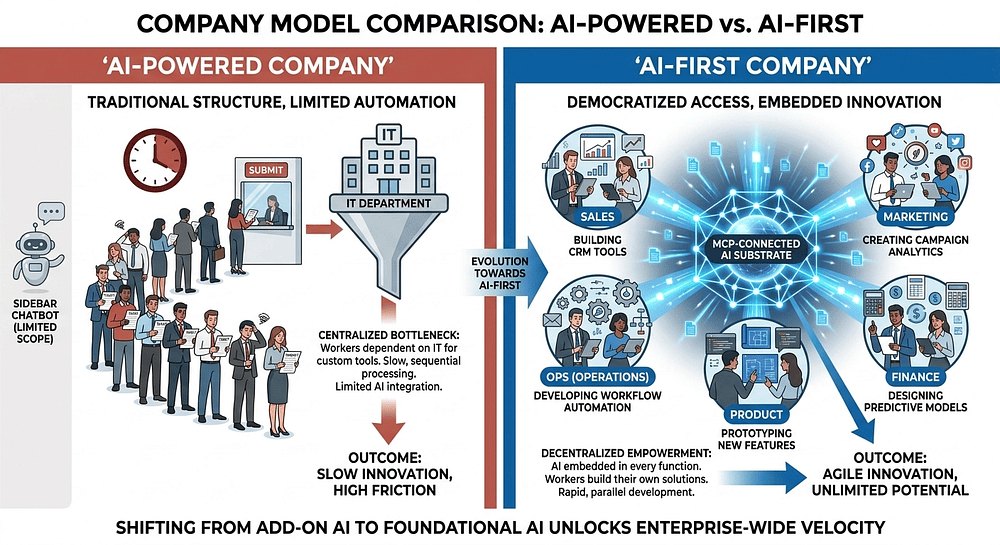
Are adopting it like an AI-Powered company or an AI-First company?
AI-Powered vs. AI-First
So what is the difference, really?
Most companies I talk to are AI-Powered. They bought Copilot seats for engineering. They rolled out ChatGPT Enterprise for marketing. They have a chatbot on the support page and a Slack bot that summarizes threads. Leadership has a slide deck titled "AI Strategy." Someone is in charge of "AI adoption." Nobody is quite sure what they are supposed to be adopting.
None of that is AI-First. Not even close.
Here is a diagnostic test. Your sales team needs a new workflow tool. Say, something that pulls customer history from Salesforce and Gong before a call and drafts a pitch deck automatically. Who builds it?
If the answer is IT, engineering, or a third-party vendor, you are AI-Powered.
If the answer is the salesperson who needed it, you are on the path to AI-First.
An AI-Powered organization treats AI as a feature bolted onto existing workflows. The sidebar. The summary button. The autocomplete. Humans still do the work; AI makes it slightly faster. The bottleneck is still the human, still the ticket queue, still the procurement cycle for the next SaaS tool.
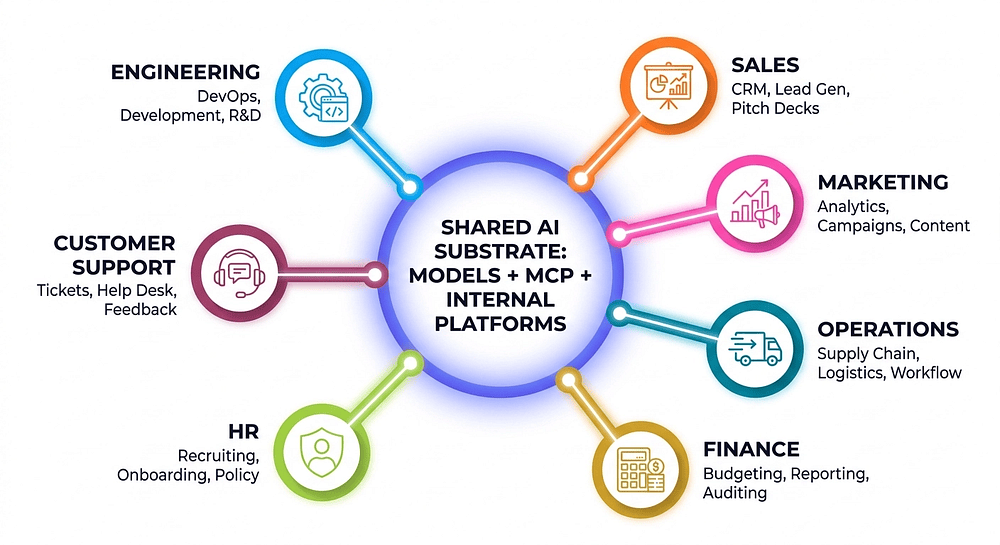
An AI-First organization treats AI as the substrate. ==Engineering's job is to build that substrate (model access, MCP connections to internal data, guardrails, deployment, monitoring, basic safety)==. The substrate is available to every employee with a computer. Those employees are expected to build their own tools on top of it, for their own workflows, with guidance and review from engineering but not gatekeeping.
The consequence is uncomfortable. In an AI-First company, the bottleneck is no longer "how fast can engineering ship." It is "how imaginative is the person closest to the problem." And how can IT and developers enable the domain experts. That is a completely different question, and it has a completely different scaling curve.
A few dimensions to stress-test where you are today:
Who builds internal tools? AI-Powered org: IT or engineering. AI-First org: whoever needs them, using shared infrastructure.
Where is the bottleneck? AI-Powered: the engineering backlog. AI-First: whoever needs them, using shared infrastructure.
What is the moat? AI-Powered: features, brand, network effects. AI-First: ==throughput per employee, organizational velocity, and the speed at which a problem discovered anywhere turns into a solution distributed everywhere==.
How fast do new employees become productive? AI-Powered: weeks of training on proprietary tools. ==AI-First: they inherit a library of workflows their peers already built, and they ship their own within days==.
If more than one of those sounds foreign, you are not AI-First yet. That is fine. Almost nobody is. The question is whether you want to be.
The Anthropic Proof Point
Before I go further, let me be careful about one thing. Anthropic is not a template to copy. They make frontier models for a living; your company probably does not. What makes them useful as a proof point is that they are already living inside the model I just described, and we get to watch what it looks like when it works.
Cat Wu is Anthropic's Head of Product for Claude Code and Cowork. In a recent interview on Lenny Rachitsky's podcast, she walked through her day-to-day. A few things stood out.
Start with the salesperson who built a web app. Not an engineer. Someone on the go-to-market side. Creating a customer-specific pitch deck used to take about thirty minutes of manual work per customer: log into Salesforce, pull the recent meeting notes from Gong, check which cloud the prospect runs on, fold in any regulatory requirements like HIPAA, assemble the slides. This person built a custom internal web app that pulls those data sources directly using MCP connections, feeds them to a model, and returns a draft deck in seconds. Thirty minutes down to seconds. Built by someone who was not officially a developer.
Read that again. That is the flagship example for what this article is about. It is not "Anthropic's engineers are fast." It is "a non-engineer built themselves a piece of production software."

Then there is antfooding. Anthropic's internal term for dogfooding. (Employees are called "ants," and they eat their own food.) Every employee uses Claude every day in their actual job, not just as a novelty. The feedback loop into the product team is continuous. Reporting on this cites messages l==anding in the team's feedback channel roughly every five minutes. There is no "we should run a user study next quarter." The user study is happening all day, every day, run by the people who built the== thing.
Then there is the launch room. At most companies, a product launch means staged handoffs: engineering, PM, PMM, DevRel, marketing. Lead times measured in weeks. At Anthropic, an "evergreen launch room" on Slack collapses that whole funnel. Engineers post features the moment they pass internal validation; marketing and docs operate on a reactive pull basis, turning around public announcements within 24 hours. Weeks of coordination, gone.
And then there is velocity itself. What used to take a quarter takes a week. What used to take a week takes a day. Not because anyone is working harder. Because the structural friction has been removed.
I want to be direct about what these examples prove and what they do not prove. They do not prove Anthropic is doing everything right. They will tell you themselves they are making plenty of mistakes. They do prove the mechanics are legible. You can see the machine working. And once you see it, you can imagine the shape it would take inside a logistics company, a hospital system, a regional bank, or a mid-size e-commerce operation.
That shape has six parts.
The Six Mechanisms of an AI-First Company
1. Velocity as the Only Moat
When code was expensive and risky to write, shipping slowly was prudent. You measured twice and cut once because cutting was hard to reverse. That economic reality no longer holds. ==AI-native tools have driven the marginal cost of writing code toward zero. The bottleneck is now decision-making, not execution.==
What follows? Your defensibility comes from how fast you can get feedback into the product. Quarterly releases become monthly, then weekly, then daily. Research previews replace polished launches. If a feature works, you harden it. If it does not, you drop it. ==The loop is the product==.
This is not only an engineering pattern. A marketing team running a "content research preview" (ship a campaign variant in a day, measure for a week, harden or kill) is doing the same thing. An operations team running a "routing preview" (new dispatch algorithm tested on 5% of routes this week, expanded if it holds up) is doing the same thing. The velocity pattern generalizes.
2. The Death of the Coordinator
Traditional orgs are full of roles whose job is to move information between specialists. PMs managing Jira, designers handing off redlines to engineers, PMMs translating engineering into marketing copy. These roles existed because the handoffs were expensive.
The handoffs are no longer expensive.
A designer at Anthropic can check in their own UI code through an agent in plan mode. A PM directly iterates on model prompts and commits changes, rather than writing a PRD nobody reads. The "hole-fixer" title Cat Wu uses for her own role says it out loud: your job is to remove any barrier between a problem and its resolution, regardless of which team nominally owns it.
This pattern extends well beyond engineering. A salesperson who writes their own MCP connector to their CRM pipeline, rather than filing an IT ticket, is killing the coordinator role in their own workflow. A finance lead who builds a month-end close agent instead of scheduling yet another kickoff with an external consultant is doing the same.
==The mindset change is that "not my job" is no longer virtuous. It is friction. The new virtuous move is "I noticed a gap, I built the thing, I asked three people to check it."==
3. Build on the Edge
The model you have today is not the model you will have next quarter. AI-First companies build for the model that is coming, not the one they have.
Cat Wu describes Claude Code's code-review feature as a case study. For months, the team attempted to build reliable automated review. Earlier models lacked the precision. Rather than abandoning the project or waiting for a model that was ready, they continued building the harness (multi-agent orchestration, scaffolding, prompts) against a model that could not yet deliver. When Sonnet 4.6 and Opus 4.7 landed, they swapped in the new intelligence, and the feature crossed the usefulness threshold almost overnight.
The non-engineering version is straightforward. An operations leader prototypes an autonomous dispatch loop today, knowing current models are marginal on the hardest routes. When the next model lands, the routes that were 70% reliable become 95% reliable, and the team is six months ahead of competitors who were still waiting for the tech to "mature."
The flip side is what Anthropic calls scaffolding debt. Every workaround you built to compensate for weak models becomes technical debt the moment the model gets smarter. Features built as crutches (manual to-do lists, heavy system prompts, complex tracking logic) must be aggressively stripped when the model can handle the task natively. ==The model is allowed to eat the harness. Teams that do not prune accumulate complexity and slow down==.
4. Model Introspection
What happens when your code misbehaves? You open a stack trace, find the bad line, fix it. Forensic. Mechanical. Familiar.
AI-native debugging is different. The model is not broken in the usual sense. It chose a path that seemed reasonable to it, and was not. The bug is cognitive, not syntactic.
The practice Cat Wu calls "the most underrated skill in modern AI development" is simple. When the model does something unexpected, ask it to introspect. Ask it why it took that path. The common revelations are that the system prompt was ambiguous, the task was delegated to a sub-agent that did not verify its own output, or the model took a shortcut that looked like a good idea in context.
This is not a skill limited to engineers. A marketing ops analyst debugging why an audience-segmentation agent keeps producing weird segments might discover that their prompt defined "qualified lead" in a way that reads fine to a human but is ambiguous to a model. A finance analyst who cannot figure out why an anomaly detector keeps flagging the wrong rows might learn, through a conversation with the model, that their instructions implied a threshold they never explicitly stated.
The shift is from forensic investigator to curious collaborator. The model is not a black box you blame. It is an earnest colleague who can tell you what it thought it was doing, if you just ask.
5. Personalized Work Software (The Centerpiece)
This is the core of the article and the core of AI-First as an idea. If you take nothing else from this piece, take this.
For forty years, we have been buying generic SaaS tools and asking employees to adapt their workflows to the tool. The tool won; the workflow compressed around it. Everyone using Salesforce used it the same way, more or less. Everyone using Workday filed expenses the same way. Standardization was the feature. Friction was the price.
That tradeoff is no longer necessary. With Claude Code, MCP connections, and the right platform substrate, the cost of building a bespoke internal tool has collapsed to something an individual contributor can carry on a Tuesday afternoon. The tool adapts to the workflow, not the other way around.
The salesperson deck story is the flagship example because it is so specific. Thirty minutes becomes seconds. Built by someone who is not a developer. Grounded in real company data through MCP.
The pattern generalizes, and it generalizes hardest in the places where the existing SaaS market has the weakest fit:
- A finance analyst builds their own variance-report generator that pulls from the GL, cross-checks against forecast, and produces a draft with plain-English commentary in under a minute. No more "export to CSV, pivot, paste, manually annotate."
- An HR specialist writes a compliance-aware candidate-sourcing agent that checks ATS history, respects hiring policy constraints, and produces a shortlist by Monday morning instead of Thursday.
- A warehouse manager builds an MCP-connected inventory watcher that flags SKUs trending toward stockout against a seasonal baseline and drafts vendor outreach emails for the worst offenders.
- ==A customer success manager builds a conversation-health monitor that reads Slack threads from enterprise customers and surfaces churn risk signals three weeks before the next QBR.==
None of these people are developers. All of them are software builders now.
The implication for leadership is uncomfortable: you cannot buy your way into this with more SaaS procurement. The tools your employees need are the tools your employees will build. Your job is to give them the substrate and the permission.
6. Managing Fleets, Not Tasks
For most of the history of work, a worker did one thing at a time. With AI, the same worker can direct ten, then fifty, then a hundred agents in parallel. The architectural shift is that the heavy lifting moves to cloud execution environments, while the human manages the fleet through a lightweight interface. The competitive advantage is no longer how much work you can do yourself. It is how efficiently you can orchestrate and verify the output of dozens of autonomous agents.
Engineering example: a staff engineer runs fifty parallel refactoring agents across a large codebase, each handling a specific module, each producing a PR to be reviewed in a batch at the end of the day.
Non-engineering examples tell the same story:
- A sales rep runs fifty parallel prospect-research agents (one per account in their pipeline) before a Monday pipeline review. Each agent pulls recent news, hiring signals, earnings commentary, and CRM history. The rep spends their prep hour verifying and editing summaries, not gathering raw data.
- A content marketer runs a dozen landing-page variant experiments in parallel across paid traffic, each with its own headline, hero image, and value prop, with a fleet of agents coordinating the creative generation, the copy tests, and the performance summaries.
- A logistics manager orchestrates a fleet of route-optimization agents across regions, each modeling a different tradeoff between cost, speed, and carbon. The manager reviews the Pareto frontier and approves the next week's plan.
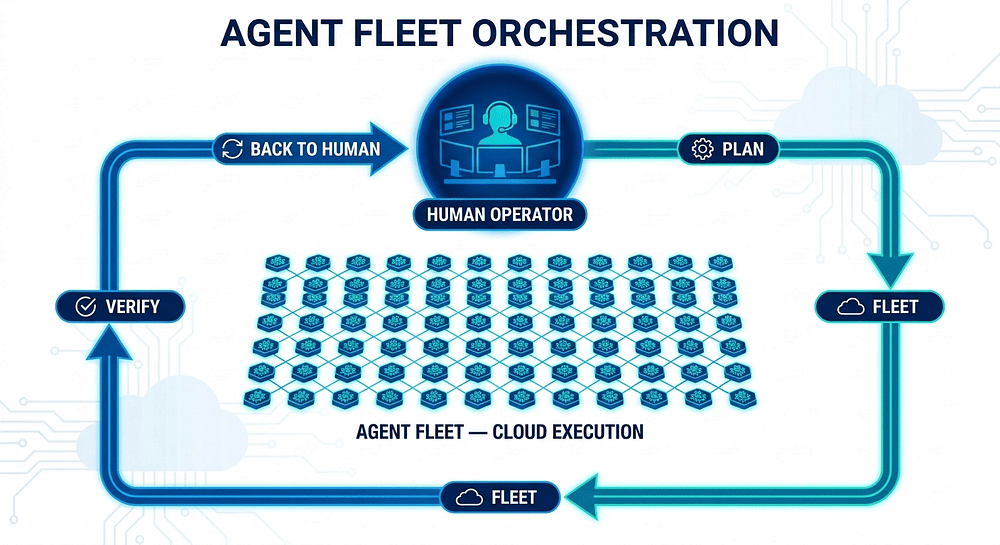
The human's job is verification bandwidth. You set the goals, you review the plans, you spot-check the outputs, you correct what needs correcting. Over time, the corrections become training data for the next run. The loop compounds.
The bottleneck in this new mode is not human speed or human fatigue. It is how many parallel outputs a human can meaningfully verify before the next fleet launches. ==Teams that design for verification throughput (rubrics, sampling protocols, automated sanity checks) scale. Teams that try to manually inspect every output plateau and then complain AI is overhyped.==
The Workforce Multiplier, Beyond Engineering
If you have read this far and you are still mostly picturing engineers, I have not done my job. The point of AI-First is that the engineering team is roughly a tenth of the story. The other nine-tenths is every other function figuring out what their version of the salesperson deck app looks like.
Here is what that looks like in each of the major business functions. None of these examples require a computer-science degree.
Sales. A pitch-deck generator built in an afternoon replaces thirty minutes of manual prep per customer. A pipeline of fifty parallel prospect-research agents runs on Sunday night so that Monday's review meeting starts with briefings, not blank pages. A call-coach agent sits on Gong recordings overnight, flags objections the rep mishandled, and drafts follow-up emails to send at 9 AM. The rep is not the agent. The rep picks which of the agent's outputs deserve a phone call.
Marketing. A variant-testing harness spins up twelve landing-page treatments against a campaign, runs them for a week, returns a synthesis. An SEO audit agent crawls the site daily, flags new issues, and drafts fixes in the CMS for review. A personalized-campaign orchestrator segments a list of 50,000 leads, generates a dozen tailored subject lines per segment, and selects the winners through a bandit. The marketing director's job is taste, positioning, and review. The execution scales in parallel.
Operations and Logistics. Route-optimization agents run every night against the next day's delivery plan, producing a ranked set of options against cost, speed, and service quality. A vendor-followup agent reads email, flags late shipments, drafts escalation messages, and stages them for human approval. An inventory-anomaly watcher flags SKUs trending toward stockout and proposes reorder quantities against seasonal history. The operations manager is reviewing proposals, not triaging spreadsheets.
Finance. An anomaly-detection agent reads the general ledger nightly, flags transactions that break their historical pattern, and drafts questions for the originating team. An automated month-end close agent executes the standard checklist, flags exceptions, and produces a first pass of the variance commentary. A forecast ensemble runs three different projection models in parallel. The CFO sees a Pareto of outcomes instead of one point estimate.
HR. A talent-sourcing agent runs against a role spec, surfaces candidates across LinkedIn and internal databases, screens them against a compliance-aware rubric, and produces a shortlist with evidence. An internal-enablement agent answers benefits and policy questions on Slack and learns from corrections when it answers wrong. A performance-synthesis agent reads 360-review inputs and produces a draft summary for the manager's review.
Customer Support. A tier-1 agent fleet handles the first response on routine tickets, drafting replies grounded in the knowledge base and escalating to humans only when confidence drops. An escalation-triage agent reads incoming tickets, routes by sentiment and complexity, and alerts account managers to at-risk customers. A sentiment-loop agent reads all closed tickets weekly, clusters the patterns, and files product issues for engineering. The support leader runs a fleet of coworkers, not a queue of typists.
Read that list again. Count the examples. More than half come from roles that did not historically touch code. That is not an accident. That is the definition of AI-First.
Culture of Chaos
The pace matters. When every employee is shipping small automations all day, and engineering is shipping substrate updates that make those automations more powerful every week, the organization runs hot. Priorities shift faster than quarterly OKRs can track. A P0 on Sunday night can be superseded by a P00 on Monday morning and a P0000 by Monday afternoon. Cat Wu's description of the AI industry as a tornado is not metaphor. It is the operating condition.
Companies that try to eliminate that chaos lose. The discipline is not to eliminate chaos. The discipline is to build an organization resilient enough to embrace it.
A few things matter:
Hire for the tornado. The question is not "can this candidate do the job I wrote down?" The job will have changed by their start date. The question is "does this candidate lean into ambiguity and ship their own tools?" This applies equally to engineering, sales, marketing, and operations hires. The profile you want is someone who sees a repetitive task and asks, "why am I doing this by hand?"
Equal disappointment. The mission-level tradeoffs are real. Every team will, in some sprint, get the short end. The culture has to absorb that without descending into politics. The test is whether the person on the short end of this sprint still believes they are on the long end of the mission.
Alignment as the friction reducer. When everyone genuinely understands why the company exists and where it is going, the number of decisions that have to go up the chain collapses. Individuals cross team boundaries because the mission is more important than the org chart. That sounds sentimental. It is actually load-bearing. Without it, the speed I described above tears the company apart.
Do not measure AI success in headcount reductions. This is the single biggest failure mode I see leaders drift toward. "==We can do more with less" is the wrong frame. The AI-First frame is "we can do dramatically more with the same people," and== ==the corollary is "we can take on bigger problems, serve more customers, and build new lines of business.== ==" ==Companies that treat AI as a growth engine beat companies that treat AI as an austerity program. Simple as that.==
Companies that treat AI as a growth engine beat companies that treat AI as an austerity program. Simple as that.
Empower the Domain Experts (The Growth Engine)
==The biggest shift in an AI-First company is not tooling. It is who gets to build.==
Instead of centralizing every automation request in IT or engineering, you treat domain experts as product builders: the people closest to routing, vendors, inventory, customer retention, underwriting, claims, support, and marketing are the ones who can imagine the right workflow — and now they can ship it.
This is where the compounding starts.
Operational innovation that creates revenue (not layoffs):
- Logistics routing as a product. Build routing agents that continuously learn from late deliveries, weather, warehouse constraints, and customer preferences, then turn those improvements into premium service tiers (faster windows, higher reliability, better SLAs).
- Vendor management as margin expansion. Agents monitor pricing drift, contract terms, fill rates, and quality signals; they renegotiate faster, surface substitute suppliers, and propose bundled buys — saving money through leverage and intelligence, not attrition.
- New product categories and services. Domain teams spin up small "micro-products" (a new replenishment cadence, a subscription bundle, a compliance service, a concierge layer) as experiments, measure results, and harden the winners.
- Retention as an always-on system. Agents watch churn signals (support patterns, delivery failures, usage dips), recommend interventions, draft outreach, and route escalations — turning "reactive save deals" into a proactive revenue machine.
- Targeted marketing with better signals. Teams build audience and offer-generation workflows grounded in real performance data, not guesswork — then run parallel experiments that converge on what works.
The enabler is a decisioning substrate:
- ==A shared platform that standardizes inputs (data sources via MCP), outputs (dashboards, actions, drafts, tickets), and verification (rubrics, approvals, sampling).==
- ==A library of reusable skills/plugins built by domain teams and reviewed like code: small, composable building blocks that other teams can adopt and remix.==
What IT and engineering build (so everyone else can build):
- ==Self-service data stores.== Curated, governed data products (plus semantic layers) that make the "right" datasets easy to discover and hard to misuse.
- Pipelines that make data usable. Batch and streaming jobs that turn raw operational exhaust into clean, timely signals — so domain teams are not waiting on exports or tickets.
- MCP connectors + safe defaults. Standard connectors to core systems (CRM, ERP, WMS, support, data lake) with opinionated guardrails.
- Role-aware copilots (RBAC/ABAC). Assistants that know who the user is, what they are allowed to see/do, and what actions require approval — so the fastest path is also the safest path.
- Sharing and compounding. A place for teams to publish workflows, dashboards, and "insight artifacts" so the best ideas propagate instead of staying trapped in one person's notebook.
- Hardening, streamlining and performance tuning essential workflows that need centralization
==The goal is not incremental efficiency. The goal is to turn every domain expert into a force multiplier.== This enables the company can ship more innovation, faster, and turn that velocity into new revenue streams.
The Multiplier Economics
Here is the bottom line.
==The moat used to be the product. Then it was the platform. Then it was the data. Those mattered, and still matter, but they are no longer sufficient on their own. The moat that matters over the next decade is the organization's ability to turn every single employee into a force multiplier.==
One person plus a hundred agents is not one person. It is a team. If you have a thousand employees and a real AI-First operating model, you have a thousand teams. If your competitor has a thousand employees and a chatbot in a sidebar, they have a thousand people. Not the same thing.
The economics are not complicated. More throughput per employee means more revenue per employee. More revenue per employee means more hiring capacity. More hiring capacity for the higher-leverage work means more compounding. Companies that shrink their workforce to capture short-term AI savings will run out of runway against companies that expand their ambition at the same rate their productivity expands.
VisiCalc did not replace accountants. It made one accountant do the work of five. Then it made five accountants do the work of a different five, on problems that were too expensive to touch before. The PC revolution was not a substitution event. It was an expansion event. Tens of millions of jobs got easier, tens of millions of new jobs got invented, and the economy grew.
This is the same moment, now, at a larger scale. ==Every computer in your company is about to become a software factory.== ==The question is whether your organization is set up to let the people in front of those computers build the things only they can imagine.==
Every computer in your company is about to become a software innovation factory.
Quick Answers
What is an AI-First company? An AI-First company is one where every employee with a computer, not just engineering, is treated as a potential software builder. ==The engineering team's job is to build the shared substrate (models, MCP connections, guardrails, platforms). Every other function builds its own tools on top of that substrate for its own workflows.==
What is the difference between AI-First and AI-Powered? AI-Powered means AI features attached to existing workflows (chatbots, sidebars, summary buttons). AI-First means AI as the substrate that every function builds on; the moat shifts from product features to throughput per employee.
Does AI-First mean replacing workers? No. AI-First is a multiplier, not a replacement. One person plus one hundred agents produces more output than one person alone. Organizations that use AI to shrink headcount lose to organizations that use AI to expand throughput.
What is MCP and why does it matter for AI-First? Model Context Protocol (MCP) is the open protocol Anthropic launched in late 2024 that has become the default way AI agents connect to enterprise data (Salesforce, Gong, Slack, GitHub, Google Workspace). MCP is what lets a non-developer employee build a tool that actually uses their company's data.
What is the VisiCalc analogy? In 1979, VisiCalc moved financial modeling out of the IT department and into the hands of accountants, driving roughly $1 billion in PC sales. AI is the same inflection point, now applied to every business process, not just spreadsheets.
Closing remarks
A company does not become AI-First by buying seats. It becomes AI-First when leadership makes a clear bet: that the best software and innovation for the business will be built by the people who live the business, every day, using a shared and safe substrate.
So here is the call to action. Pick one high-friction workflow in the next two weeks, in one non-engineering team. Give that team access to the right data through MCP or agent skill, a simple set of guardrails, and a fast path to ship. Measure the before-and-after in time saved, error rates, and outcomes. Then publish what worked as a reusable pattern, and repeat.
If you want to lead the next decade, do not ask whether you should "adopt AI." Decide whether you will build an organization where every employee can build software.
If you just read this and asked yourself, "okay, but how do I actually get my company there?" That is exactly what Part 2 addresses. A 90-day playbook for the Lead AI Architect who has to make it happen. Coming next.
About the Author
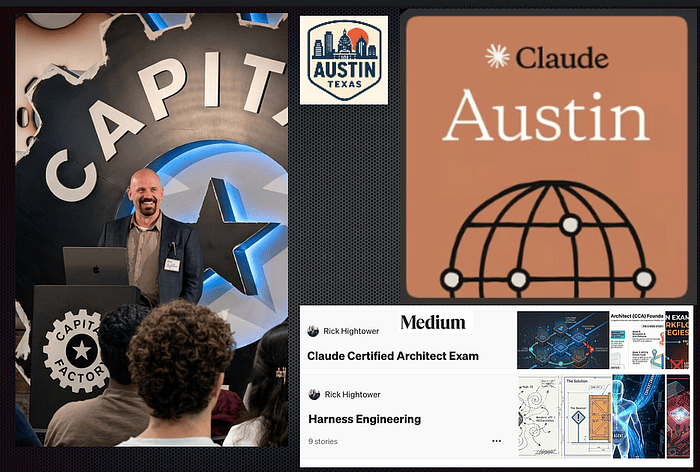
Rick Hightower is a former Senior Director of Data Engineer at a fortune 100 fintech focusing on delivering ML / AI insights to intelligent front line applications. He is now a practitioner building multi-agent production systems, and advising fortune 100 companies on AI adoption and harness engineering. Follow him on Medium for more hands-on agent engineering content. You can also book him to speak and train your team: Check out Rick Hightower's SpeakerHub.
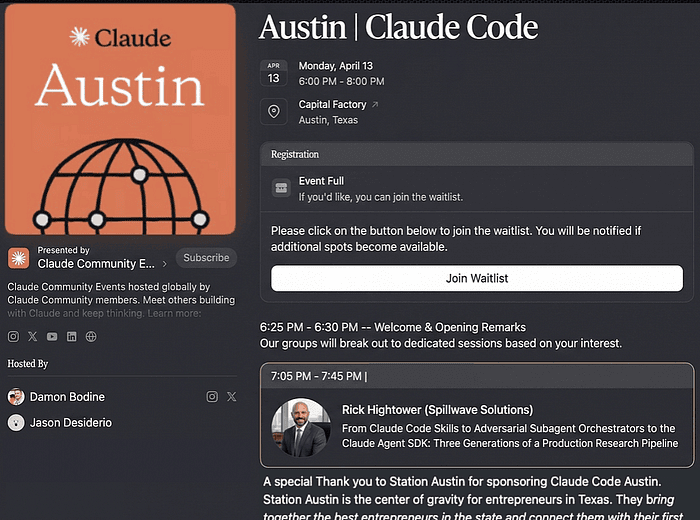
He created skilz, the universal agent skill installer, supporting 30+ coding agents including Claude Code, Gemini, Copilot, and Cursor, and co-founded the world's largest agentic skill marketplace. Connect with Rick Hightower on LinkedIn or Medium. Check out SpillWave, your source for AI expertise.
Rick has been actively developing generative AI systems, agents, and agentic workflows for years. He is the author of numerous agentic frameworks and developer tools and brings deep practical expertise to teams looking to adopt AI. He enjoys writing about himself in the 3rd person.
Rick also wrote a Claude Certified Architect (CCA) series of articles that have a lot of useful information on writing agentic AI systems. If you want to improve your ability to create well-behaved AI agents, studying for the CCA Exam is a good place to start.
CCA Exam Prep on Agentic Development
- Claude Certified Architect: The Complete Guide to Passing the CCA Foundations Exam
- CCA Exam Prep: Mastering the Code Generation with Claude Code Scenario
- CCA Exam Prep: Mastering the Multi-Agent Research System Scenario
- CCA Exam Prep: Structured Data Extraction
- CCA: Master the Developer Productivity Scenario
- Claude Certified Architect: Master the CI/CD Scenario
- CCA Exam Prep: Mastering the Customer Support Resolution Agent Scenario
Rick also wrote a series on harness engineering and how to improve agentic systems using harness engineering for feedback loops and adversarial agents. These articles also go hand in hand with this article.
Harness Engineering Articles
- The $9 Disaster: What Anthropic's Harness Design Paper Teaches Us About Building Autonomous AI
- Harness Engineering vs Context Engineering: The Model is the CPU, the Harness is the OS
- LangChain Deep Agents: Harness and Context Engineering: Memory, Skills, and Security
- Beyond the AI Coding Hangover: How Harness Engineering Prevents the Next Outage
- LangChain's Harness Engineering: From Top 30 to Top 5 on Terminal Bench 2.0
- Anthropic's Harness Engineering: Two Agents, One Feature List, Zero Context Overflow
- OpenAI's Harness Engineering Experiment: Zero Manually-Written Code