Understanding OpenAI's o-Series: The Evolution of AI Reasoning Models
Originally published on Medium.
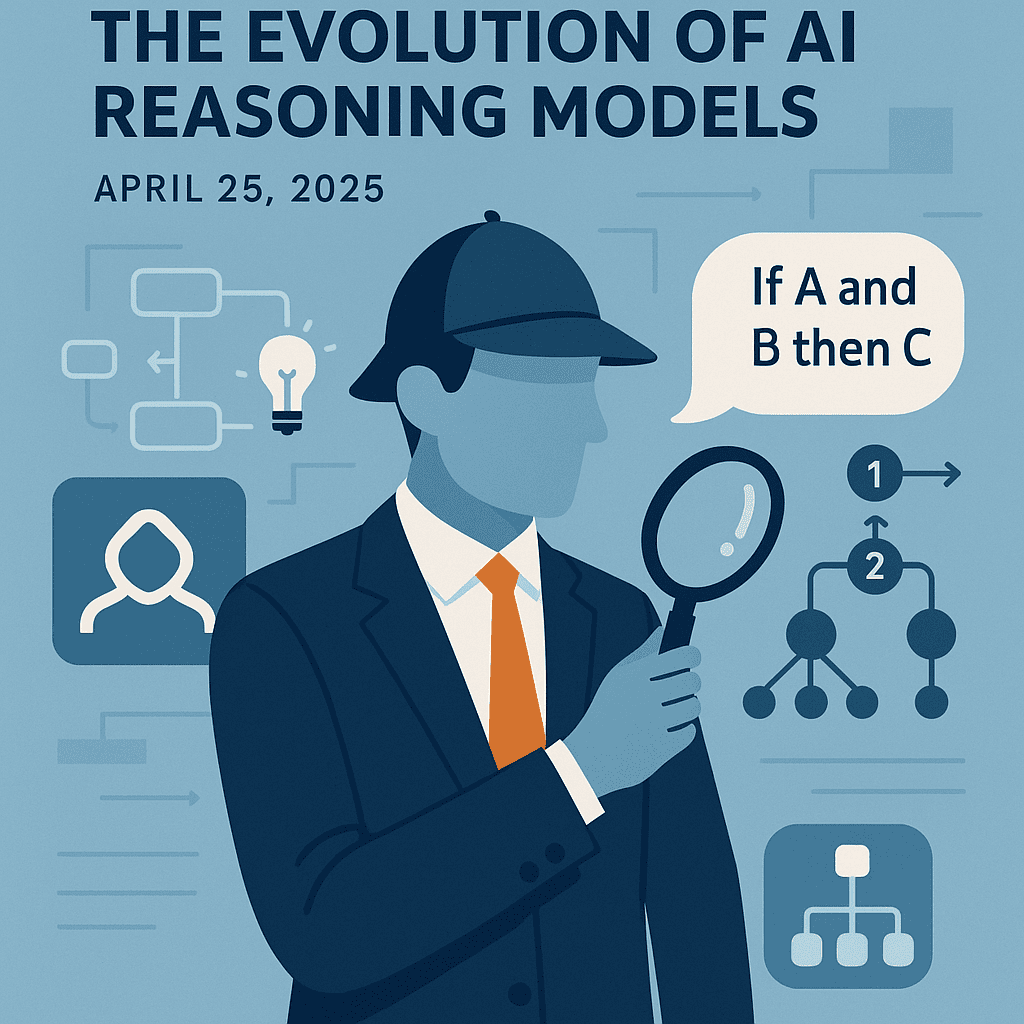
Discover AI’s Next Evolution OpenAI’s o-Series models are transforming machine reasoning through advanced logical deduction and multi-step planning capabilities. The o4-mini model offers enhanced context windows, accuracy, and tool support for complex tasks, enabling more sophisticated AI applications. Well-suited for enterprise use, it delivers robust reasoning and decision-making while maintaining cost-effectiveness. This makes it ideal for organizations seeking to improve their AI capabilities without compromising performance. We also compare o-Series models to their competitors.
The landscape of AI models is evolving rapidly, with specialized models designed for specific tasks becoming increasingly important. In this article, I’ll explore OpenAI’s o-series models, which represent a significant advancement in AI reasoning capabilities.
What Makes Reasoning Models Different?
Imagine a skilled detective investigating a complex crime scene. They don’t just list objects they see; they analyze blood spatter patterns, connect footprints to witness statements, deduce motives, and build a logical sequence of events. Standard AI models might excel at describing the scene, but reasoning models act like that detective -- delving deeper, performing logical deductions, solving complex problems, and planning multi-step actions.
These specialized AI systems are designed specifically for tasks demanding logical deduction, inference, planning, and multi-step problem-solving. Unlike standard language models that excel primarily at generating fluent text, reasoning models can understand abstract concepts, identify logical structures, and connect disparate pieces of information to reach well-supported conclusions.
This article is based on this chapter in this book if you want more details.
The o-Series Model Lineup
OpenAI’s o-series models are purpose-built for logical deduction, multi-step planning, and STEM tasks. They’re tuned to “spend more internal tokens thinking before speaking,” yielding higher accuracy on math, code, and complex planning benchmarks.
The current lineup includes:
Generation Models Context Window Reasoning Depth Tool Support Status o3 o3 128K Highest Full Generally Available o3-mini o3-mini 32K High (70–80% of o3) Limited Generally Available o4-mini o4-mini 128K High Full Generally Available (since Apr 16, 2025) o4 o4-preview 256K (target) Highest Full Developer Preview Only
Key Improvements in the o4 Generation
The o4 generation represents OpenAI’s next step in dedicated reasoning models. The o4-mini model, which is now generally available, addresses many limitations of o3-mini:
- Larger context with no latency penalty: o4-mini provides a 4x increase in context window (from 32K to 128K tokens) yet remains faster than o3-mini at the same reasoning effort level.
- Full tool support: Unlike o3-mini, o4-mini can browse the web, run Python, analyze files/images, call functions, and generate images through the standard Chat Completions API.
- Higher accuracy: Benchmarks show o4-mini achieving parity with o3 “medium effort” and clear wins over o3-mini on mathematical reasoning, science questions, and software engineering tasks.
- Enhanced reasoning capability: The reasoning_effort parameter continues to function effectively, with “high” settings yielding deeper chains of thought while keeping costs significantly below o3.
The full o4 model, still in limited developer preview, promises even more capabilities:
- 256K target context window for very long research and reasoning chains
- Built-in reasoning summaries via the reasoning_summary=detailed parameter
- Better tool orchestration with more deterministic parallel function calls
Important Parameters for o-Series Models
When working with o-series models, you’ll need to understand some important API parameters:
max_completion_tokens replaces max_tokens
- max_tokens is rejected by every o-series model.
- Use max_completion_tokens instead.
- Most client libraries added this field in late 2024; upgrade to ≥ openai-python 1.14 to avoid errors.
reasoning_effort -- the "think-time" dial
reasoning_effort: "low" | "medium" | "high" # default = "medium"
- High → more hidden reasoning tokens → better accuracy but higher latency/cost.
- Low → fewer reasoning tokens → faster, cheaper replies (good for trivial tasks).
Quick-Start Python Example
Here’s a simple example of using o4-mini with the OpenAI API:
import os, openai
from dotenv import load_dotenv
load_dotenv()
openai.api_key = os.getenv("OPENAI_API_KEY")

response = openai.chat.completions.create(
    model="o4-mini",  # Using the newest generally available model
    messages=[
        {"role": "system",
         "content": "You are a careful math tutor. Think step-by-step."},
        {"role": "user",
         "content": "Prove that the sum of the first n odd numbers is n^2."}
    ],
    reasoning_effort="high",          # give it more "think time"
    max_completion_tokens=512,
    temperature=0.2
)
print(response.choices[0].message.content)
Effective Prompting for Reasoning Models
When working with reasoning models, certain prompting techniques become especially valuable:
- Ask for chain-of-thought explicitly: “Show your reasoning before the final answer.”
- Provide intermediate scratch-pads: Guide multi-step deduction with sub-questions.
- Use structure tags:
... tags let you strip internal reasoning later. - Include few-shot demonstrations: Examples with both reasoning steps and final answers reduce hallucinated logic leaps.
Migration Decision Guide
Wondering whether to migrate to the newest models? Here’s a quick decision chart:
Use-case Stay on o3 Switch to o4-mini Wait for o4 Low-volume, highest accuracy required ✓ High-volume chat, code review bots ✓ Long research briefs (>128K) ✓ Fine-tuned domain model None of these (no o-series fine-tuning yet)
Remaining Limitations to Be Aware Of
Despite the improvements, o4-mini still has some limitations to consider:
- Fine-tuning: Not supported for any o-series model (though OpenAI indicates it’s “on the roadmap”).
- Parameter compatibility: Some libraries still reject reasoning_effort or max_completion_tokens.
- Vision token cost: Image inputs consume large token blocks, with each 512×512 image tile using approximately 5,667 tokens.
- Occasional hallucinations: While improved over o3-mini, the model still sometimes hallucinates on edge cases.
Migration Checklist
If you’re planning to adopt o-series models, here’s a migration checklist:
- Update SDKs (OpenAI Python ≥ 1.14, JS ≥ 4.5).
- Replace every max_tokens with max_completion_tokens.
- Decide on a global default for reasoning_effort (start with medium).
- Add regression tests measuring accuracy vs. latency at each effort level.
- For most production reasoning tasks, default to o4-mini-medium for the best price/quality balance.
Open AI reasoning models are arguably the best as of April 2025 as all-around reasoning models. They do have competitors. You can get reasoning models even if you have to target Bedrock or Vertex.
Competitive Landscape: Alternative Reasoning Models
Several AI platforms offer specialized reasoning models that compete with OpenAI’s o3 and o4 models. Here’s how they compare across the major platforms:
Google VertexAI
- Gemini Ultra: Google’s flagship model leads in mathematical reasoning with AlphaCode 2 integration and strong multimodal analysis capabilities. It offers robust tool integration but comes with enterprise pricing and a steeper learning curve compared to OpenAI’s offerings.
- Gemini Pro: Offers a balance between performance and cost efficiency, with solid reasoning capabilities for everyday use cases, though not as powerful as Gemini Ultra for complex mathematical problems.
Amazon Bedrock
- Claude 3 Opus: Anthropic’s general-purpose model available on AWS Bedrock offers state-of-the-art reasoning (MMLU: 86.8%) and 200K token context. It excels in long-context analysis but has higher latency and a more complex API.
- Claude 3 Sonnet: Balances speed and accuracy, preferred in 60–80% of expert evaluations, making it competitive with o4-mini in many use cases.
- Amazon Titan Models: While not specifically focused on reasoning like the dedicated o-series, Titan models support various reasoning tasks and are optimized for AWS integration.
Perplexity AI
Perplexity offers several specialized reasoning models tailored for different use cases:
- DeepSeek-R1: An open-source reasoning specialist with 671B mixture-of-experts parameters, 128K token context, and 32K reasoning tokens. It offers a 27x cost advantage over o1 and transparent reasoning logs, though it has less tool integration than OpenAI models.
- sonar-reasoning-pro: Perplexity’s premier reasoning offering powered by DeepSeek R1 with Chain of Thought capabilities, designed for complex multi-step tasks.
- sonar-reasoning: A faster real-time reasoning model designed for quick problem-solving with integrated search capabilities.
- sonar-deep-research: An expert-level research model that conducts exhaustive searches and generates comprehensive reports, ideal for in-depth analysis across multiple information sources.
Comparative Analysis
Model Platform Strengths Limitations o4-mini OpenAI / Azure Best cost/performance balance, full tool support Limited context vs. full o4 Claude 3 Opus AWS Bedrock / Anthropic Highest benchmark scores, long-context analysis Higher latency, complex API Gemini Ultra Google VertexAI Multimodal integration, competition-grade math Enterprise pricing, steep learning curve Amazon Titan AWS Bedrock / Anthropic Strong AWS integration, good general reasoning Less specialized than dedicated reasoning models DeepSeek-R1 Perplexity / (many others) Cost advantage, transparent reasoning logs Less tool integration than OpenAI sonar-reasoning-pro Perplexity Specialized reasoning with search integration Best for specific use cases rather than general applications
Each platform offers unique advantages: Google VertexAI excels in mathematical and multimodal reasoning, AWS Bedrock provides enterprise-grade integration with Claude’s reasoning capabilities, and Perplexity differentiates itself with cost-effective specialized research models and integrated search capabilities.
I tend to mix and match models and try different combinations for different tasks.
def init_default_providers(llm_manager):
    # Register available providers
    # gemini-pro, gemini-think, gemini-flash

    try:
        google_provider = GoogleGeminiProvider(model="gemini-2.0-flash")
        llm_manager.register_provider("gemini-flash", google_provider)
        logger.info("Registered Google Flash provider")
    except Exception as e:
        logger.warning(f"Failed to initialize Google Flash provider: {e}")
    try:
        google_provider = GoogleGeminiProvider(model="gemini-2.0-flash")
        llm_manager.register_provider("google-flash", google_provider)
        logger.info("Registered Google Flash provider")
    except Exception as e:
        logger.warning(f"Failed to initialize Google Flash provider: {e}")
    try:
        google_provider = GoogleGeminiProvider(model="gemini-2.5-pro-preview-03-25")
        llm_manager.register_provider("gemini-pro", google_provider)
        logger.info("Registered Google provider")
    except Exception as e:
        logger.warning(f"Failed to initialize Google Pro provider: {e}")
    ...
    ...
    # Try to register OpenAI as a fallback provider
    try:
        openai_provider = OpenAIProvider()
        llm_manager.register_provider("openai", openai_provider)
        logger.info("Registered OpenAI provider")
    except Exception as e:
        logger.warning(f"Failed to initialize OpenAI provider: {e}")
    try:
        openai_provider = OpenAIProvider(model="gpt-4o-2024-08-06")
        llm_manager.register_provider("gpt-4o", openai_provider)
        logger.info("Registered OpenAI provider gpt-4o")
    except Exception as e:
        logger.warning(f"Failed to initialize gpt-4o OpenAI provider: {e}")
    try:
        openai_provider = OpenAIProvider(model="o3-mini-2025-01-31")
        llm_manager.register_provider("o3-mini", openai_provider)
        logger.info("Registered OpenAI provider")
    except Exception as e:
        logger.warning(f"Failed to initialize o3-mini OpenAI provider: {e}")
    try:
        openai_provider = OpenAIProvider(model="gpt-4o-mini-2024-07-18")
        llm_manager.register_provider("gpt-4o-mini", openai_provider)
        logger.info("Registered OpenAI provider gpt-4o-mini")
    except Exception as e:
        logger.warning(f"Failed to initialize gpt-4o-mini OpenAI provider: {e}")
    try:
        openai_provider = OpenAIProvider(model="gpt-4o-search-preview-2025-03-11")
        llm_manager.register_provider("gpt-4o-search", openai_provider)
        logger.info("Registered OpenAI provider gpt-4o-search")
    except Exception as e:
        logger.warning(f"Failed to initialize gpt-4o-search OpenAI provider: {e}")

    ...
    ...
    try:
        perplexity_provider = PerplexityProvider()
        llm_manager.register_provider("perplexity", perplexity_provider)
        logger.info("Registered Perplexity provider")
    except Exception as e:
        logger.warning(f"Failed to initialize Perplexity provider: {e}")

    try:
        perplexity_provider = PerplexityProvider(model="sonar")
        llm_manager.register_provider("sonar", perplexity_provider)
        logger.info("Registered Perplexity provider")
    except Exception as e:
        logger.warning(f"Failed to initialize Perplexity provider: {e}")

    try:
        perplexity_provider = PerplexityProvider(model="sonar-reasoning")
        llm_manager.register_provider("sonar-reasoning", perplexity_provider)
        logger.info("Registered Perplexity provider")
    except Exception as e:
        logger.warning(f"Failed to initialize Perplexity provider: {e}")

    try:
        perplexity_provider = PerplexityProvider(model="sonar-reasoning-pro")
        llm_manager.register_provider("sonar-reasoning-pro", perplexity_provider)
        logger.info("Registered Perplexity provider")
    except Exception as e:
        logger.warning(f"Failed to initialize Perplexity provider: {e}")

    try:
        anthropic_provider = AnthropicProvider()
        llm_manager.register_provider("anthropic", anthropic_provider)
        logger.info("Registered Anthropic provider")
    except Exception as e:
        logger.warning(f"Failed to initialize Anthropic provider: {e}")

    ...
If you enjoyed this article, check out this chapter in this book.
Conclusion
The o-series models represent a significant advancement in AI reasoning capabilities. While o3 and o3-mini laid the groundwork, o4-mini now offers the best balance of reasoning capability, tool support, and cost efficiency for most applications. The full o4 model, when it becomes generally available, will provide even greater capabilities for the most demanding reasoning tasks.
By understanding the strengths, limitations, and proper usage of these models, developers can build more sophisticated applications capable of complex problem-solving, planning, and analysis.
Have you experimented with the o-series models yet? Share your experiences in the comments below!
About the Author
Rick Hightower is a seasoned technology expert and AI enthusiast with extensive experience in enterprise software development and cloud architecture. As a respected voice in the AI community, Rick specializes in evaluating and implementing cutting-edge AI models for practical business applications. He regularly shares insights about emerging AI technologies and their real-world implications through technical articles and conference presentations.
Connect with Rick: LinkedIn