Wall Street's $3.7 Quadrillion Problem — From T+2 to T+0 on Blockchain and Ethereum
Part 1 of Rewiring Wall Street: The Institutional Ethereum Revolution
Originally published on Medium.
Part 1 of Rewiring Wall Street: The Institutional Ethereum Revolution
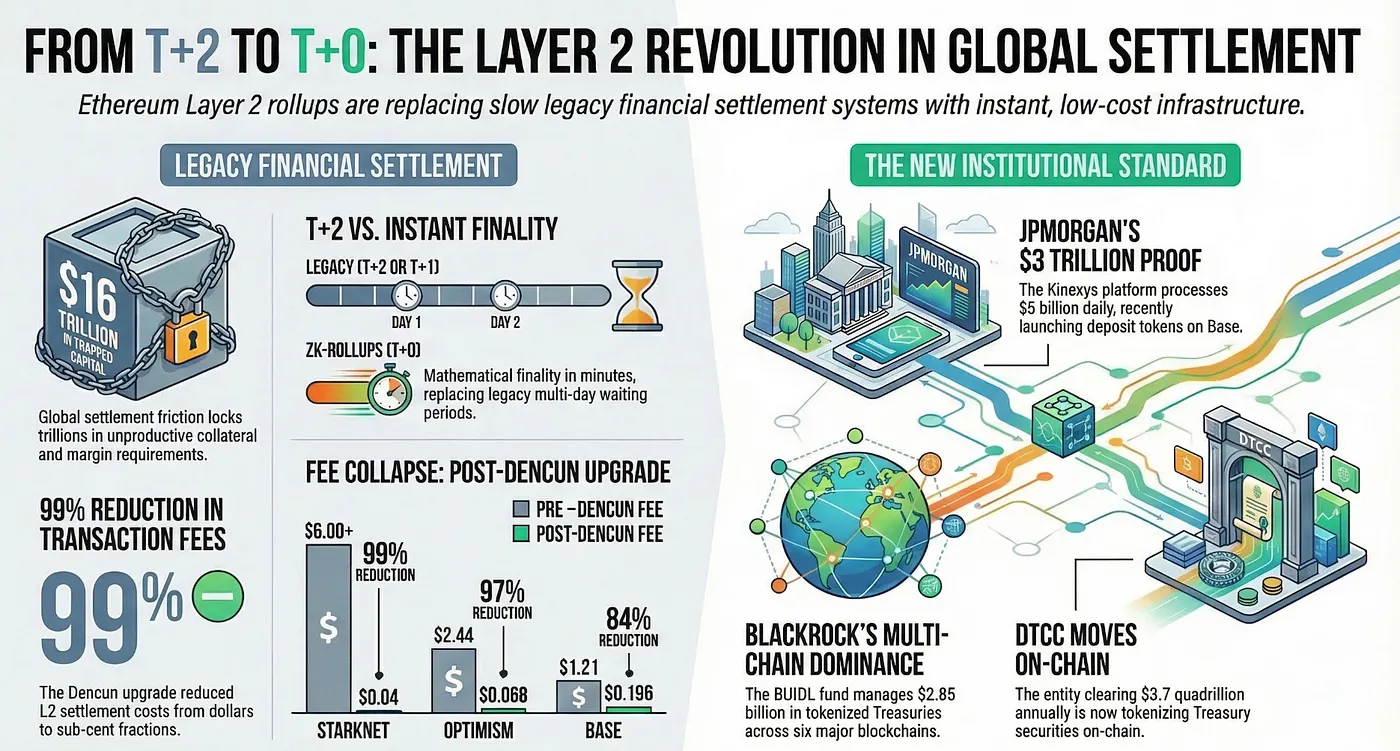
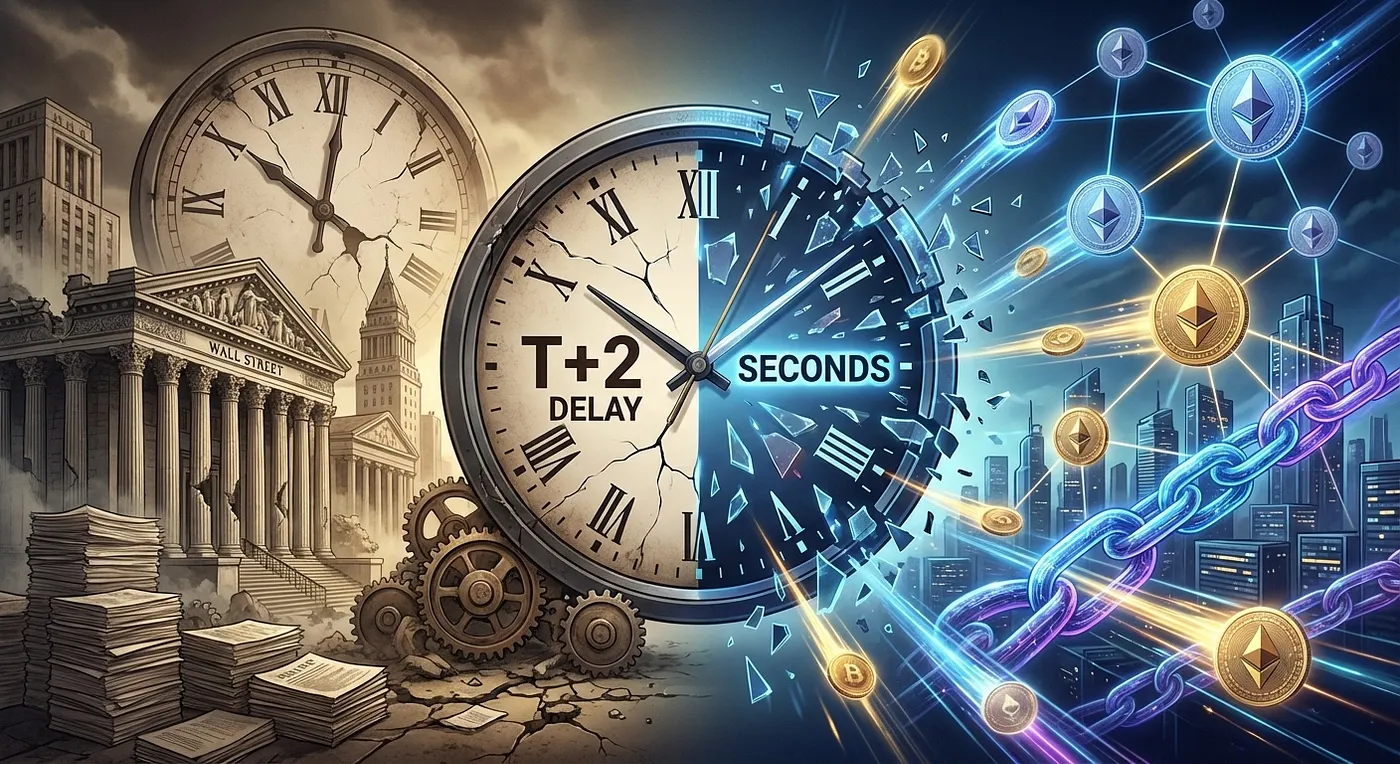 T+0 transaction speed reduces friction
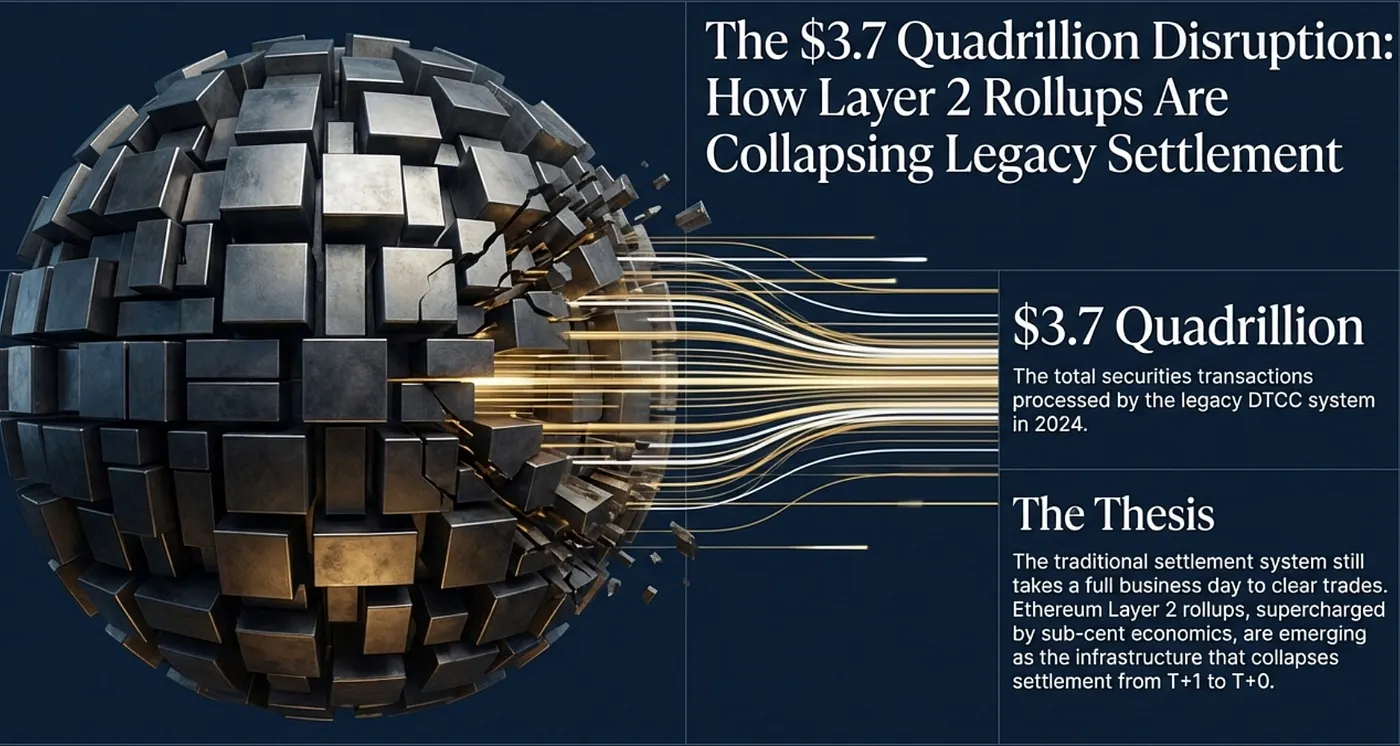
Every business day, DTCC processes roughly $10 trillion in securities transactions through a settlement system designed decades ago. Layer 2 rollups are coming for every dollar of it.
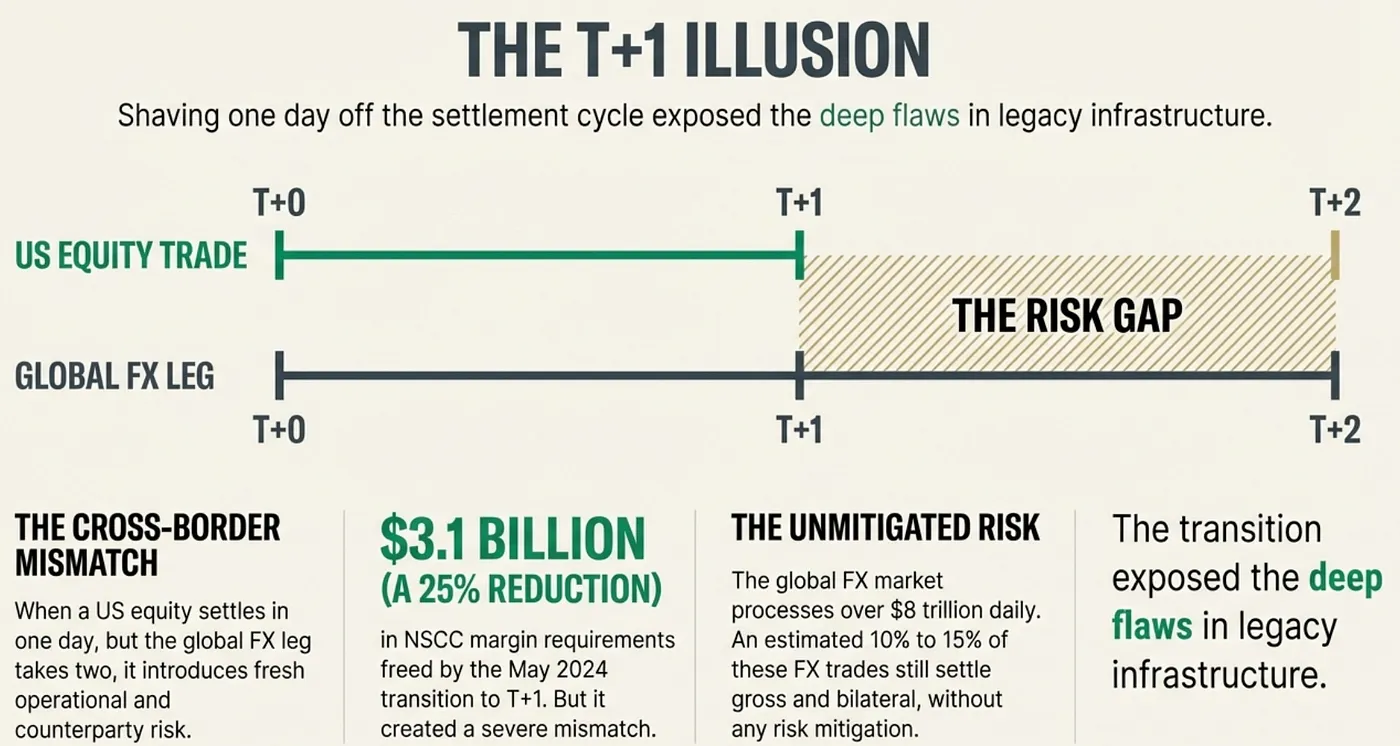
The National Securities Clearing Corporation (NSCC) is a subsidiary of the Depository Trust & Clearing Corporation (DTCC) and serves as the central counterparty for virtually all broker-to-broker trades in US equities, corporate bonds, and municipal securities. When two parties execute a trade, the NSCC steps between them, becoming the buyer to every seller and the seller to every buyer. This “novation” eliminates bilateral counterparty risk and allows the NSCC to net offsetting trades, dramatically reducing the number of settlements required. The NSCC clearing fund, collateral posted by members to cover potential defaults, is calibrated based on settlement risk. Shortening the settlement cycle from T+2 to T+1 reduced this fund by 25%, freeing billions in capital that had been locked as a cushion against multi-day exposure.
FX (foreign exchange) trades involve the exchange of one currency for another, such as converting US dollars to Euros. The global FX market processes over $8 trillion daily through CLS Bank across 18 currencies. Unlike equities that moved to T+1 in the US, most FX trades still settle at T+2, meaning the actual exchange of currencies occurs two business days after the trade is executed. When a cross-border equity trade settles at T+1 but its associated FX leg settles at T+2, the mismatch creates operational complexity and additional counterparty risk, as one half of the transaction completes before the other.
In financial markets, friction refers to the operational, capital, and risk costs that arise from delays in the settlement process. These frictions include:
Collateral requirements
Counterparty credit risk
Reconciliation overhead
Failed trade penalties
Cross-border and cross-asset mismatches
Each additional settlement day multiplies these costs across trillions in daily volume.
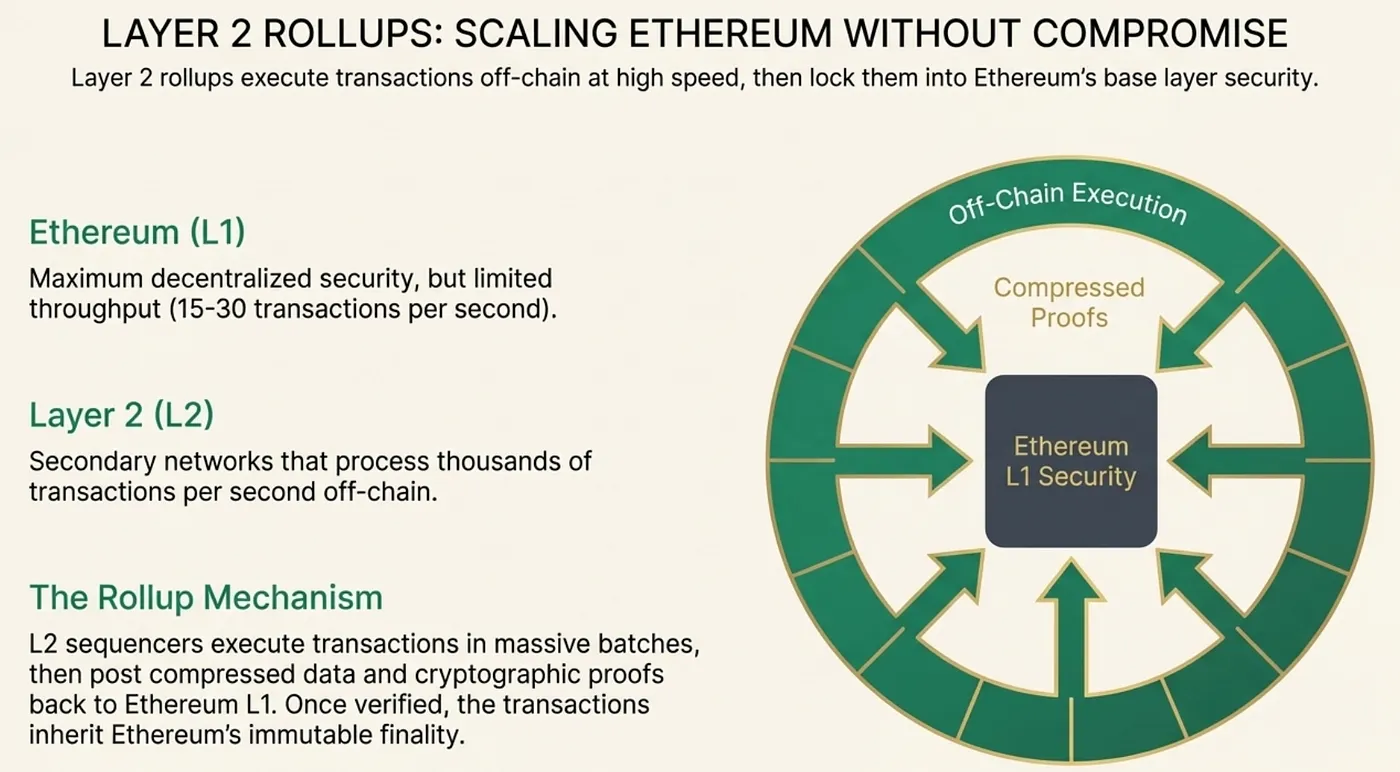
Ethereum (Ethereum L1) is the main Ethereum blockchain, a decentralized public ledger secured by thousands of validators worldwide. Every transaction on Ethereum L1 is verified by the entire network, providing maximum security but limited throughput (roughly 15–30 transactions per second) and higher costs during periods of network congestion.
Layer 2 (L2) refers to secondary networks built on top of Ethereum that inherit its security while dramatically increasing transaction speed and reducing costs. Layer 2 networks process transactions separately from Ethereum L1, then post compressed proofs back to L1 for final settlement.
Off-chain means transaction execution happens outside the main Ethereum blockchain. In the context of Layer 2 rollups, transactions execute off-chain on the L2 network at high speed and low cost, then the results are posted back to Ethereum L1 with cryptographic proofs. This allows thousands of transactions per second while still inheriting Ethereum’s security guarantees once the proof is verified on-chain.
DeFi (Decentralized Finance) refers to financial services built on blockchain networks that operate without traditional intermediaries like banks or brokerages. DeFi protocols enable lending, borrowing, trading, and earning yield directly through smart contracts.
Total Value Locked (TVL) measures the total dollar value of all assets deposited in DeFi protocols on a particular blockchain or network. It’s a key metric for assessing the size and adoption of a DeFi ecosystem.
Layer 2 DeFi TVL specifically measures the value locked across all DeFi protocols operating on Layer 2 networks (like Base, Arbitrum, and Optimism) rather than on Ethereum’s main chain.
When we say “Base commands approximately 46.58% of all Layer 2 DeFi total value locked,” it means that nearly half of all the capital deployed in DeFi applications across all Ethereum Layer 2 networks is on Coinbase’s Base network. Combined with Arbitrum’s 30.86%, these two optimistic rollups control over three-quarters of the entire L2 DeFi ecosystem, demonstrating the current market dominance of optimistic rollup architecture despite the settlement advantages of ZK rollups which will cover shortly.
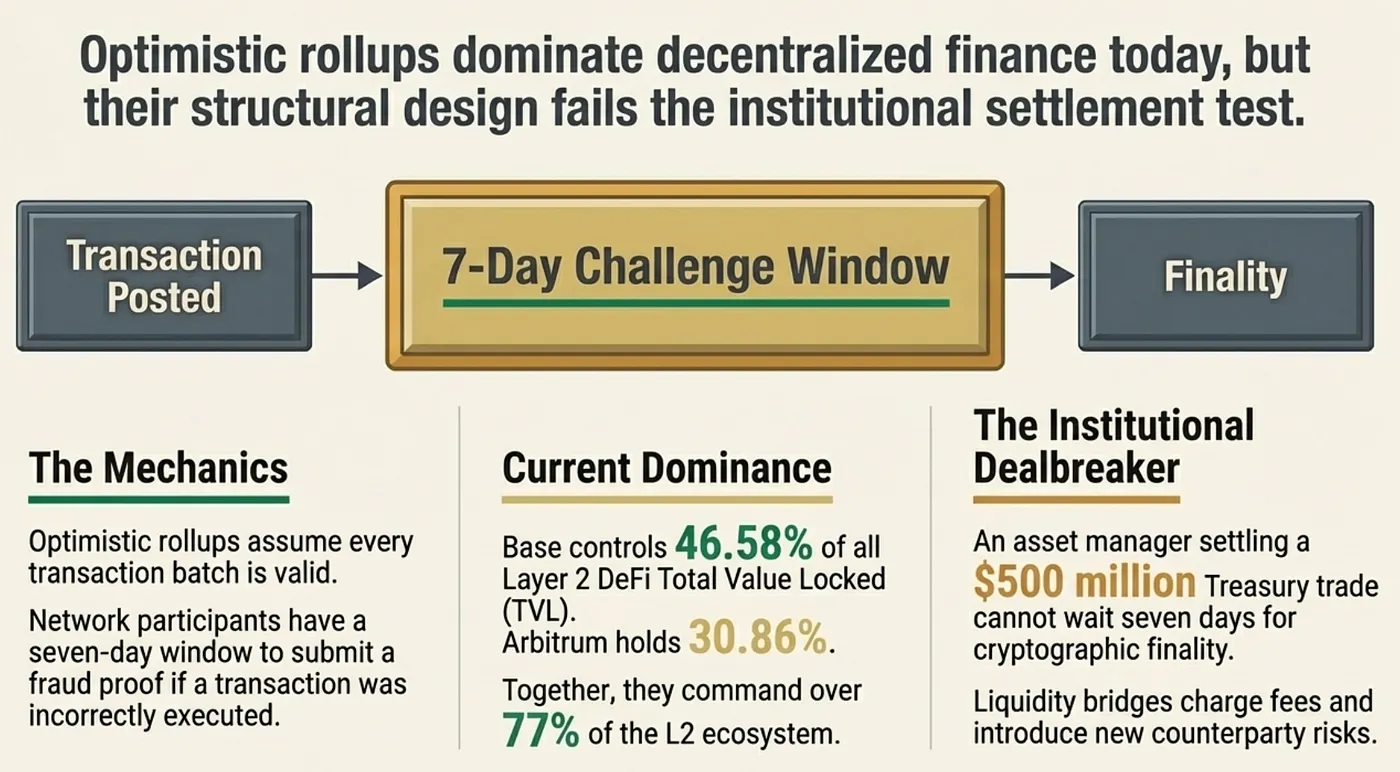
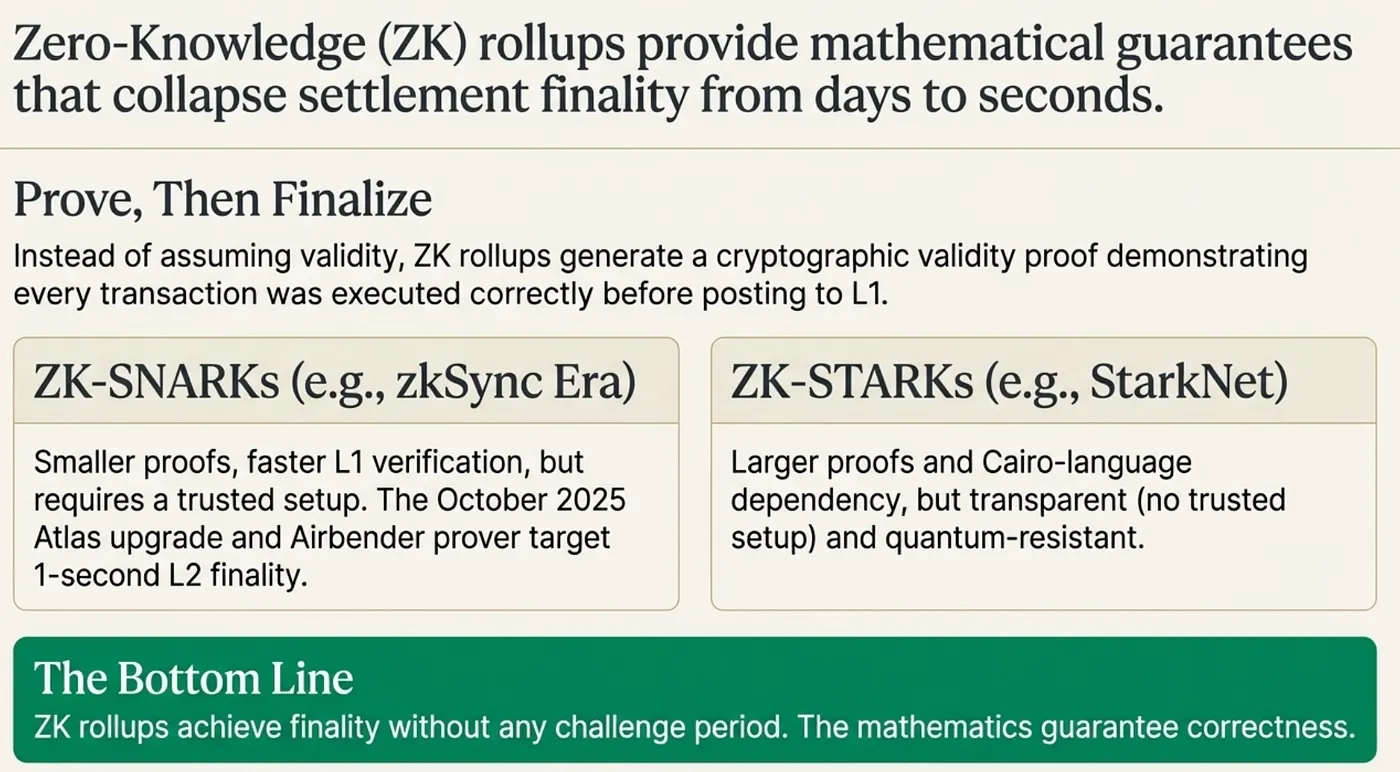
ZK rollups are Layer 2 scaling solutions that use zero-knowledge proofs to verify transaction validity. Unlike optimistic rollups that assume validity and allow challenges, ZK rollups generate mathematical proofs that transactions were executed correctly before posting them to Ethereum L1.
ZK-SNARK (Zero-Knowledge Succinct Non-Interactive Argument of Knowledge) is a type of cryptographic proof that allows one party to prove they know certain information without revealing the information itself. SNARKs produce very small proofs (often just a few hundred bytes) that can be verified quickly on Ethereum L1. However, they require a “trusted setup” ceremony where initial parameters are generated — if this setup is compromised, the security of the entire system could be at risk.
ZK-STARK (Zero-Knowledge Scalable Transparent Argument of Knowledge) is an alternative proof system that does not require a trusted setup, making it “transparent.” STARKs are generally larger in size than SNARKs and more expensive to verify on-chain, but they offer stronger security guarantees against quantum computing attacks and eliminate the trusted setup risk entirely.
zkSync Era is a major ZK rollup built by Matter Labs that uses ZK-SNARKs for its validity proofs. It achieves full EVM compatibility, meaning existing Ethereum smart contracts can deploy without modification. As mentioned earlier, zkSync Era currently has approximately $839 million in total value locked and is working toward sub-minute L1 finality through upgrades to its proof generation and verification systems.
The Atlas upgrade (October 2025) was a major milestone for zkSync Era that introduced the Atlas sequencer for faster transaction ordering, ZKsync OS as the network’s operating system layer, and the Airbender prover for accelerated proof generation. The upgrade targets one-second finality at the L2 level with ongoing compression of the time required for L1 verification, bringing zkSync Era closer to institutional-grade settlement speeds.
StarkNet is a ZK rollup developed by StarkWare that uses ZK-STARKs rather than SNARKs. With approximately $593 million in TVL as of early 2025, StarkNet offers the advantage of no trusted setup and stronger theoretical security guarantees. However, it uses the Cairo programming language instead of the Ethereum Virtual Machine (EVM), meaning developers must write contracts specifically for StarkNet rather than porting existing Ethereum code. This creates a tradeoff: stronger cryptographic foundations but a steeper learning curve for developers already familiar with Solidity and the EVM ecosystem.
For institutional settlement, the choice between SNARK-based and STARK-based rollups represents a tradeoff between proof size and verification cost (favoring SNARKs) versus transparency and quantum resistance (favoring STARKs). Both approaches are converging on finality windows measured in minutes to hours rather than days, making either architecture viable for next-generation settlement infrastructure.
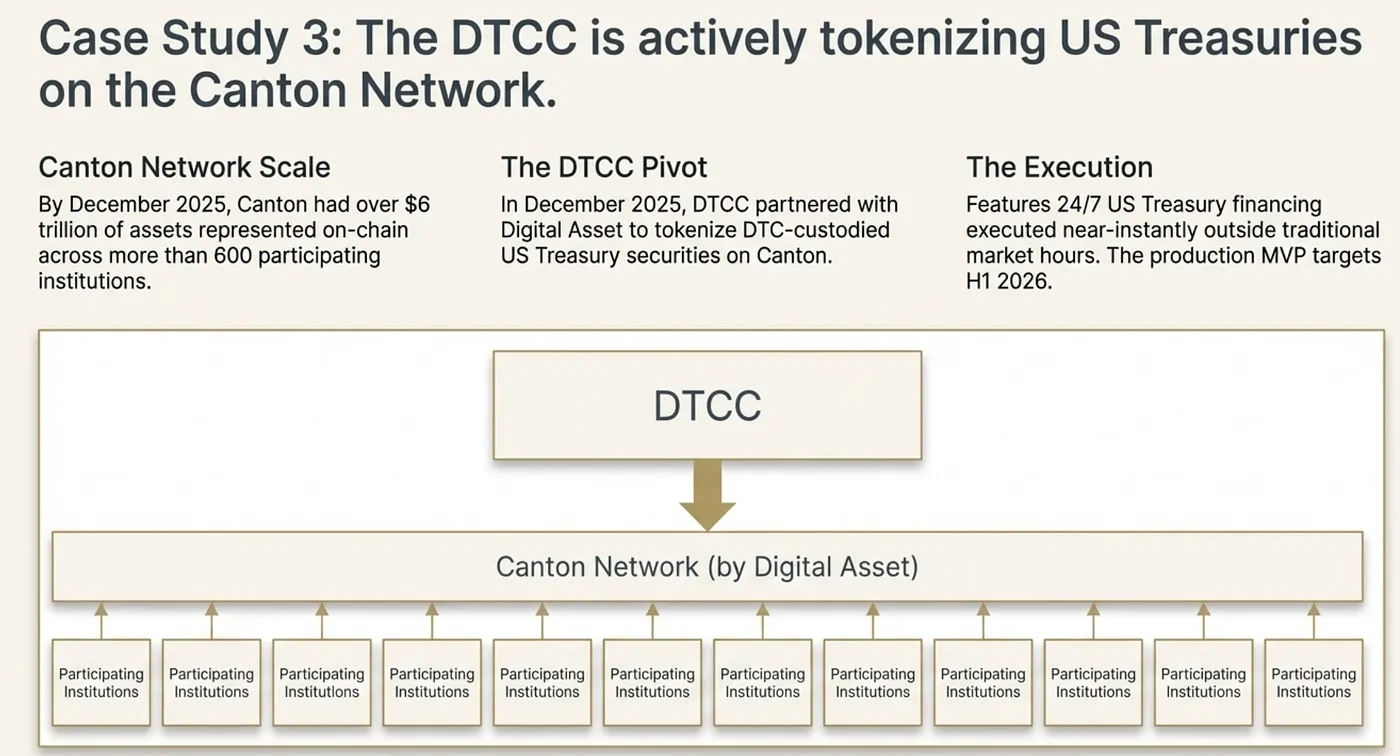
- Canonical asset ratio (20% weight): What percentage of assets originate from and settle on Ethereum L1?
- Canonical bridge usage (20% weight): Does the L2 rely on trustless Ethereum bridges or external alternatives?
- Settlement latency (20% weight): How quickly does the L2 achieve Ethereum-level finality?
- Censorship resistance (30% weight): Can users force-include transactions if the sequencer censors them?
-
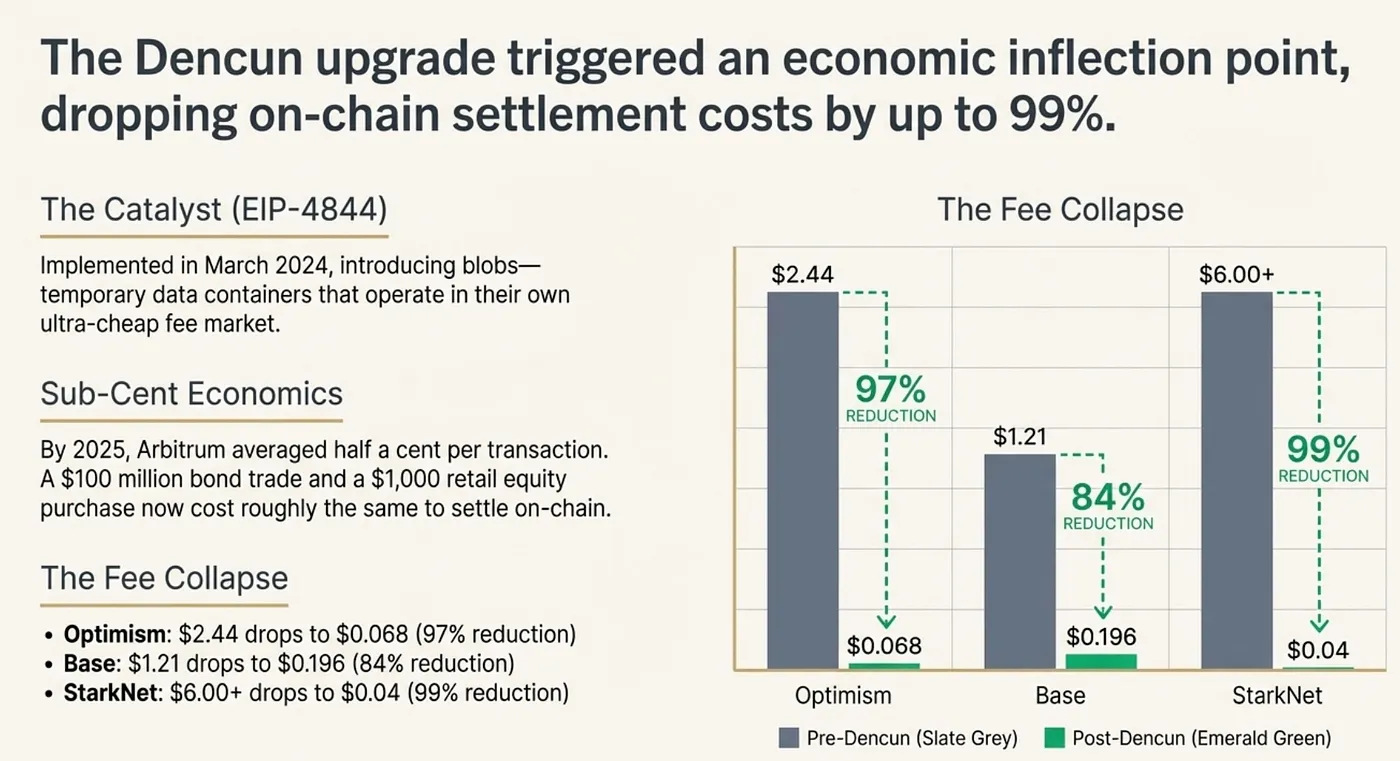
Arbitrum: A Layer 2 scaling solution for Ethereum that uses optimistic rollup technology. Arbitrum bundles multiple transactions together and posts them to Ethereum’s main chain, reducing costs while maintaining security. As of 2025, Arbitrum averages roughly half a cent per transaction and recorded a peak of 5.95 million daily transactions in September 2025.
-
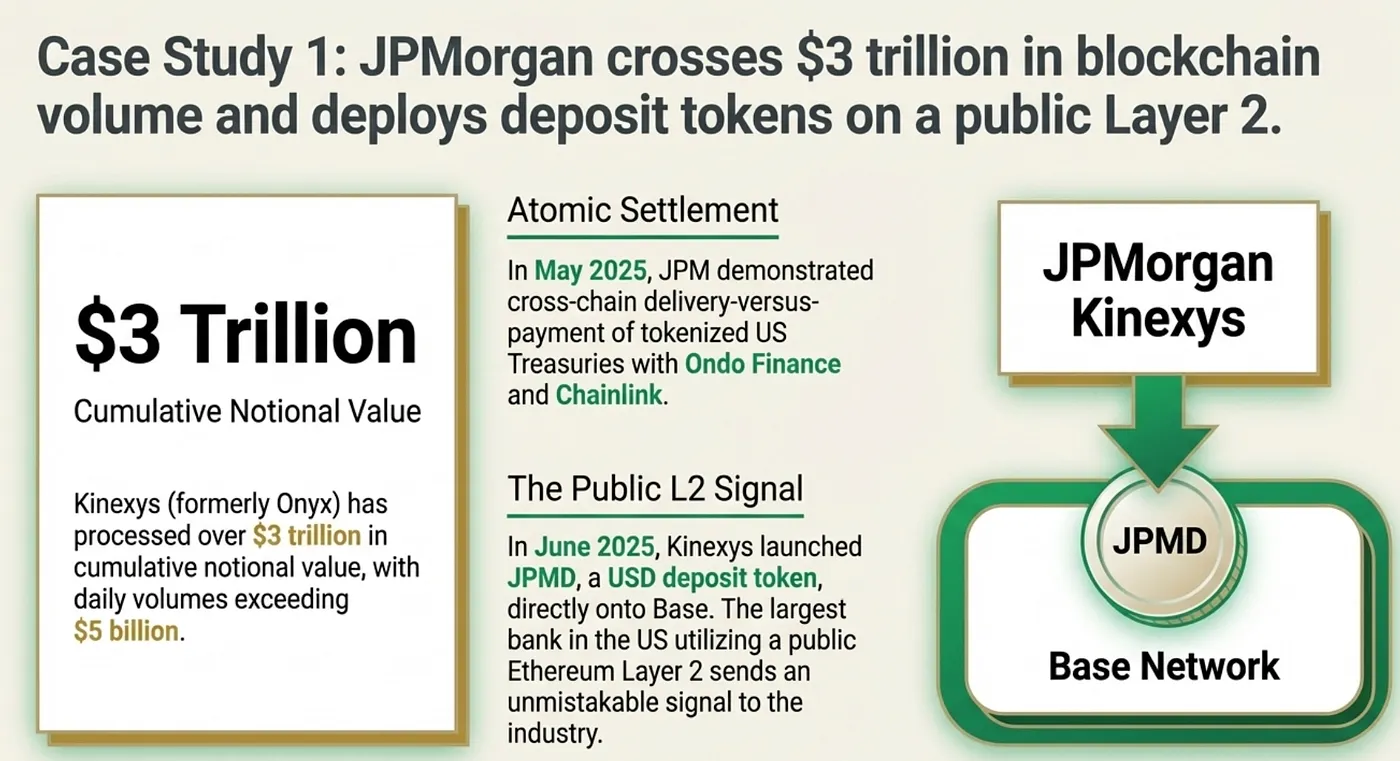
Base: A Layer 2 network built by Coinbase on top of Ethereum using Optimism’s technology stack. Base provides lower transaction costs and faster settlement while inheriting Ethereum’s security. JPMorgan used Base to launch JPMD, its USD deposit token, in June 2025.
-
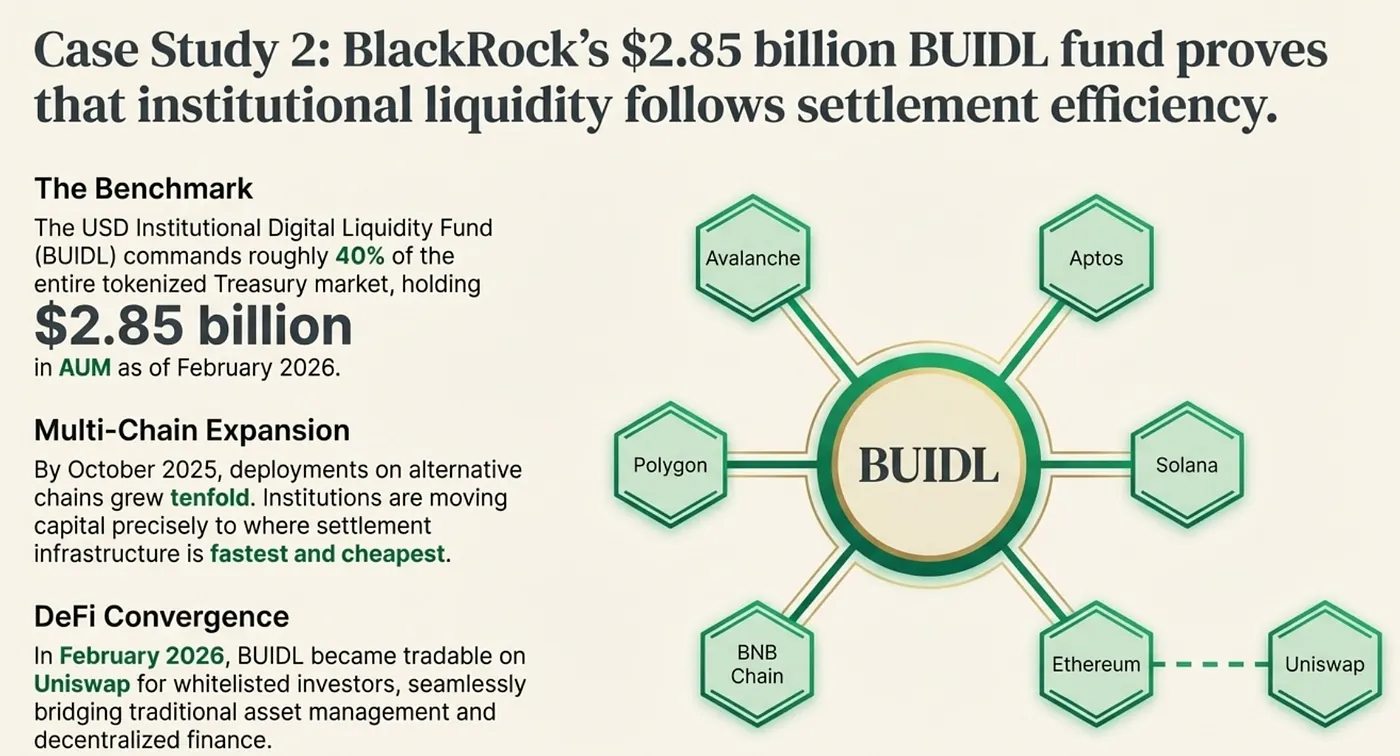
BlackRock: The world’s largest asset manager. BlackRock launched the USD Institutional Digital Liquidity Fund (BUIDL) in March 2024, which has become the benchmark for institutional tokenization of Treasury securities. As of February 2026, BUIDL holds approximately $2.85 billion in assets.
-
Blob: A new type of data storage introduced by Ethereum’s EIP-4844 upgrade. Blobs are temporary data containers (approximately 125 KB each) that Layer 2 networks use to post transaction data to Ethereum at dramatically reduced cost. Blobs are automatically deleted after about 18 days, but remain available long enough to verify transactions.
-
BUIDL (BlackRock USD Institutional Digital Liquidity Fund): BlackRock’s tokenized money market fund launched in March 2024. BUIDL invests in cash, US Treasury bills, and repurchase agreements, and is represented as tokens on multiple blockchains including Ethereum, Avalanche, Aptos, Polygon, Solana, and BNB Chain. It surpassed $1 billion in assets by early 2025 and holds approximately $2.85 billion as of February 2026, commanding roughly 40% of the tokenized Treasury market.
-
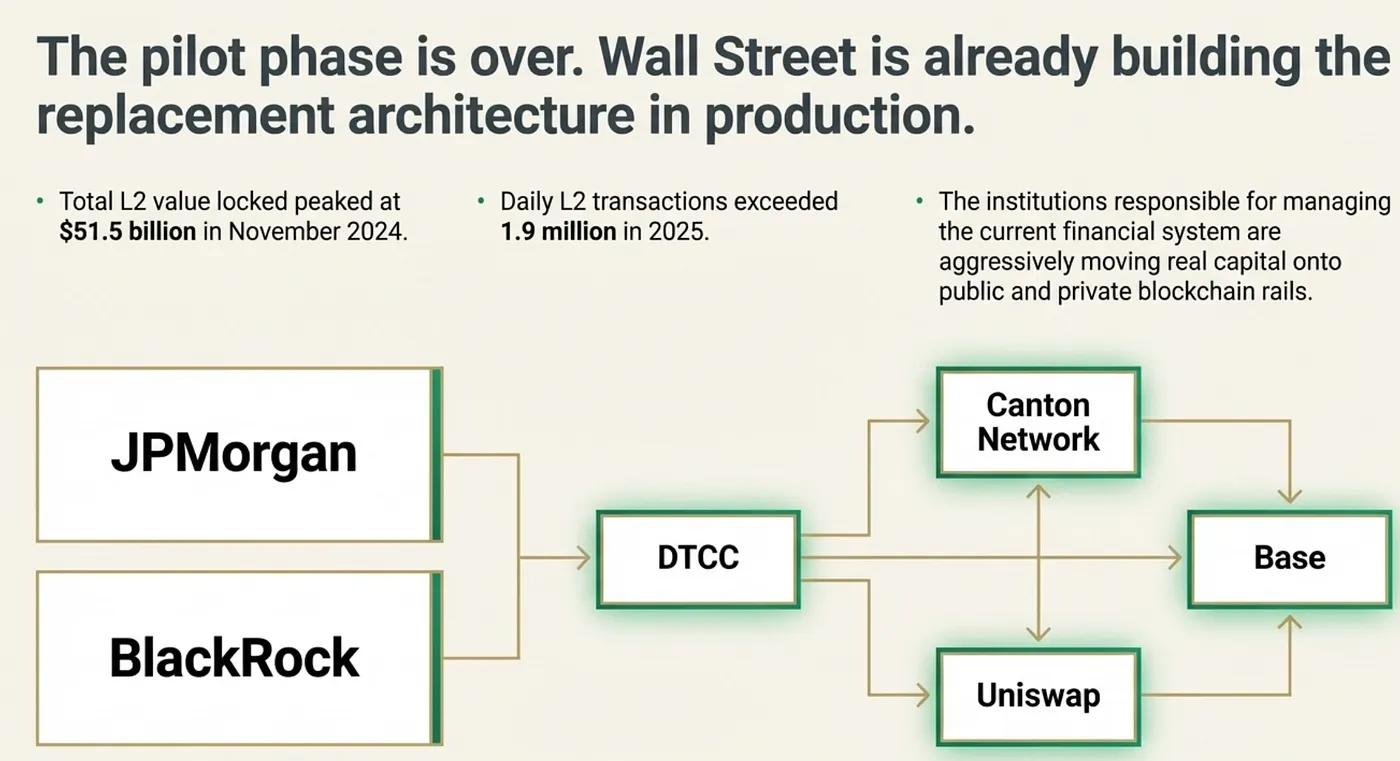
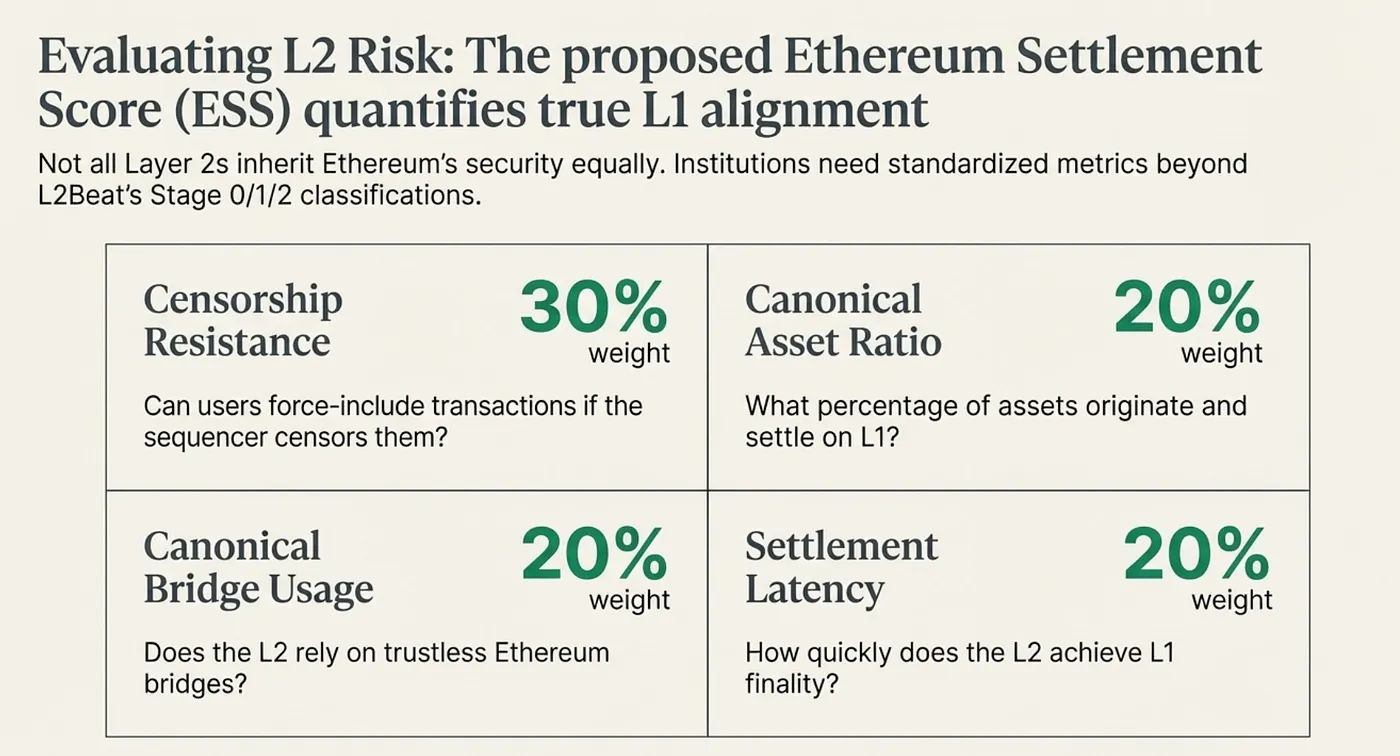
Canton Network: A privacy-preserving, interoperable blockchain network built by Digital Asset using the Daml smart contract language. Designed specifically for financial institutions, Canton had over $6 trillion of assets represented on-chain with more than 600 participating institutions by December 2025. The DTCC is tokenizing US Treasury securities on Canton, with a production MVP targeting H1 2026.
-
Censorship Resistance: The ability of a blockchain network to process transactions even if operators attempt to block or censor them. In the context of Layer 2 rollups, censorship resistance refers to whether users can force their transactions to be included on Ethereum even if the Layer 2 sequencer refuses to process them. This is a key security property for institutional settlement.
-
Counterparty Risk: The risk that the other party in a financial transaction will fail to fulfill their obligations. Traditional settlement systems carry counterparty risk during the multi-day settlement period. Blockchain-based atomic settlement eliminates counterparty risk by ensuring both sides of a transaction execute simultaneously and irreversibly.
-
Daml: A smart contract programming language developed by Digital Asset, used to build the Canton Network. Daml is designed specifically for privacy-preserving financial applications where different parties need to transact without revealing confidential information to everyone on the network.
-
Delivery-versus-Payment (DVP): A settlement mechanism where the transfer of securities occurs only if the corresponding payment is made. This eliminates the risk that one party delivers without receiving payment, or vice versa. Blockchain enables atomic DVP where both legs settle simultaneously in a single transaction.
-
Decentralization: The distribution of control, authority, and decision-making away from a central entity across multiple independent participants. In blockchain networks, decentralization means no single party controls transaction processing, data storage, or network governance. Decentralization reduces single points of failure, censorship risk, and reliance on trusted intermediaries. Layer 2 networks are at various stages of decentralization, with most still operating centralized sequencers as of early 2026.
-
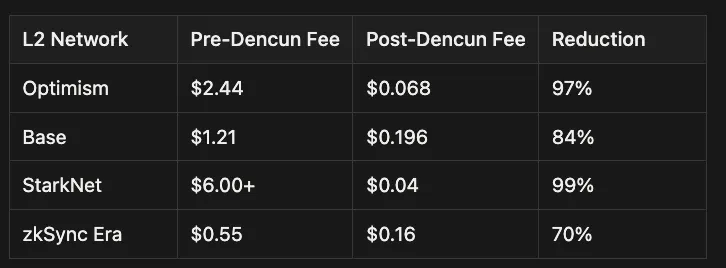
Dencun: The name for Ethereum’s March 2024 network upgrade that combined two simultaneous upgrades: “Deneb” on the consensus layer and “Cancun” on the execution layer. Dencun’s most significant feature was EIP-4844 (proto-danksharding), which introduced blobs and reduced Layer 2 transaction costs by 90–95%. The upgrade was critical to making blockchain settlement economically competitive with legacy infrastructure.
-
Digital Asset: The company that built the Canton Network and the Daml smart contract language. Digital Asset raised $135 million in June 2025 from investors including DRW, Tradeweb, BNP Paribas, Circle, Citadel Securities, DTCC, and Goldman Sachs.
-
DTCC (Depository Trust & Clearing Corporation): The central clearing and settlement organization for US securities markets. DTCC processes roughly $10 trillion in securities transactions every business day, or approximately $3.7 quadrillion annually. In December 2025, DTCC partnered with Digital Asset to tokenize DTC-custodied US Treasury securities on the Canton Network, with production rollout planned for 2026.
-
EIP-4844 (Ethereum Improvement Proposal 4844): A major upgrade to Ethereum implemented in March 2024, also known as “proto-danksharding.” EIP-4844 introduced blobs — temporary data containers that allow Layer 2 networks to post transaction data to Ethereum at dramatically lower cost. This upgrade reduced Layer 2 transaction fees by 90–95%, making blockchain settlement economically competitive with legacy systems.
-
Ethereum: The second-largest blockchain network by market capitalization and the dominant platform for decentralized finance and institutional tokenization. Ethereum hosts approximately 65% of the real-world asset tokenization market. Its programmable smart contracts and established security infrastructure make it the preferred settlement layer for major financial institutions.
-
Ethereum L1 (Layer 1): The main Ethereum blockchain, also called Ethereum mainnet. All transactions on Ethereum L1 are processed and secured by thousands of independent validators worldwide. Layer 2 networks build on top of Ethereum L1 to provide faster and cheaper transactions while inheriting its security.
-
Ethereum Settlement Score (ESS): A proposed framework for measuring how effectively a Layer 2 network leverages Ethereum’s security for settlement. ESS scores networks across four dimensions: canonical asset ratio, canonical bridge usage, settlement latency, and censorship resistance. The framework is not yet an established industry standard as of early 2026, but addresses a gap in evaluating L2 settlement risk for institutional investors.
-
EVM (Ethereum Virtual Machine): The runtime environment for smart contracts on Ethereum. EVM compatibility means that smart contracts written for Ethereum can run on other networks without modification. Most major Layer 2 networks are EVM-compatible or EVM-equivalent.
-
Finality: The point at which a transaction becomes irreversible and permanently recorded on the blockchain. Different networks and settlement methods achieve finality at different speeds. Traditional settlement takes days; blockchain settlement can achieve finality in minutes or seconds.
-
Force Inclusion: A mechanism that allows users to bypass a Layer 2’s centralized sequencer and submit transactions directly to Ethereum L1 if the sequencer censors or fails to process them. Force inclusion is a key component of censorship resistance and trustless security.
-
Fraud Proof: A cryptographic mechanism used by optimistic rollups to detect and prove invalid state transitions. If someone submits fraudulent transaction data, anyone can submit a fraud proof to Ethereum L1 to challenge it. The security model assumes fraud proofs will be submitted if fraud occurs, hence “optimistic.”
-
JPMorgan: The largest bank in the United States. JPMorgan operates Kinexys (formerly Onyx), a blockchain platform that has processed over $3 trillion in cumulative notional value with daily transaction volumes exceeding $5 billion. In June 2025, JPMorgan became the first major bank to issue a USD deposit token (JPMD) on a public Ethereum Layer 2 (Base).
-
JPMD: JPMorgan’s USD deposit token, launched in June 2025 on Base as a proof-of-concept. JPMD represents dollar deposits held at JPMorgan and can be issued and redeemed near-instantly. Clients including B2C2, Coinbase, and Mastercard participated in the initial deployment.
-
Kinexys (formerly Onyx): JPMorgan’s blockchain platform for institutional payments and settlement, rebranded from Onyx in November 2024. Kinexys has processed over $3 trillion in cumulative notional value with daily transactions exceeding $5 billion. Clients span five continents and include Siemens, BlackRock, and Ant International. In 2025, Kinexys demonstrated cross-chain atomic settlement and launched JPMD on Base.
-
L2 (Layer 2): A blockchain network built on top of Ethereum (Layer 1) to provide faster and cheaper transactions while inheriting Ethereum’s security. Layer 2 networks bundle many transactions together and post compressed data to Ethereum. Examples include Arbitrum, Optimism, Base, and various ZK rollups.
-
L2Beat: An independent analytics platform that tracks Layer 2 networks and evaluates their security properties. L2Beat’s security stage classification (Stage 0, Stage 1, Stage 2) is the established benchmark for rollup maturity as of early 2026.
-
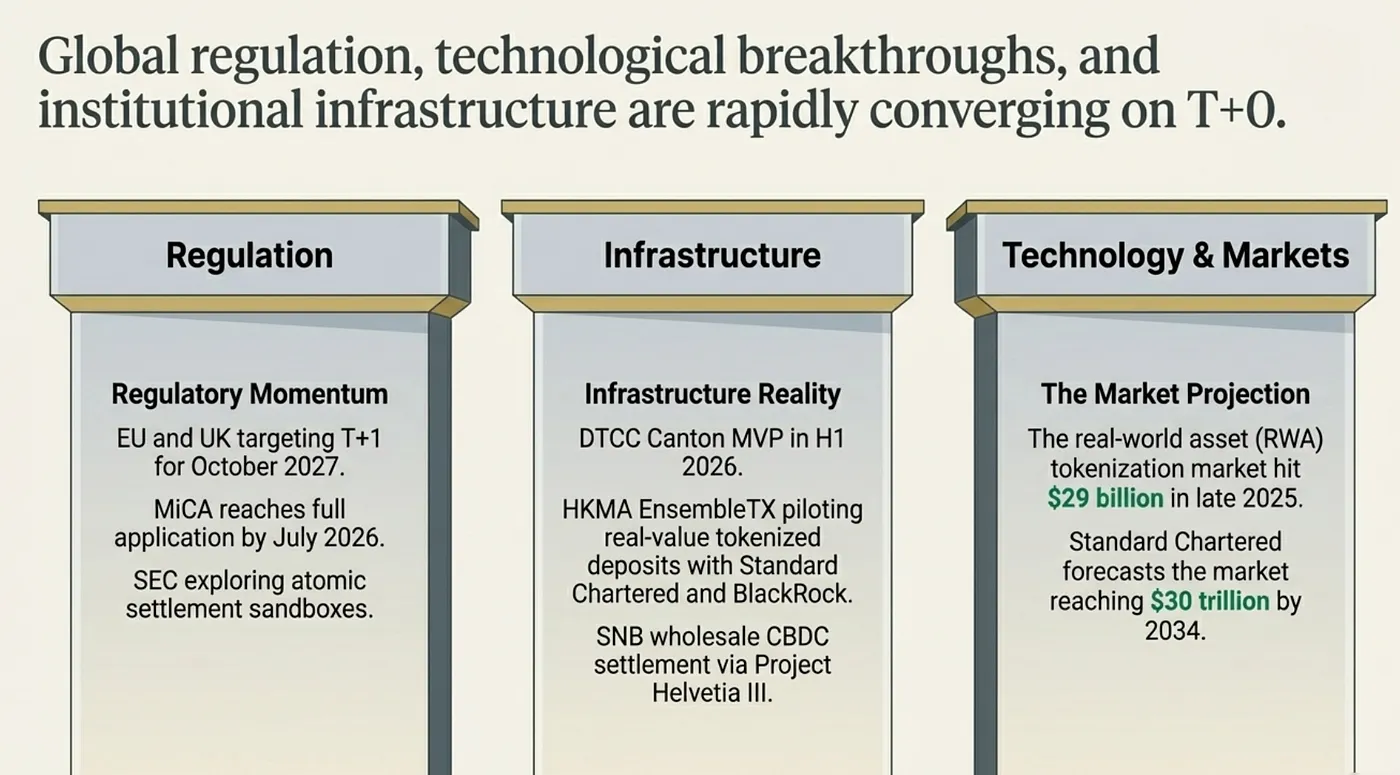
MiCA (Markets in Crypto-Assets Regulation): Comprehensive cryptocurrency regulation passed by the European Union. MiCA reaches full application by July 1, 2026, establishing regulatory frameworks for crypto-assets, stablecoins, and tokenized securities across EU member states.
-
On-Chain: Refers to transactions, data, or operations that are recorded and executed directly on a blockchain. On-chain activity is publicly verifiable, immutable, and secured by the blockchain’s consensus mechanism. Examples include token transfers, smart contract executions, and settlement transactions recorded on Ethereum or Layer 2 networks.
-
Off-Chain: Refers to transactions, data, or operations that occur outside the blockchain. Off-chain activity is not recorded on the blockchain itself and typically relies on traditional infrastructure or private databases. Examples include trades executed on centralized exchanges before settlement, or internal bank ledger updates. Off-chain systems often require trust in intermediaries, whereas on-chain systems are trustless and cryptographically verifiable.
-
Optimism: A Layer 2 network for Ethereum using optimistic rollup technology. Optimism routinely processes transactions for under a penny. Its technology stack has been adopted by other networks including Base (built by Coinbase).
-
Optimistic Rollup: A type of Layer 2 scaling solution that assumes transactions are valid by default (“optimistic”) and only computes fraud proofs if someone challenges a transaction. Optimistic rollups include Arbitrum, Optimism, and Base. They provide significant cost savings compared to Ethereum L1 but require a longer finality period, typically days, to allow time for fraud challenges.
-
Proto-danksharding: The technical name for EIP-4844. “Proto” indicates this is a preliminary step toward full danksharding, a future Ethereum upgrade that will provide even greater data availability for Layer 2 networks. Proto-danksharding introduced blobs in March 2024.
-
Real-World Asset (RWA) Tokenization: The process of representing traditional financial assets like Treasury bonds, real estate, or commodities as tokens on a blockchain. This enables 24/7 trading, atomic settlement, fractional ownership, and programmable compliance. The RWA tokenization market grew from roughly $5 billion to over $29 billion between 2022 and September 2025.
-
Rollup: A Layer 2 scaling solution that “rolls up” many transactions into a single batch and posts the compressed data to Ethereum L1. Rollups come in two main types: optimistic rollups, which use fraud proofs, and ZK rollups, which use validity proofs. Rollups inherit Ethereum’s security while providing dramatically lower transaction costs.
-
SEC (Securities and Exchange Commission): The primary regulator of securities markets in the United States. The SEC established the T+1 settlement requirement that took effect on May 28, 2024. The SEC’s Crypto Task Force has solicited input on atomic settlement and recommended regulatory sandboxes for tokenized securities.
-
Sequencer: The component of a Layer 2 network responsible for ordering and processing transactions. Most Layer 2 networks currently use centralized sequencers controlled by a single entity, though many are working toward decentralized sequencers. Centralized sequencers create censorship risk unless the network includes force inclusion mechanisms.
-
Settlement: The final transfer of securities and cash that completes a trade. In traditional markets, settlement occurs days after a trade is executed, such as T+1 or T+2. Blockchain enables near-instant settlement where both sides of a transaction complete simultaneously and irreversibly.
-
Settlement Latency: The time delay between when a transaction is executed and when it achieves final settlement. Traditional securities settlement has 1–2 day latency. Layer 2 blockchain networks are engineering toward settlement latency measured in minutes or seconds.
-
Smart Contract: Self-executing code deployed on a blockchain that automatically enforces the terms of an agreement. Smart contracts enable atomic settlement, programmable compliance, and complex financial operations without intermediaries. They are fundamental to blockchain-based settlement infrastructure.
-
Stage 0 / Stage 1 / Stage 2 (L2Beat Security Stages): L2Beat’s classification system for rollup security maturity. Stage 0 rollups have centralized control and limited security guarantees. Stage 1 rollups have functional fraud or validity proofs but still rely on centralized components. Stage 2 rollups achieve full decentralization with trustless fraud or validity proofs and functional force inclusion. Most production rollups operated at Stage 0 or Stage 1 throughout 2025.
-
T+0 Settlement: Same-day settlement where trades settle on the same day they are executed. Blockchain technology enables T+0 settlement through atomic transactions. Some blockchain systems achieve settlement in minutes or seconds, which is functionally T+0 even if not exactly instantaneous.
-
T+1 Settlement: Trade date plus one business day settlement. US securities markets transitioned from T+2 to T+1 settlement on May 28, 2024, as mandated by the SEC. This reduced settlement time from two business days to one business day after a trade is executed.
-
T+2 Settlement: Trade date plus two business days settlement. This was the standard for US securities markets before the May 2024 transition to T+1. Under T+2, a trade executed on Monday would settle on Wednesday, assuming no holidays.
-
Tokenization: The process of creating a digital token on a blockchain that represents ownership of an asset. Tokenized assets can include securities, currencies, real estate, commodities, or any other asset. Tokenization enables fractional ownership, programmable compliance, 24/7 trading, and blockchain-based settlement.
-
Trustless: A property of blockchain systems where participants do not need to trust any central authority or counterparty. Trustless systems rely on cryptographic proofs and decentralized consensus rather than institutional trust. Trustless settlement means transactions are guaranteed to execute correctly by mathematics rather than by trusting a third party.
-
Uniswap: The largest decentralized exchange (DEX) for trading tokens on Ethereum. In February 2026, BlackRock’s BUIDL fund became tradable on Uniswap for whitelisted investors, bridging traditional asset management and decentralized finance.
-
USDC: A US dollar stablecoin issued by Circle. Each USDC token is backed 1:1 by US dollar reserves. USDC is widely used in blockchain-based financial applications, including as the settlement currency for on-chain Treasury financing on the Canton Network.
-
Validity Proof: A cryptographic proof used by ZK rollups to verify that a batch of transactions was processed correctly. Unlike optimistic rollups that assume validity and check only if challenged, ZK rollups provide mathematical proof of correctness with every batch. This enables faster finality but requires more computational resources to generate proofs.
-
Web3: The vision of a decentralized internet built on blockchain technology, where users own their data, identity, and digital assets without relying on centralized platforms. Web3 encompasses decentralized applications (dApps), smart contracts, cryptocurrencies, NFTs, and decentralized finance (DeFi). In the context of financial infrastructure, Web3 represents the shift from intermediated settlement systems to trustless, peer-to-peer transactions secured by cryptographic proofs.
-
ZK Rollup (Zero-Knowledge Rollup): A type of Layer 2 scaling solution that uses validity proofs, also called zero-knowledge proofs, to verify transaction correctness. ZK rollups provide cryptographic proof that transactions were processed correctly, enabling faster finality than optimistic rollups. Major ZK rollup projects are engineering toward sub-minute proof verification as of 2026.
-
Zero-Knowledge Proof: A cryptographic method that allows one party to prove to another that a statement is true without revealing any information beyond the validity of the statement itself. In the context of ZK rollups, zero-knowledge proofs verify that a batch of transactions was processed correctly without requiring validators to re-execute every transaction.
-
AUM: Assets Under Management.
-
BIS: Bank for International Settlements.
-
CBDC: Central Bank Digital Currency.
-
CCIP: Cross-Chain Interoperability Protocol.
-
CLS: Continuous Linked Settlement.
-
DeFi: Decentralized Finance.
-
DEX: Decentralized Exchange.
-
DTC: Depository Trust Company.
-
ETH: Ether, the native asset of Ethereum.
-
ESS: Ethereum Settlement Score.
-
EVM: Ethereum Virtual Machine.
-
FX: Foreign Exchange.
-
HKMA: Hong Kong Monetary Authority.
-
L1: Layer 1.
-
L2: Layer 2.
-
MVP: Minimum Viable Product.
-
NSCC: National Securities Clearing Corporation.
-
PoC: Proof of Concept.
-
RWA: Real-World Asset.
-
SEC: Securities and Exchange Commission.
-
SNARK: Succinct Non-Interactive Argument of Knowledge.
-
STARK: Scalable Transparent Argument of Knowledge.
-
TVL: Total Value Locked.
-
ZK: Zero-Knowledge.