War of the Agent Worlds: Your Strategic Battle Plan
Introduction: Welcome to the Agent Development Battlefield
It’s late 2025, and if you’re building anything with AI agents, you’re not just coding: you’re deploying troops in the middle of a full-scale war. The landscape is a chaotic battlefield of frameworks, each claiming to be the ultimate weapon for AI agent development.
This isn’t marketing hyperbole. We’re witnessing an all-out war for developer mindshare, a high-stakes battle where the victors will define how we build intelligent systems for the next decade. Every framework is fighting for your allegiance, your projects, and your long-term loyalty.
The stakes couldn’t be higher. Pick the right agentic framework, and you gain a massive tactical advantage: faster development, better scalability, and a clear path to production. Pick the wrong one? You’re looking at months of wasted effort, technical debt that compounds daily, and potentially a complete rewrite when you hit the framework’s limitations.
Think of this article as your field manual for surviving; and winning; in the framework wars. We’re not here to pick sides. We’re here to give you the intelligence you need to make the right strategic choice for your mission.
**Your battle agentic development battle plan:
- Understand the terrain -- Map the two main battle fronts (cloud vs. open source)
- Know your allies -- Examine the champions on both sides and their unique weapons
- Choose your strategy -- Match agentic frameworks to real-world use cases and project requirements
- Plan for the future -- Understand where the battlefield is heading and position yourself accordingly
Let’s deploy.
The Fundamental Choice for Agentic Tools: Speed or Sovereignty?
Every battle begins with a strategic decision. In the agent framework wars, that decision is deceptively simple but profoundly consequential:
Do you fight with the big, managed cloud platforms? Or do you fight for the freedom of open source? Or both?
This isn’t about ideology. It’s about matching your weapon to your mission. Let’s break down what each side brings to the battlefield.
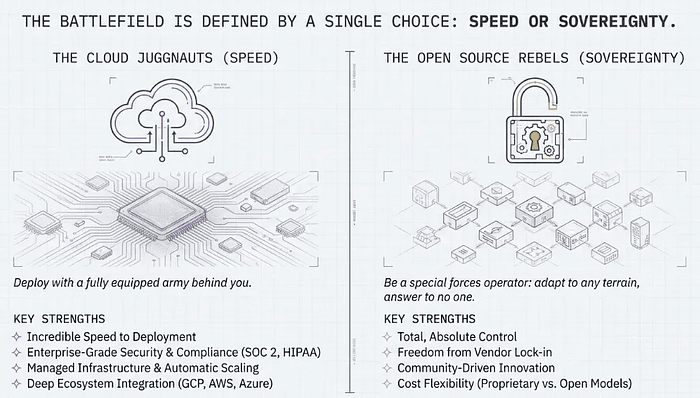 Picking the right agentic tools and frameworks for your use cases
The Cloud Platform Advantage: Overwhelming Agentic Infrastructure Firepower
Cloud platforms are like deploying with a fully equipped army behind you. You get:
Incredible Speed to Deployment
- Launch production-ready agents in minutes, not weeks
- Pre-configured AI infrastructure that scales automatically
- Less DevOps overhead; just write code and deploy
Enterprise-Grade Security Arsenal
- Built-in compliance frameworks (SOC 2, HIPAA, GDPR)
- Audit trails and access controls out of the box
- Security teams that monitor threats 24/7
Scalability Without the Headache
- Auto-scaling infrastructure handles traffic spikes automatically
- Global distribution for low-latency responses
- Managed databases and state persistence
Deep Ecosystem Integration
- Seamless connection to data warehouses (BigQuery, Redshift, Synapse)
- Native authentication systems (IAM, Active Directory)
- Comprehensive monitoring and observability tools
Real-world scenario: You’re building a customer support agent for a Fortune 500 company. You need SOC 2 compliance, integration with Salesforce and Zendesk, and the ability to handle 10,000 concurrent conversations. A cloud platform gives you all of this on day one.
The Agentic Framework Open Source Promise: Total Control
Open-source frameworks are like being a special forces operator: you carry only what you need, you adapt to any terrain, and you answer to no one. You get:
Total, Absolute Control
- Every line of code, every decision point, every integration is in your hands. You can run in the cloud or on your laptop.
- Customize behavior at the deepest levels
- No artificial limitations imposed by platform vendors
Freedom from Vendor Lock-in
- Switch between Claude, GPT, Gemini, Grok, or Llama without rewriting your application
- Move between cloud providers (or on-premises) seamlessly
- Own your destiny; no surprise pricing changes or deprecated features
Community Innovation
- Benefit from thousands of developers contributing improvements daily
- Access to cutting-edge features before they hit commercial platforms
- Transparent development; see exactly what’s changing and why
Cost Flexibility
- Choose between premium proprietary models and cost-effective open-source alternatives
- Run on your own infrastructure to eliminate per-request costs
- Fine-tune smaller models for specific tasks at a fraction of the cost
Real-world scenario: You’re building a healthcare diagnostic agent that must run entirely on-premises due to HIPAA requirements. You need to use a fine-tuned Llama model trained on your proprietary medical data. Open source gives you the flexibility to build exactly what you need without sending any data to external APIs.
The Strategic Trade-off
This is the core tension: speed or sovereignty.
Neither choice is inherently better. The right answer depends entirely on:
- Your mission -- What are you building?
- Your team -- What expertise do you have?
- Your timeline -- How fast do you need to ship?
- Your constraints -- What are your security, compliance, and cost requirements?
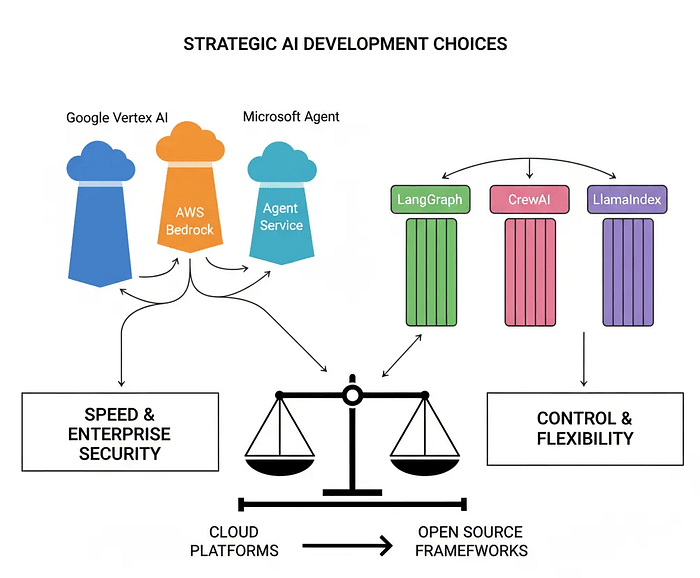 Google Vertex AI, AWS Bedrock and Azure AI on one side of the scale, LangGraph, CrewAI and LlamaIndex on the other or together
Let’s visualize the agentic framework battlefield.
The Framework Landscape at a Glance
Here’s how the forces are arrayed across the battlefield:
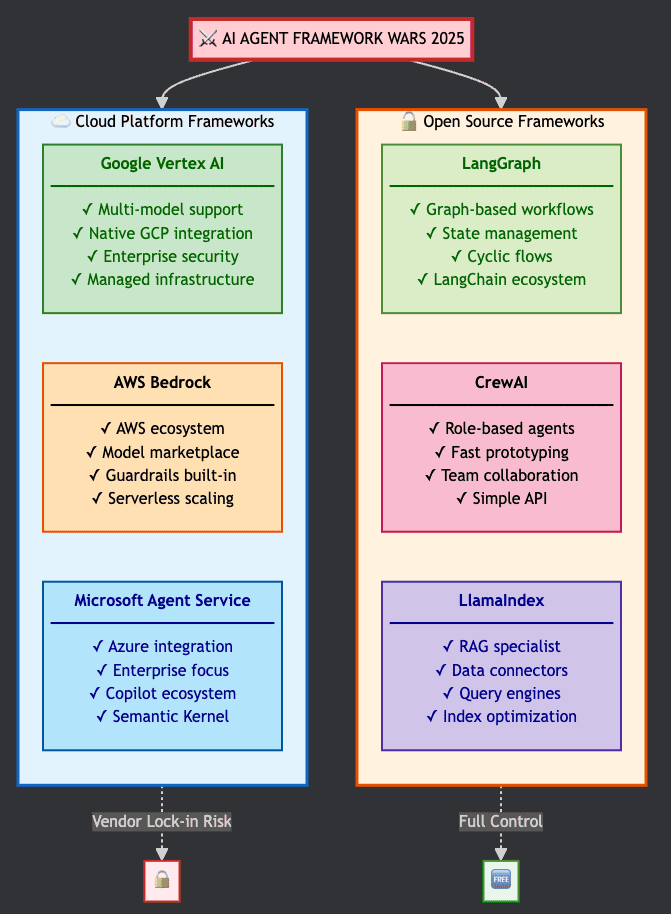 Google Vertex AI, AWS Bedrock and Azure AI versus LangGraph, CrewAI and LlamaIndex is often a choice of speed versus flexibility and control
Now that you understand the strategic landscape, let’s examine the individual combatants and their unique capabilities.
The Hybrid Warriors: When Cloud Meets Open Source
Not all battles are fought on a single front. Some of the smartest strategic moves involve combining the strengths of both cloud platforms and open-source frameworks.
Let’s explore how savvy teams are winning by refusing to choose just one side.
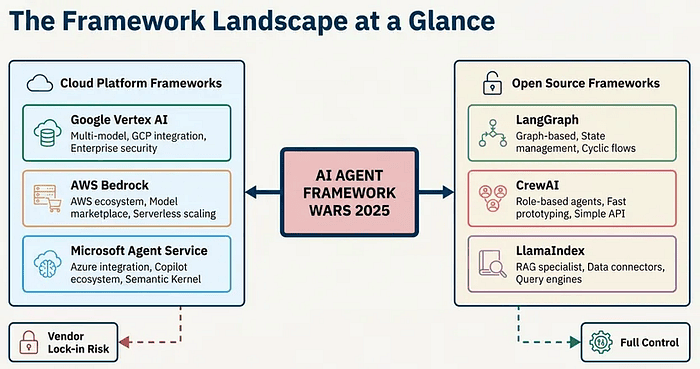 Microsoft Agent Service, AWS Bedrock and Google Vertex AI offer a lot but usually at the expense of Cloud Lock in.
Battle Front #1: The Cloud Native Titans
If you’re building inside one of the major clouds, you’re enlisting in an army. You get the full support of a massive organization, but you also commit to their way of fighting. The three generals commanding the cloud battlefield are Google, AWS, and Microsoft.
Each brings unique weapons to the fight. Let’s examine their arsenals.
Google Vertex AI: The Agent Marketplace Commander
Google has made a bold strategic move, positioning Vertex AI Agent Builder as the “app store for AI agents.” In November 2025, they deployed their most powerful weapon yet.
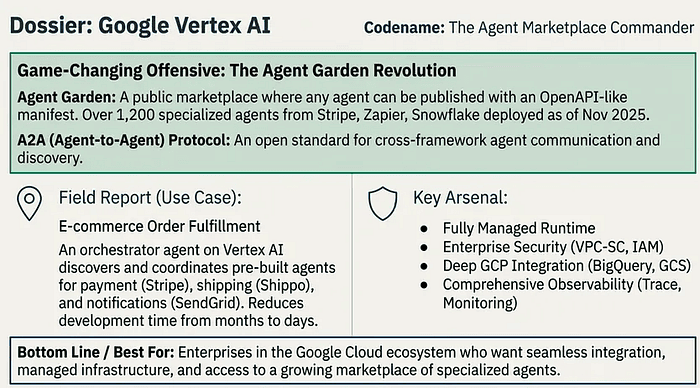 Google VertexAI
The Agent Garden Revolution: A Game-Changing Offensive
Google launched two interconnected innovations that fundamentally changed the battlefield:
**Agent Garden: **A public marketplace where any agent, regardless of its underlying framework (LangGraph, CrewAI, AutoGen, etc.), can be published with an OpenAPI-like manifest. Once registered, agents become discoverable and invokable by other agents through natural language routing.
Think of it like the iOS App Store, but for AI agents. As of late November 2025, over 1,200 specialized agents are already deployed, including battle-tested integrations from Stripe, Zapier, and Snowflake.
A2A Protocol (Agent-to-Agent) -- An open protocol designed specifically for agent-to-agent communication, distinct from the tool-focused Model Context Protocol (MCP). This creates a universal standard so any agent, no matter what framework it was built with, can be published and discovered.
What this means for developers: Vertex AI isn’t a walled garden anymore. It’s a massive open marketplace. You can build highly specialized sub-agents and publish them for broader consumption; and potential monetization; while using any framework you prefer for your core supervisor logic.
Real-World Use Case: E-commerce Order Fulfillment
Scenario: You’re building an e-commerce platform that needs to coordinate inventory, shipping, payment processing, and customer notifications.
With Vertex AI Agent Garden:
- Deploy your main orchestrator agent on Vertex AI
- Discover and integrate pre-built agents from the marketplace:
- Stripe payment agent (handles all payment processing)
- Shippo shipping agent (calculates rates, generates labels)
- SendGrid notification agent (sends order confirmations)
-
Your orchestrator coordinates these specialized agents using natural language commands
-
Total development time: Days instead of months
Key Vertex AI Capabilities
Fully Managed Runtime
- Zero infrastructure to maintain
- Automatic scaling from 0 to millions of requests
- Built-in fault tolerance and retry logic
Enterprise Security Arsenal
- VPC Service Controls (VPC-SC) compliance
- Native agent identities with fine-grained IAM
- Security Command Center integration for threat detection
- Audit logging for every agent action
Deep Google Cloud Integration
- BigQuery for analytics and data warehousing
- Cloud Storage for document processing
- Google Workspace for calendar, email, and docs access
- Vertex AI Search for enterprise knowledge retrieval
Comprehensive Observability
- Google Cloud Trace for distributed tracing
- Cloud Monitoring for metrics and alerting
- Cloud Logging for centralized log management
- Built-in debugging tools for agent behavior
Agent Development Kit (ADK)
- Open-source toolkit for Python and Java
- Local development and testing
- Seamless deployment to managed runtime
The Agent Development Kit (ADK) is Google’s open-source toolkit that provides developers with a comprehensive set of tools for building, testing, and deploying AI agents locally before moving them to Vertex AI’s managed runtime. The ADK supports both Python and Java, making it accessible to a wide range of development teams and allowing them to work in their preferred language. This local-first approach means developers can iterate quickly on their agent logic, test different configurations, and debug issues in their familiar development environment without incurring cloud costs or dealing with deployment overhead during the development phase.
One of the ADK’s key strengths is its seamless deployment pipeline. Once you’ve built and tested your agent locally, the ADK provides streamlined tools to package and deploy your agent directly to Vertex AI’s managed runtime with minimal configuration changes. This eliminates the common friction of “works on my machine” problems that plague many cloud deployments. The ADK handles the complexity of translating your local development setup into a production-ready deployment, managing dependencies, environment configurations, and runtime requirements automatically.
Beyond just deployment, the ADK includes powerful debugging and testing utilities specifically designed for agent workflows. These tools help developers trace agent reasoning, inspect decision-making processes, and validate that tools and functions are being invoked correctly. The ADK also provides local simulation of Vertex AI services, allowing you to test integrations with BigQuery, Cloud Storage, and other Google Cloud services without actually connecting to them during development. This comprehensive toolkit significantly reduces the time from initial concept to production deployment, while maintaining the flexibility to work in your local environment and the confidence that your agent will work identically when deployed to Google’s managed infrastructure.
The Google Vertex AI platform is top notch and I enjoy working with it.
Best for: Enterprises already invested in the Google Cloud ecosystem who want seamless integration, managed infrastructure, and access to a growing marketplace of specialized agents.
AWS Bedrock AgentCore: The Flexibility Champion
Amazon’s strategy is fundamentally different. Instead of building a walled garden, they’ve constructed a modular, framework-agnostic infrastructure stack called Bedrock AgentCore.
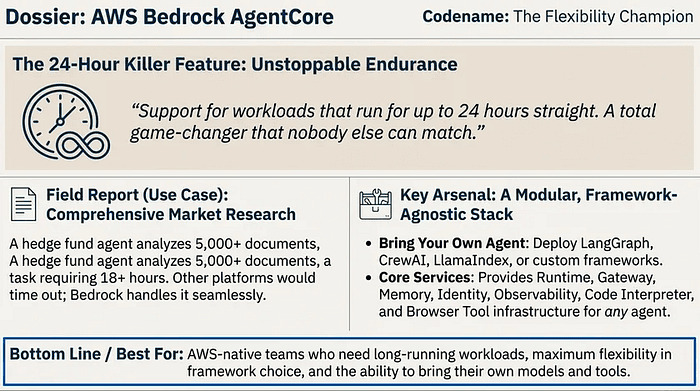 AWS Bedrock AgentCore, powerful tools
Think of it as providing the ammunition, logistics, and support: but letting you choose your own weapons.
The Seven Core Services: A Complete Arsenal:
AgentCore provides comprehensive infrastructure that works with any framework:
1. Runtime
- Execution environment for agents built with any framework
- Support for Python, Node.js, and containerized workloads
- Automatic scaling and load balancing
2. Gateway
- API management and routing
- Rate limiting and throttling
- Request/response transformation
3. Memory
- State persistence across sessions
- Support for short-term (conversation) and long-term (user profile) memory
- Redis-compatible interface for easy integration
4. Identity
- Authentication and authorization
- Integration with AWS IAM, Cognito, and third-party identity providers
- Fine-grained access control for agent actions
5. Observability
- Distributed tracing with AWS X-Ray
- Metrics and logging with CloudWatch
- Custom dashboards and alerting
6. Code Interpreter
- Safe code execution sandbox
- Support for Python, JavaScript, and SQL
- Isolated environments prevent malicious code execution
7. Browser Tool
- Web automation capabilities
- Headless browser for scraping and interaction
- Screenshot and PDF generation
The 24-Hour Killer Feature: Unstoppable Endurance:
Here’s what sets Bedrock apart from every other platform: support for workloads that run for up to 24 hours straight.
The session limit started at 8 hours in preview but was raised to 24 hours in the November 18, 2025 release. This is a total game-changer that nobody else can match.
Real-World Use Case: Comprehensive Market Research
Scenario: You’re a hedge fund building an agent that conducts deep market research on emerging technologies.
The Mission:
- Scrape and analyze 5,000+ news articles, blog posts, and research papers
- Identify key trends, companies, and technologies
- Cross-reference findings with patent databases and SEC filings
- Generate a comprehensive 50-page report with citations
Why Bedrock Wins:
- This task requires 18+ hours of continuous processing
- Other platforms would time out or require complex checkpointing
- Bedrock’s 24-hour sessions handle this seamlessly
- The agent can pause for human review and continue without losing context
Bring Your Own Agent: Framework Freedom:
AgentCore is completely framework-agnostic. You can deploy agents built with:
- LangGraph for complex workflows
- CrewAI for rapid prototyping
- LlamaIndex for RAG-heavy applications
- Custom frameworks built from scratch
This mitigates vendor lock-in while still leveraging AWS’s enterprise security posture (VPC, PrivateLink, IAM).
How AgentCore Works With Any Framework: The Universal Infrastructure Layer
AWS Bedrock AgentCore’s true power lies in its framework-agnostic architecture. Unlike platform-specific solutions that lock you into a particular way of building agents, AgentCore functions as a universal infrastructure layer that sits beneath whatever framework you choose. Think of it as providing the plumbing, electricity, and foundation for a house while letting you decide whether to build a modern mansion, a cozy cottage, or an industrial loft on top.
At its core, AgentCore exposes its seven services through standardized APIs and SDKs that any framework can integrate with. Whether you’re building with LangGraph’s state machine approach, CrewAI’s role-based agent orchestration, LlamaIndex’s RAG-focused architecture, or even a completely custom framework you’ve built from scratch, your agents can leverage AgentCore’s runtime, memory, identity, and observability services through simple API calls. The framework handles the agent logic and decision-making, while AgentCore handles the operational complexity of scaling, state management, security, and monitoring.
This separation of concerns creates powerful advantages. Your development team can choose the framework that best fits their skills and use case without sacrificing enterprise-grade infrastructure. Need to migrate from one framework to another as your requirements evolve? AgentCore’s services remain consistent, significantly reducing migration risk and effort. Want to run multiple agent systems built with different frameworks? They can all share the same identity management, observability dashboard, and operational tooling through AgentCore’s unified interface.
The practical implementation is straightforward: your framework-based agent runs in AgentCore’s runtime environment (which supports Python, Node.js, and containerized workloads), makes calls to AgentCore’s Memory service to persist state, authenticates users through the Identity service, executes code safely via the Code Interpreter, and automatically sends telemetry to the Observability stack. From your framework’s perspective, these are just API calls to well-documented services. From AgentCore’s perspective, it doesn’t matter whether the calling agent was built with LangGraph, CrewAI, or custom code: it’s all treated the same way, with the same security guarantees, scaling behavior, and operational visibility.
Best for: AWS-native teams who need long-running workloads, maximum flexibility in framework choice, and the ability to bring their own models and tools.
Microsoft Agent Service: The Unified Enterprise Commander
Microsoft finally made their decisive move. In October 2025, they shipped the Microsoft Agent Service; a unified platform that ended the confusion between their two flagship frameworks.
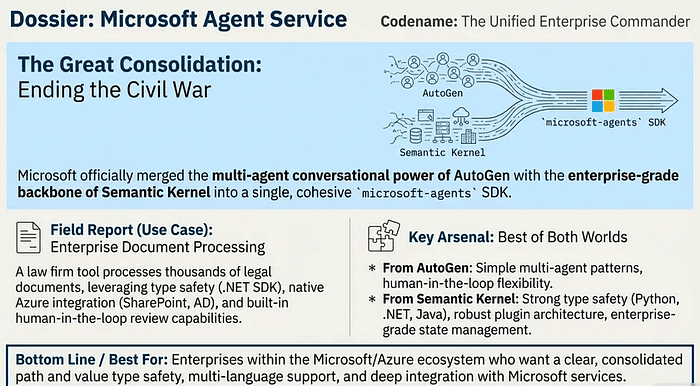 Microsoft Agent Service
The Great Consolidation: Ending the Civil War:
For years, Microsoft had two competing frameworks:
- AutoGen -- Simple abstractions for multi-agent collaboration
- Semantic Kernel -- Enterprise-grade backbone with type safety and plugins
Developers were confused. Which one should they choose? Would one be deprecated?
Microsoft’s answer: Both. Together. Unified.
They officially merged:
- The multi-agent conversational power of AutoGen (simple abstractions for agent collaboration)
- The enterprise-grade backbone of Semantic Kernel (type safety, multi-language support, robust plugin architecture)
Into a single, cohesive platform accessed via the microsoft-agents SDK.
What You Get: The Best of Both Worlds:
The unified framework combines the strengths of both predecessors:
From AutoGen:
- Simple abstractions for multi-agent conversational patterns
- Flexible support for varying levels of human involvement (fully autonomous to always-on approval)
- Natural message-based collaboration between agents
- Built-in patterns for common scenarios (debate, consensus, sequential processing)
From Semantic Kernel:
- Strong type safety across Python, .NET, and Java
- Robust plugin architecture for extensibility
- Function invocation filters for observability and control
- Enterprise-grade state management for long-running scenarios
- Memory connectors for vector databases and traditional data stores
Real-World Use Case: Enterprise Document Processing:
Scenario: You’re building an internal tool for a law firm that processes thousands of legal documents daily.
The Requirements:
- Extract key information from contracts (parties, dates, obligations)
- Identify potential risks and flag them for attorney review
- Generate summaries and store them in SharePoint
- Maintain audit trails for compliance
Why Microsoft Agent Service Wins:
- Type Safety -- .NET SDK ensures compile-time checking for critical legal data
- Azure Integration -- Native connection to SharePoint, Azure AD, and Compliance Center
- Human-in-the-Loop -- Attorneys can review and approve flagged risks before final processing
- Enterprise Security -- Built-in compliance with legal industry standards
Best for: Enterprises within the Microsoft/Azure ecosystem who want a clear, consolidated path forward with no confusion about which framework to choose. Ideal for teams that value type safety, multi-language support, and deep integration with Microsoft services.
 Sometimes you just need to go Cloud Native because you are already there and it is the platform choice for the company, and if you do, you get a lot of useful tools
This next one not a Cloud provider offering like Azure AI, AWS BedRock or Google Vertex, but from a major AI LLM Agent company: Anthropic. Anthropic is the makers of the Claude Code which has wide industry adoption, and they built their Claude Agent SDK on the foundations of Claude Code which makes their offering one of the mostly widely deployed and testing offerings for real world agentic development. They are the dark horse and perhaps your secret weapon.
Claude Computer Use and Agent SDK: The Terminal Warrior
What happens when you give an AI agent direct access to a computer terminal, along with powerful tools for file manipulation, command execution, and skill discovery?
Welcome to the world of agentic search and autonomous computing.
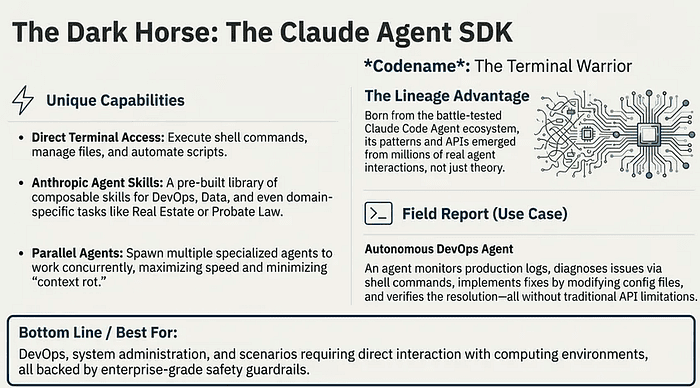 Already stole the hearts and minds of Developers with Claude Code, now Claude Agent SDK is quite the framework
Claude Computer Use: Building on Code Success:
Anthropic’s Claude Computer Use and Agent SDK represent a fundamental shift in how agents interact with computing environments. Building on the success of Claude Code (their AI-powered coding assistant), Anthropic has expanded the vision to encompass full computer interaction. To learn more read this article I wrote Giving Claude a Computer.
Core Capabilities:
Terminal Access
- Direct shell command execution (bash, etc.)
- Process management and system monitoring
- Environment variable manipulation
- Script automation and orchestration
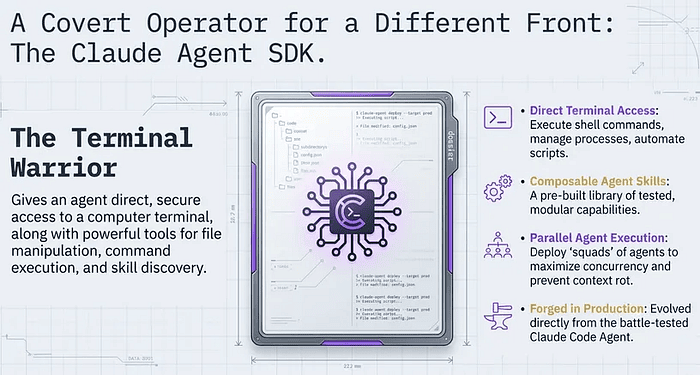 Give an Agent a Terminal and see what it can do! Agentic Search, Tooling, forged and battle hardened with Claude Code ecosystem, Claude Agent SDK might just be the most capable toolkit
File System Operations
- Read, write, create, delete files and directories
- Pattern matching with grep, find, and glob
- Text processing with sed, awk, and similar tools
- File permissions and ownership management
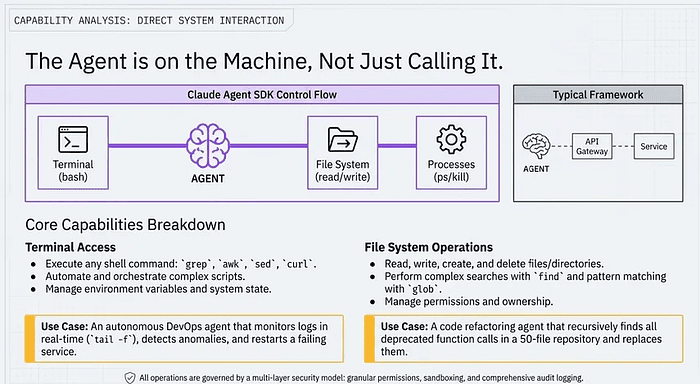 Claude Agent SDK getting access to Terminal and File System is something to behold
Skill Discovery and Learning
- Agents can discover new tools and commands available on the system
- Learn command syntax through experimentation
- Build libraries of reusable scripts and workflows
- Adapt to different operating systems and environments
Anthropic Agent Skills: The Skill Library:
The Agent SDK introduces Anthropic Agent Skills: pre-built, composable capabilities that agents can leverage for common computing tasks.
What Are Agent Skills?
- Modular capabilities that can be added to any Claude-powered agent
- Tested, reliable implementations of common workflows
- Built with safety guardrails and permission controls
- Extensible framework for custom skill development
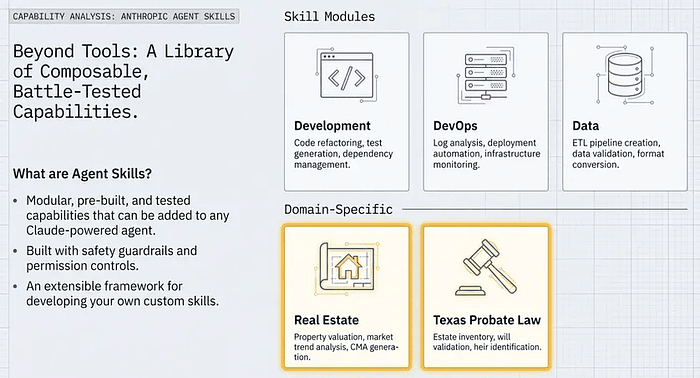 Agent Skills might one day be more important than MCP. It is a powerful concept.
Example Skills:
Development Skills
- Code refactoring and optimization
- Test generation and execution
- Dependency management and updates
- Build system configuration
DevOps Skills
- Log analysis and troubleshooting
- Deployment automation
- Infrastructure monitoring
- Configuration management
Data Skills
- ETL pipeline creation
- Data validation and cleaning
- Format conversion and transformation
- Database query optimization
Real Estate Skills
- Property search and valuation analysis
- Market trend analysis and price prediction
- Mortgage calculation and financing options
- Comparative market analysis (CMA) generation
Probate Law in Texas Skills
- Estate inventory and asset valuation
- Heir identification and notification
- Will validation and probate filing procedures
- Debt settlement and creditor claims management
The Skills allow the agents to have new abilities beyond Development and DevOps. And in addition to Skills, you can run parallel agents to maximize concurrency and minimize context rot.
These are the same skills that can run on the Claude desktop app and that work with the Claude API. Skills are deeply embedded into the Claude ecosystem. I feel like Skills are going to be bigger than MCP and A2A one day. To learn more about Agentic Skills read this article I wrote called: Claude Skills Conceptual Deep Dive.
Claude Agent SDK: Running Parallel Agents: Maximizing Concurrency
One of the most powerful features of the Claude Agent SDK is the ability to run parallel agents to maximize concurrency and minimize context rot.
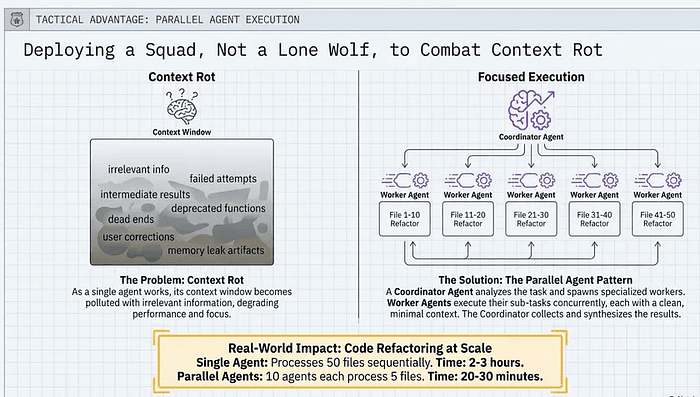 Claude Agent SDK probably has the easiest to use parallel agents that all get their own context. This is just one of the many killer features of Claude Agent SDK borne from the Claude Code ecosystem
The Context Rot Problem the Claude Agent SDK fixes:
As agents work through complex tasks, their context windows can become polluted with intermediate results, dead-end explorations, and irrelevant information. This “context rot” degrades performance over time.
The Parallel Agent Solution from Claude Agent SDK:
Instead of one monolithic agent with a bloated context, you can spawn multiple specialized agents that work concurrently:
Specialization Benefits
- Each agent maintains a clean, focused context
- Agents can work on different aspects of a problem simultaneously
- Failed explorations don’t pollute other agents’ contexts
- Results are merged only when relevant
Concurrency Gains
- Parallel execution reduces total task completion time
- Independent agents can make progress without blocking each other
- Resource utilization is optimized across multiple tasks
Real-World Example: Code Refactoring at Scale:
Scenario: You need to refactor a large codebase with 50 Python files, updating deprecated API calls and improving code quality.
Single Agent Approach:
- Process files sequentially
- Context grows with each file processed
- Performance degrades over time
- Total time: 2–3 hours
Parallel Agent Approach:
- Spawn 10 agents, each handling 5 files
- Each agent maintains clean, focused context
- Agents work simultaneously
- Total time: 20–30 minutes
The Orchestration Pattern:
- A coordinator agent analyzes the overall task
- Coordinator spawns specialized worker agents with clear boundaries
- Worker agents execute independently with minimal context
- Coordinator collects results and handles dependencies
- Final synthesis happens with fresh context
Claude Skills + Claude Agent SDK Parallel Agents: The Power Combo:
When you combine Anthropic Agent Skills with parallel agent execution, you get unprecedented power:
Example: Multi-Domain Analysis
Imagine analyzing a real estate portfolio across multiple markets:
Agent 1: Property Valuation (Real Estate Skills)
- Analyzes properties in Texas markets
- Uses market trend analysis and price prediction skills
- Generates comparative market analyses
Agent 2: Legal Compliance (Probate Law Skills)
- Reviews estate documentation
- Validates will and probate procedures
- Identifies compliance issues
Agent 3: Financial Analysis (Data Skills)
- Analyzes cash flow and ROI
- Optimizes mortgage and financing options
- Generates financial projections
Agent 4: Due Diligence (DevOps Skills)
- Automated document retrieval and validation
- Data pipeline creation for multi-source analysis
- Report generation and distribution
Result: A comprehensive portfolio analysis that would take days with a single agent completes in hours with parallel execution, and each agent maintains focus and clarity.
Claude Agent SDK vs. Traditional Approaches:
Compare this parallel agent capability to traditional frameworks:
LangGraph Multi-Agent
- Requires explicit graph definition for agent interactions
- Context sharing is manual and complex
- Debugging parallel flows is challenging
CrewAI Teams
- Sequential role-based execution by default
- Parallel tasks require careful orchestration
- Context management across agents is limited
Claude Agent SDK
- Native support for spawning parallel agents
- Automatic context isolation and merging
- Built-in monitoring and debugging for concurrent execution
- Skills library makes specialization trivial
The Agent SDK treats parallel execution as a first-class feature, not an afterthought.
Real-World Use Case: Autonomous DevOps Agent:
Scenario: You need an agent to monitor production systems, diagnose issues, and implement fixes autonomously.
The Agent’s Workflow:
- Monitor Logs -- Use grep and tail to watch application logs in real-time
- Detect Anomalies -- Pattern matching to identify error spikes or performance degradation
- Investigate Root Cause -- Execute diagnostic commands, check system resources, query databases
- Implement Fix -- Modify configuration files, restart services, deploy patches
- Verify Resolution -- Monitor metrics to confirm the issue is resolved
- Document Actions -- Create incident reports with detailed logs of what was done
Where Claude Agent SDK Wins:
- Direct terminal access means no API limitations
- Agent can use any command-line tool available on the system
- Learn and adapt to custom infrastructure tools
- Handle complex multi-step operations that would be impossible with traditional APIs
- Agentic Search
- Access to Skills and Files
Safety and Control: The Guardrails:
Giving an agent terminal access raises obvious security concerns. Anthropic addresses this with multiple layers of protection:
Permission System
- Granular control over which commands and tools the agent can use
- Whitelist/blacklist approach for sensitive operations
- Require explicit approval for destructive actions
Sandboxing
- Agents run in isolated environments by default
- Network access can be restricted
- File system access limited to specific directories
Audit Logging
- Every command executed is logged with full context
- Real-time monitoring of agent actions
- Rollback capabilities for reversible operations
Constitutional AI Integration
- Claude’s built-in safety training prevents malicious command execution
- Agent refuses harmful operations even if technically permitted
- Balances autonomy with responsible behavior
Integration with MCP: The Perfect Pairing:
The Claude Agent SDK works seamlessly with the Model Context Protocol (MCP), enabling agents to combine terminal access with structured tool integrations.
Example Workflow:
- Use MCP to connect to a database and retrieve schema information
- Use terminal tools to generate migration scripts
- Use MCP to execute migrations safely
- Use terminal tools to verify data integrity
- Use MCP to update application configuration
This hybrid approach combines the flexibility of terminal access with the safety and structure of MCP tools.
The Competitive Landscape:
Claude Computer Use and Agent SDK represent a unique positioning in the framework wars:
vs. Cloud Platforms
- More flexible than managed agent services
- Works across any cloud or on-premises environment
- No vendor lock-in for infrastructure
vs. Open-Source Frameworks
- Built-in safety guardrails that would take months to implement
- Pre-built skills library accelerates development
- Enterprise support and reliability
vs. Traditional RPA Tools
- Natural language understanding vs. rigid scripts
- Adaptive to changing environments
- Can learn new workflows without explicit programming
Best for: DevOps automation, system administration, infrastructure management, and any scenario where agents need to interact directly with computing environments. Ideal for teams that want the power of terminal access with enterprise-grade safety controls. It is really good for other types of agentic development, but it has a sweet spot due to its pedigree.
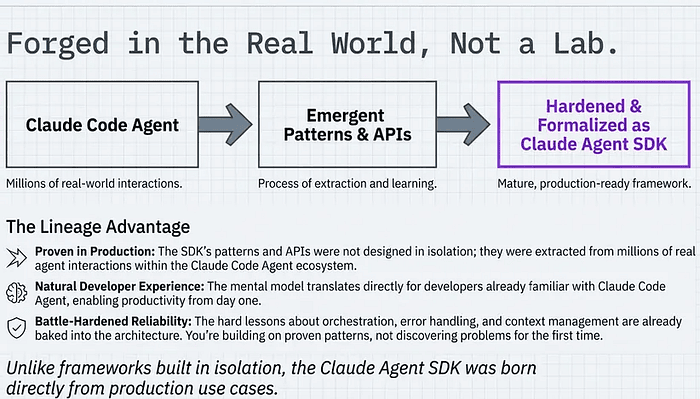 The Claude Agent SDK was originally called the Claude Code Agent SDK, but it has grown out of its just developer centric focus and has been shown to be useful in many domains and is a powerful well-worn battle tested agentic loop solving real-world problems. In the agentic software world, Claude Agent SDK has the experience on its resume
Battle Front #2: The Open Source Revolution
Now let’s cross the battlefield to the other side: the world of open source. This is for the builders who want ultimate control; the special forces operators who want to own their stack from the ground up.
Open source frameworks don’t give you a fully equipped army. They give you the tools to build exactly the force you need.
LangGraph: The Power User’s Weapon
At the heart of the open-source camp, you have LangGraph, the most powerful and flexible framework in the ecosystem. It’s part of the broader LangChain family, but it has evolved into something far more sophisticated.
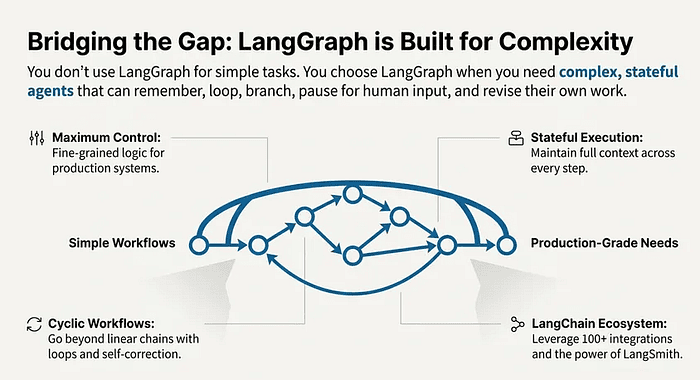 LangChain was built to solve hard problems
Not for Simple Tasks: Built for Complexity:
You don’t grab LangGraph for simple, straight-line tasks. You choose LangGraph when you need complex, stateful agents that must:
- Remember what happened before -- Maintain context across multiple steps
- Loop and branch based on conditions -- Dynamic workflows that adapt to results
- Pause to ask a human for input -- Human-in-the-loop checkpoints
- Revise their approach based on new information -- Self-correction and learning
- Handle fault tolerance and recovery -- Graceful degradation when things go wrong
It’s all managed as a visual graph with nodes (actions) and edges (transitions), enabling critical patterns like branching, looping, and state revision that are impossible with simple chain-based frameworks.
Why Developers Choose LangGraph: Unmatched Control:
Maximum Control for Production Systems
- Unparalleled control for production-grade applications requiring:
- Fault tolerance and sophisticated error handling
- Human-in-the-loop checkpoints at any stage
- Dynamic adaptation based on runtime conditions
- Complex branching logic based on agent outputs
- Observability built-in
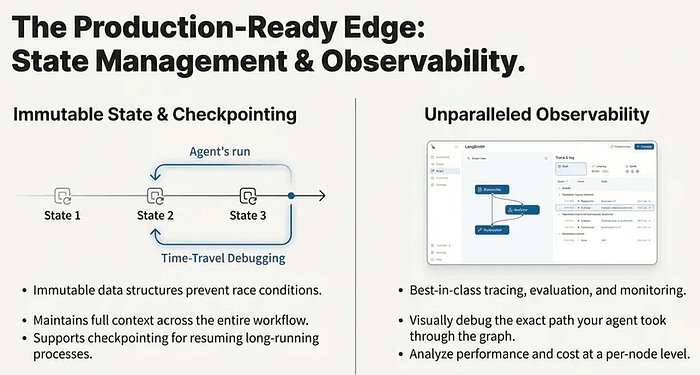 LangGraph has some of the best enterprise tools for monitoring and managing agentic deployments with Observability, which is very advance and not tied to a single cloud vendor.
State Management Excellence
- Uses immutable data structures to prevent race conditions
- Maintains full context across complex workflows
- Supports checkpointing for long-running processes
- Enables time-travel debugging (replay from any state)
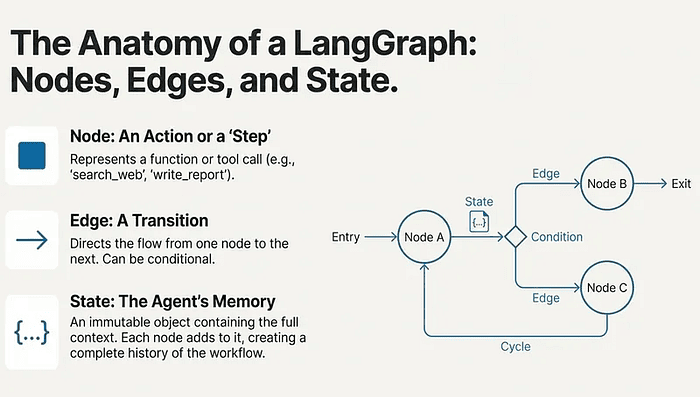 LangGraph: Nodes, Edges and State
Ecosystem Integration
- Benefits from LangChain’s 100+ integrations
- Tight coupling with LangSmith for best-in-class tracing, evaluation, and observability
- Active community contributing new patterns and tools
- Regular updates with cutting-edge features
Real-World Use Case: Autonomous Research Agent:
Scenario: You’re building a research agent that investigates complex technical questions by reading papers, running experiments, and synthesizing findings.
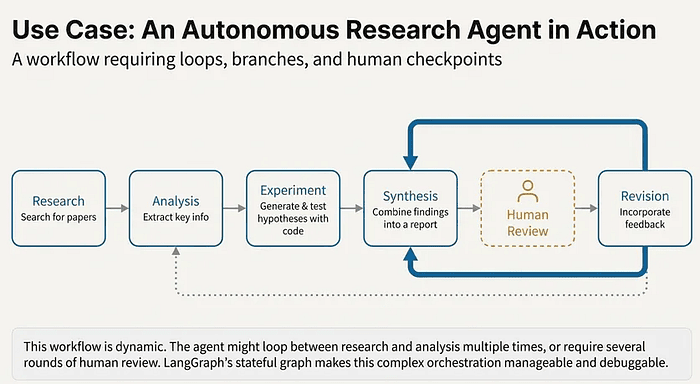 LangChain Use Case
The Workflow:
- Research Phase -- Search for relevant papers and articles
- Analysis Phase -- Read and extract key information
- Experiment Phase -- Generate hypotheses and test them with code
- Synthesis Phase -- Combine findings into a coherent report
- Review Phase -- Human expert reviews and provides feedback
- Revision Phase -- Agent incorporates feedback and improves the report
Where LangGraph Wins:
- This workflow requires loops (iterate on experiments), branches (different paths based on findings), and human checkpoints (expert review)
- State management ensures the agent never loses context across phases
- Fault tolerance handles failures in code execution or API calls
- The graph structure makes the complex workflow visual and debuggable
The Learning Curve Trade-off:
LangGraph has a steep learning curve. You need to understand:
- Graph theory basics (nodes, edges, cycles)
- State management patterns
- Asynchronous programming
- Error handling strategies
But this complexity buys you power and flexibility that make it the preferred choice for complex production systems where the path to a solution is not predetermined.
Best for: Teams building complex, production-grade systems who need maximum flexibility, model-agnosticism, and fine-grained control over agent workflows. Ideal for applications where the agent’s behavior must adapt dynamically to unpredictable conditions.
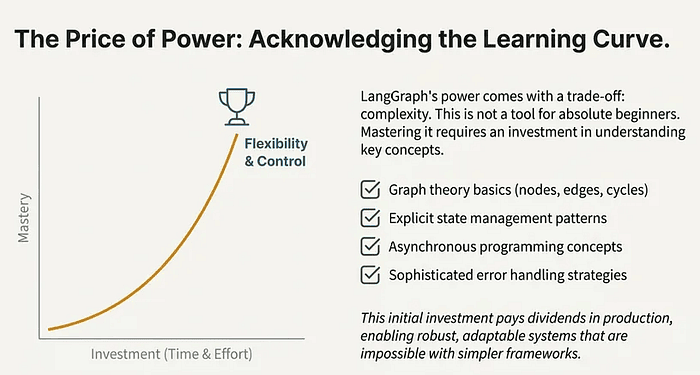 LangChain is not for the casual AI engineer. This is the real deal. But a big investment in time.
LangChain: The Old Guard Still Standing
Before LangGraph, before CrewAI, before the entire ecosystem exploded, there was LangChain. The original framework that started it all. And while it’s no longer the default choice for complex agentic workflows, it remains remarkably relevant.
 The original OSG Agentic Framework
The Pioneer: Building the Foundation:
LangChain launched in October 2022 and quickly became the de facto standard for building LLM applications. It introduced concepts that are now universal across the ecosystem:
- Chains -- Sequential operations that transform inputs to outputs
- Prompts -- Reusable prompt templates with variable interpolation
- Memory -- Stateful conversation history and context management
- Agents -- LLMs that can use tools and make decisions
- Retrievers -- Abstraction layer for document retrieval systems
These patterns became the blueprint for every framework that followed. CrewAI, LlamaIndex, and even cloud platforms borrowed heavily from LangChain’s architecture.
Why It’s No Longer the Default: The Evolution Problem:
LangChain’s challenge is that it was designed for a simpler era. The early abstraction choices that made it powerful also made it difficult to evolve:
Chain-Based Architecture Limitations
- Linear chains struggle with complex branching logic
- Difficult to implement loops and conditional flows
- State management across chains becomes unwieldy
- Hard to debug when chains nest multiple levels deep
Abstraction Overhead
- Heavy abstraction layers that can obscure what’s actually happening
- Steep learning curve for the full API surface
- Breaking changes between versions frustrated developers
- Performance overhead from excessive wrapping
Community Fragmentation
- LangGraph emerged as the better choice for complex workflows
- Developers started choosing specialized tools (LlamaIndex for RAG, CrewAI for teams)
- The “jack of all trades, master of none” perception grew
Where LangChain Still Excels: The Middle Ground:
Despite the competition, LangChain remains the best choice for a specific category of applications:
Simple to Moderately Complex Workflows
- Conversational chatbots with memory
- Document Q&A systems without complex retrieval
- Prompt chaining with 3–5 steps
- Rapid prototyping of LLM features
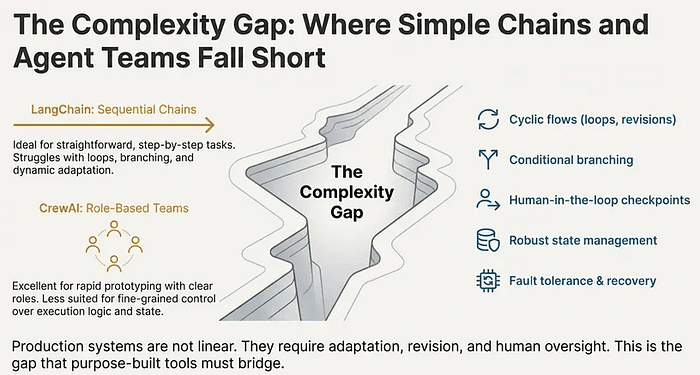 You can start with LangChain and CrewAI to get your MVP and they may always be enough for some use cases; then if you need more, look to LangGraph
Ecosystem Breadth
- Unmatched integration library (100+ tools, APIs, and data sources)
- Pre-built chains for common patterns
- Active community and extensive documentation
- Compatible with LangSmith for observability
Developer Familiarity
- Largest developer community in the space
- Extensive tutorials, courses, and examples
- Most Stack Overflow answers and GitHub issues
- Easy to find developers with LangChain experience
Real-World Use Case: Customer Support Chatbot:
Scenario: You’re building a customer support chatbot for an e-commerce company that answers questions about orders, returns, and product information.
The Requirements:
- Maintain conversation history across multiple messages
- Query company knowledge base for product information
- Access order database to check order status
- Escalate to human agents when needed
- Generate empathetic, brand-appropriate responses
Why LangChain Wins:
Perfect Complexity Match
- The workflow is straightforward (receive message → retrieve context → generate response)
- No complex branching or loops required
- Built-in memory management handles conversation history
Fast Development
- Pre-built chains for conversational retrieval
- Simple integration with vector stores for knowledge base
- Easy connection to SQL databases for order lookup
- From zero to working prototype in days, not weeks
Maintainability
- Clear, readable code that junior developers can understand
- Well-documented patterns for this exact use case
- Easy to extend with new tools and data sources
Not Worth the Complexity
- LangGraph would be overkill for this straightforward workflow
- CrewAI’s role-based model doesn’t fit (single agent is sufficient)
- LlamaIndex is too specialized (basic RAG is enough)
The Verdict: Know When to Use the Classics:
LangChain is like a reliable sedan. It’s not the fastest sports car (LangGraph), not the rugged off-roader (LlamaIndex), and not the flashy new model (CrewAI). But it’s comfortable, practical, and gets most people where they need to go without fuss.
Use LangChain when:
- Your workflow is primarily sequential with minimal branching
- You need rapid prototyping with proven patterns
- Your team is already familiar with the framework
- You’re building conversational applications with memory
- You need broad integration support out of the box
Don’t use LangChain when:
- You need complex state management with loops and branches (use LangGraph)
- Your agents need role-based collaboration (use CrewAI)
- Your primary focus is sophisticated document retrieval (use LlamaIndex)
- You need enterprise managed infrastructure (use cloud platforms)
The old guard isn’t dead. It’s just found its niche in the ever-expanding battlefield of AI frameworks. And for a huge swath of real-world applications, that niche is exactly where you need to be.
Best for: Simple to moderately complex conversational applications, teams that prioritize development speed and ecosystem breadth over cutting-edge features, and organizations with existing LangChain expertise who don’t need the advanced capabilities of newer frameworks.
CrewAI: The Rapid Prototyping Champion
Then you have CrewAI, and its philosophy is totally different: and honestly, brilliantly intuitive.
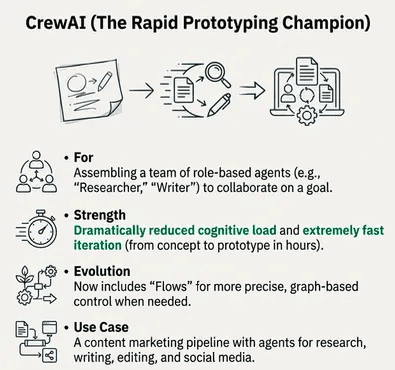 CrewAI: Use teams of agents instead of graphs of agents
Assemble a Team, Not a Graph: The Role-Based Revolution:
Here, you don’t build complex graphs. You assemble a team. The architecture is beautifully simple and mirrors how humans work:
Agents -- Defined with roles (e.g., “Senior Researcher”) and backstories
- Each agent has a specific expertise
- Agents have personalities and working styles
- They collaborate naturally based on their roles
Tasks -- Specific objectives assigned to agents
- Clear, actionable goals
- Dependencies between tasks
- Expected outputs defined upfront
Crews -- Teams of agents working toward a shared goal
- Hierarchical or collaborative structures
- Automatic task delegation based on agent roles
- Built-in coordination and communication
You define agents with roles like “researcher” or “writer,” give them a shared goal, and CrewAI handles the collaboration. It’s incredibly fast for getting an idea off the ground.
The Developer Experience Advantage: Speed Wins:
Why CrewAI Wins for Prototyping:
Dramatically Reduced Cognitive Load
- Role-based design matches human mental models
- No need to think about graphs, nodes, or edges
- Focus on what agents do, not how they do it
Extremely Fast Iteration
- From concept to working prototype in hours, not days
- Simple API with minimal boilerplate
- Built-in patterns for common scenarios
Autonomous Coordination
- CrewAI handles task delegation based on agent roles
- Agents communicate naturally without explicit routing
- Automatic error handling and retries
Real-World Use Case: Content Marketing Pipeline:
Scenario: You’re building a content marketing system that researches topics, writes articles, and generates social media posts.
The Crew:
- Research Agent -- “Senior Market Researcher with expertise in tech trends”
- Task: Research trending topics in AI and gather key insights
2. Writer Agent -- “Experienced Technical Writer with a knack for clear explanations”
- Task: Write a 1,500-word article based on research findings
3. Editor Agent -- “Meticulous Editor focused on clarity and engagement”
- Task: Review and improve the article
4. Social Media Agent -- “Creative Social Media Manager skilled at viral content”
- Task: Generate Twitter thread and LinkedIn post from the article
Why CrewAI Wins:
- This workflow is naturally role-based (just like a real marketing team)
- Each agent has clear responsibilities
- CrewAI handles coordination automatically
- You can prototype this entire system in an afternoon
The Common Wisdom: Start Fast, Scale Later:
This highlights the dynamic between LangGraph and CrewAI. The common wisdom you hear from developers everywhere is:
Start with CrewAI because it’s unbelievably fast for prototyping. Prove your concept, validate your idea, and get feedback from users.
Then, once you’ve proven the concept, migrate that core logic over to LangGraph to get the fine-grained control and robustness you need for production.
Recent Evolution: Flows for Precision Control:
CrewAI recently added Flows, which complement Crews by providing precise, graph-based control over execution logic. This allows developers to balance agent autonomy with deterministic workflow control when needed.
Think of it as having both a creative team (Crews) and a project manager (Flows) working together.
Best for: Rapid prototyping, proof-of-concept development, and role-based agent systems where speed to first working version is critical. Ideal for startups and innovation teams that need to validate ideas quickly.
LlamaIndex: The RAG Specialist
Finally, in the open-source world, we have the specialist: LlamaIndex. This is the framework that does one thing exceptionally well.
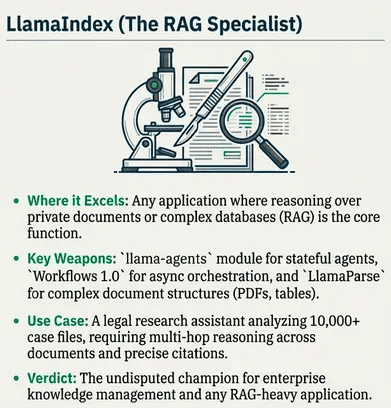 LlamaIndex: Document and RAG expert
Purpose-Built for Private Data: The Document Warrior:
If your agent’s main job is to reason over your own private documents or complex databases; that whole process we call Retrieval Augmented Generation (RAG); then LlamaIndex is the undisputed champion. Full stop.
No other framework comes close to LlamaIndex’s sophistication in handling document-heavy workflows.
What Makes LlamaIndex Special: Unmatched RAG Capabilities:
LlamaIndex has evolved from a data-indexing library to a full-fledged agentic framework specializing in document-heavy workflows.
Key Components:
llama-agents module
- For creating stateful, intelligent agents
- Specialized in document understanding and reasoning
- Built-in support for multi-hop reasoning across documents
Workflows 1.0
- Event-driven, async-first system
- Orchestrates complex multi-step processes
- Handles document processing pipelines efficiently
LlamaParse
- Specialized tool for parsing complex document structures
- Handles PDFs, Word docs, PowerPoint, and more
- Preserves formatting, tables, and images
Architecture Excellence:
Excels at creating data-aware agents that can query and reason over:
Structured Datastores
- SQL databases with natural language queries
- NoSQL databases (MongoDB, Cassandra)
- Data warehouses (Snowflake, BigQuery)
Vector Stores for Semantic Search
- Pinecone, Weaviate, Qdrant, Chroma
- PostgresSQL Vector indexes
- Hybrid search (keyword + semantic)
- Metadata filtering for precise retrieval
Graph Databases for Relationship Analysis
- Neo4j, Amazon Neptune
- Knowledge graph construction from documents
- Multi-hop reasoning across relationships
Real-World Use Case: Legal Document Analysis:
Scenario: You’re building a legal research assistant for a law firm that needs to analyze thousands of case files, contracts, and legal precedents.
The Requirements:
- Ingest 10,000+ legal documents (PDFs, Word docs)
- Build a searchable knowledge base with semantic understanding
- Answer complex legal questions that require reasoning across multiple documents
- Cite sources with page numbers and excerpts
- Handle follow-up questions that refine the search
Why LlamaIndex Wins:
Document Ingestion
- LlamaParse handles complex PDF layouts (multi-column, tables, footnotes)
- Preserves legal citations and formatting
- Extracts metadata (case numbers, dates, parties)
Semantic Search
- Vector embeddings capture legal concepts and precedents
- Hybrid search combines keyword matching with semantic understanding
- Metadata filtering (e.g., “cases from 2020–2023 in California”)
Multi-Hop Reasoning
- Agent can follow chains of legal precedents
- Synthesizes information from multiple cases
- Identifies contradictions and nuances
Citation Quality
- Returns exact page numbers and excerpts
- Maintains source attribution for legal compliance
- Enables lawyers to verify findings quickly
Development Time:
- With LlamaIndex: 2–3 weeks to production
- With general-purpose frameworks: 2–3 months (building RAG infrastructure from scratch)
The RAG Ecosystem Advantage:
LlamaIndex provides:
- 100+ data connectors -- Notion, Google Drive, Slack, databases, APIs
- 25+ vector store integrations -- Choose the best tool for your scale
- Advanced retrieval strategies -- Sentence window, auto-merging, hierarchical
- Query optimization -- Automatic query rewriting and routing
- Evaluation tools -- Measure retrieval quality and answer accuracy
Best for: Enterprise knowledge management, legal document analysis, customer support systems grounded in extensive documentation, and any application where RAG is central to the value proposition. Ideal for teams that need to build sophisticated document understanding systems quickly.
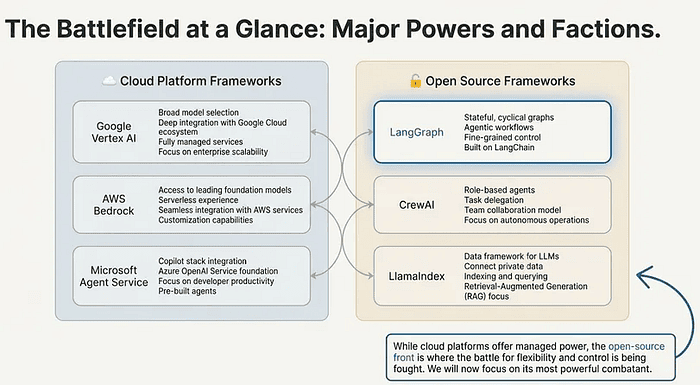 There are many choices and the reality is you can mix and match. There are integration points. It is about picking the best tool for the job.
Choosing Your Framework: The Strategic Decision Guide
We’ve seen the players, we’ve mapped the battlefield, we’ve examined their weapons. Now for the most important part: How do you match the right framework to your specific mission?
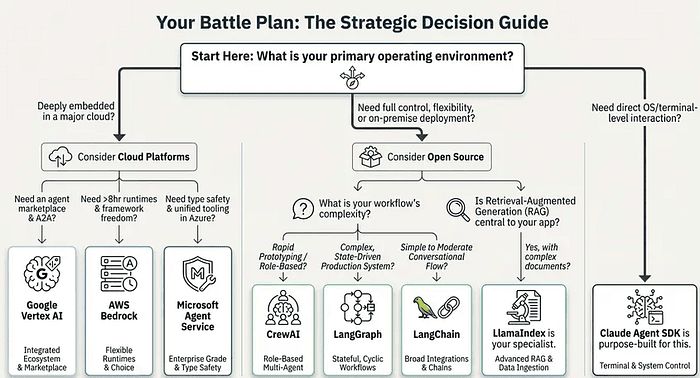 Google Vertex AI, AWS Bedrock, Microsoft Agent Service, CrewAI, LangChain, LangGraph, LlamaIndex, and the Claude Agent SDK: there are so many choices and options. It is good to have a decision chart.
This is where we turn all theory into actual, actionable strategy.
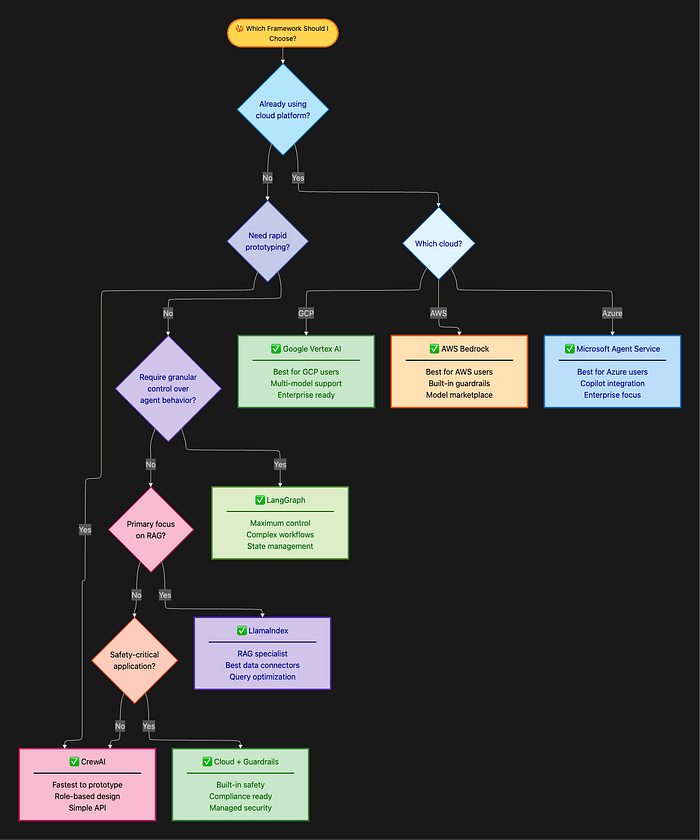 How do you decide which Agentic Framework to choose?
The Key Question: What Is Your Mission?
Before you choose a framework, you need to answer these fundamental questions:
Strategic Questions:
- Are you building deep inside an enterprise cloud ecosystem?
- Do you need raw prototyping speed, or do you need ultimate granular control?
- Testing and evaluation infrastructure
- Ongoing optimization and fine-tuning
Operational Costs:
- Human review and quality assurance
- Customer support for agent failures
- Compliance and security audits
The bottom line: The cheapest framework isn’t always the most cost-effective. Factor in total cost of ownership, not just model API costs.
The Future: Is a Truce Coming?
After all this talk of wars, battle fronts, and champions, where is all of this heading?
The most powerful trend we’re seeing suggests less conflict and more collaboration. A truce might be on the horizon.
Rapid Standardization: From Chaos to Convergence
Look at this timeline. The pace of change is incredible. In just one year, we went from scattered, fragmented tools to major players unifying around common standards.
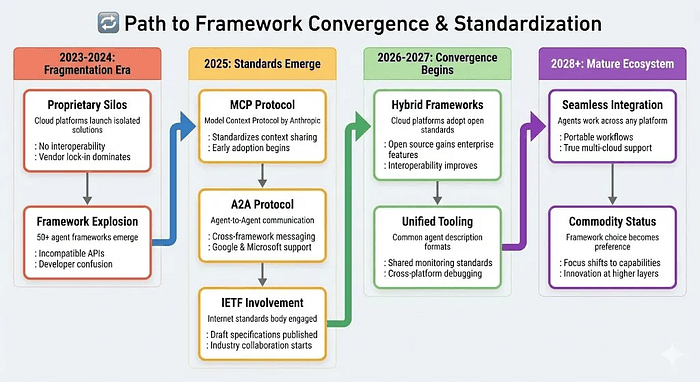
timeline
    title 🔄 Path to Framework Convergence & Standardization

    section 2023-2024: Fragmentation Era
        Proprietary Silos : Cloud platforms launch isolated solutions
                          : No interoperability
                          : Vendor lock-in dominates
        Framework Explosion : 50+ agent frameworks emerge
                            : Incompatible APIs
                            : Developer confusion

    section 2025: Standards Emerge
        MCP Protocol : Model Context Protocol by Anthropic
                     : Standardizes context sharing
                     : Early adoption begins
        A2A Protocol : Agent-to-Agent communication
                     : Cross-framework messaging
                     : Google & Microsoft support
        IETF Involvement : Internet standards body engaged
                         : Draft specifications published
                         : Industry collaboration starts

    section 2026-2027: Convergence Begins
        Hybrid Frameworks : Cloud platforms adopt open standards
                          : Open source gains enterprise features
                          : Interoperability improves
        Unified Tooling : Common agent description formats
                        : Shared monitoring standards
                        : Cross-platform debugging

    section 2028+: Mature Ecosystem
        Seamless Integration : Agents work across any platform
                             : Portable workflows
                             : True multi-cloud support
        Commodity Status : Framework choice becomes preference
                         : Focus shifts to capabilities
                         : Innovation at higher layers
The Protocol Revolution: Building the Peace Treaty -- MCP and A2A not war
Three major protocols are emerging as the foundation for interoperability:
Model Context Protocol (MCP): The Universal Translator:
What it is: Originally introduced by Anthropic, MCP provides a universal, standardized interface for connecting AI models to external tools and data.
The breakthrough: On November 12, 2025, the MCP 1.0 specification was finalized and became an official IETF internet-draft, with native server support announced by Google, OpenAI, Anthropic, and Mistral.
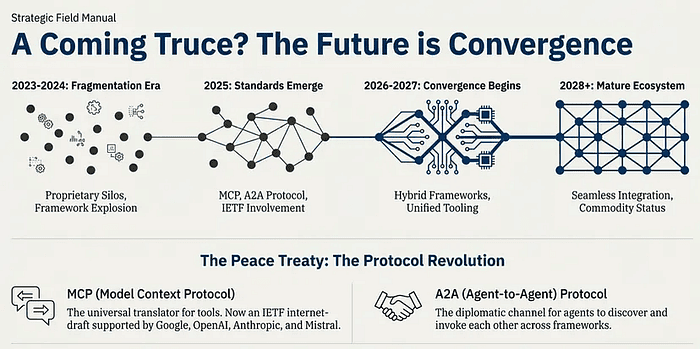
What this means: Any tool that implements MCP can work with any model that supports MCP. No more building custom integrations for each model.
Real-world impact:
- Build a database connector once, use it with Claude, GPT, Gemini, or Llama
- Switch models without rewriting tool integrations
- Third-party developers can build tools that work everywhere
One issue with MCP is using too many tools pollutes your context memory. Claude has a new MCP tool search tool which loads MCPs only when needed. Docker and CloudFlare have similar solutions to minimize context rot and minimize the tools to the ones that you need.
Agent-to-Agent (A2A) Protocol: The Diplomatic Channel:
What it is: Google’s A2A protocol is a complementary standard focused explicitly on agent-to-agent communication, discovery, and invocation.
The innovation: Unlike MCP (which focuses on tools), A2A enables agents to discover and invoke other agents using natural language routing.
What this means: An agent built with LangGraph can discover and invoke an agent built with CrewAI, which can then invoke an agent built with Microsoft Agent Service.
Real-world impact:
- Build specialized agents and make them discoverable to the entire ecosystem
- Compose complex systems from best-of-breed agents
- Monetize your agents by publishing them to marketplaces
IETF Formalization: Making It Official:
What it is: These protocols are now being formalized by the Internet Engineering Task Force (IETF): the same group that defines how the internet works (HTTP, TCP/IP, DNS).
What this means: These aren’t just vendor-specific standards. They’re becoming fundamental internet protocols with the same level of standardization as email or the web.
Real-world impact:
- Long-term stability and backward compatibility
- Industry-wide adoption and support
- Foundation for the next decade of AI development
The Big Question: Will Framework Wars Even Matter?
This leaves us with one last, fascinating question:
As these protocols for getting agents to talk to each other become the norm, will these framework wars even matter anymore?
Or is the future a collaborative garden of specialized agents, all speaking the same common language?
The Convergence Hypothesis: A Unified Future
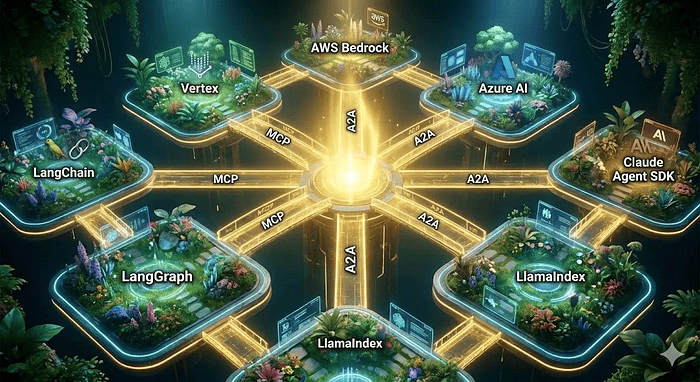 Futuristic visualization of AI agent ecosystem with specialized agents connected by golden protocol bridges labeled MCP and A2A, converging into a collaborative interoperable digital garden
The evidence suggests we’re heading toward a world where:
Frameworks Become Commoditized
- The choice of framework matters less as interoperability increases
- Developers choose based on developer experience, not capability
- Migration between frameworks becomes easier
Specialized Agents Emerge
- Instead of monolithic solutions, we’ll compose ecosystems of focused agents
- Each agent does one thing exceptionally well
- Agents are discovered and invoked dynamically based on capabilities
Standards Enable Competition
- Open protocols mean agents can be swapped out
- Forces continuous innovation to stay competitive
- Prevents any single vendor from dominating
The “Agent Marketplace” Becomes Reality
- Discover, deploy, and monetize agents across any platform
- Third-party developers build specialized agents for niche use cases
- Enterprises compose custom solutions from marketplace agents
What this means for you: Choose frameworks based on developer experience and ecosystem, not fear of lock-in. The future is portable.
Pick the best tool for the job.
Conclusion: Making Your Choice and Winning the War
The AI agent framework wars of 2025 are real, intense, and consequential. But they’re also a sign of a healthy, rapidly maturing ecosystem. The battles we’re seeing today are forging the standards and tools that will define the next decade of AI development.
Your strategic battle plan:
1. Understand Your Mission
- Cloud-native enterprise integration? → Cloud platforms
- Rapid prototyping and validation? → CrewAI, Claude Agent SDK
- Complex production workflows? → LangGraph
- Simpler workflows? → LangChain
- RAG-heavy applications? → LlamaIndex
- Safety-critical systems? → Anthropic Claude 4.5 with MCP
2. Evaluate the Economics
- Can your business model support premium models?
- What’s your breakeven point for cost savings?
- Do you have infrastructure for self-hosting?
- Factor in total cost of ownership, not just API costs
3. Consider the Future
- Bet on platforms and frameworks that embrace interoperability standards (MCP, A2A)
- Choose frameworks with active communities and regular updates
- Prioritize portability over vendor-specific features
- Build with the assumption that you’ll need to integrate with other agents
4. Start Pragmatically
- Use CrewAI and Claude Agent SDK to prove concepts quickly
- Migrate to LangGraph for production if you need fine-grained control with observability
- Go all-in on cloud platforms if you’re already committed to that ecosystem
- Don’t over-engineer; start simple and scale complexity as needed
The Dark Horse: Claude Agent SDK
There’s one more contender we haven’t discussed yet in depth, and it might be the most underestimated player in the framework wars: Claude Agent SDK.
Why it matters:
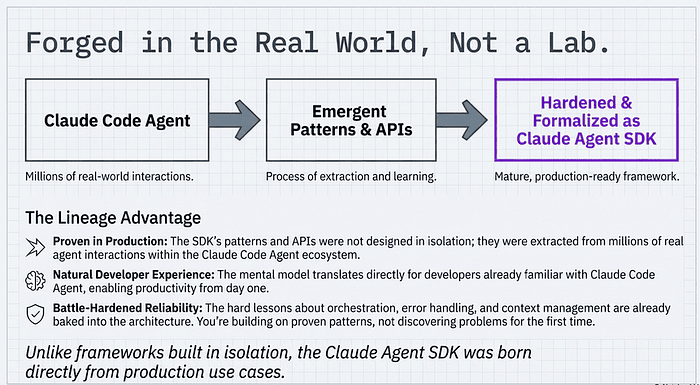
The Claude Agent SDK has a unique advantage that many developers overlook: real-world battle testing. Unlike frameworks built in isolation, the Claude Agent SDK was born directly from the Claude Code Agent ecosystem -- meaning it evolved from actual production use cases, not theoretical design.
The lineage advantage:
- Proven in production -- The patterns and APIs emerged from millions of real agent interactions
- Natural developer experience -- If you’ve mastered Claude Code Agent, the SDK feels immediately familiar
- Tight Claude integration -- First-class support for Claude’s extended thinking, tool use, and context management
- MCP-native -- Built from the ground up with Model Context Protocol support
Who should consider Claude Agent SDK:
- Developers already comfortable with Claude Code Agent who want to extend those patterns
- Teams prioritizing Claude models and wanting the most natural integration
- Projects requiring sophisticated tool use and context management
- Applications where developer productivity and intuitive APIs are critical
The productivity factor:
For developers who have already mastered Claude Code Agent, the Claude Agent SDK isn’t just another framework to learn; it’s a natural extension of their existing skills. The mental model translates directly, meaning you can be productive from day one rather than climbing another learning curve.
Real-world impact: The SDK’s lineage from Claude Code Agent means the hard lessons about agent orchestration, error handling, and context management are already baked in. You’re not starting from scratch; you’re building on proven patterns.
Bottom line: Don’t sleep on Claude Agent SDK. While it may not have the massive marketing push of cloud platforms or the broad ecosystem of LangGraph, its real-world heritage and natural developer experience make it a dark horse worth serious consideration; especially if Claude or Claude Code is already part of your stack.
The Winning Strategy: Flexibility and Standards
The framework wars won’t last forever. The protocols being developed today (MCP, A2A) are building bridges between the warring factions. In 2–3 years, the choice of framework will matter less than the quality of your agents and the value they deliver.
But the choices you make today will shape your projects for years to come.
Choose wisely. Build with standards. Stay flexible. And may the best framework win; or better yet, may they all learn to work together.
Key Takeaways: Your Field Manual Summary
✅ The fundamental choice: Cloud platforms (speed, security, managed infrastructure) vs. Open source (control, flexibility, cost optimization)
✅ Cloud champions:
- Google Vertex AI -- Agent Garden marketplace, A2A protocol, GCP integration
- AWS Bedrock -- 24-hour sessions, framework-agnostic, modular services
- Microsoft Agent Service -- Unified AutoGen + Semantic Kernel, Azure integration
✅ Open source champions:
- LangGraph -- Complex workflows, state management, maximum control
- CrewAI -- Rapid prototyping, role-based design, fast iteration
- LlamaIndex -- RAG specialist, document understanding, best data connectors
✅ Economics matter: 80x cost difference between premium and open-source models can determine project viability. Know your breakeven point.
✅ Standards are emerging: MCP and A2A protocols creating interoperability, IETF formalization making them official internet standards
✅ The future is collaborative: Specialized agent ecosystems speaking common languages, not monolithic platform lock-in. Framework choice becomes preference, not prison.
✅ Start pragmatically: Prototype fast (CrewAI), scale to production (LangGraph), or commit to cloud platforms if already invested. Build with standards for portability.
Last updated: December 2025 Battlefield intelligence compiled from real-world deployments and official framework documentation
About the Author
Rick Hightower is an accomplished technology executive and data engineer with extensive experience at a Fortune 100 financial technology organization, where he led the development of advanced Machine Learning and AI solutions focused on enhancing customer experience metrics and fraud detection. His expertise spans both theoretical AI research and practical enterprise implementation.
His professional qualifications include TensorFlow certification and completion of Stanford University’s Machine Learning Specialization program. Rick’s technical proficiency encompasses supervised learning methodologies, neural network architectures, and enterprise-grade AI solution development. He recently earned multiple certifications from Anthropic, including Claude SDK implementation on Vertex AI and Amazon Bedrock, Claude Tools, and Model Context Protocol (MCP). His hands-on experience includes building production systems with LangChain, LlamaIndex, ChatGPT API, Lite-llm, and other frameworks across AWS, Azure, and GCP cloud platforms. Currently, his focus is on agentic AI solutions utilizing Claude Code, OpenCode, and Claude Agent SDK.
Rick wrote the skilz universal skill installer that works with Gemini, Claude Code, Codex, OpenCode, Github Copilot CLI, Cursor, Aidr, Qwen Code, Kimi Code and about 14 other coding agents as well as the co-founder of the world’s largest agentic skill marketplace.
And, remember now it is not just Claude Code but also Codex, Github Copilot and OpenCode have all announced support for Agentic Skills. There is even a marketplace for agentic skills that support Gemini, Aidr, Qwen Code, Kimi K2 Code, Cursor (14+ and counting) and more with Agentic Skill Support via a universal installer.
Connect with Rick Hightower on LinkedIn or Medium for insights on enterprise AI implementation and strategy.
Community Extensions & Resources
The Claude Code community has developed powerful extensions that enhance its capabilities. Here are some valuable resources from Spillwave Solutions:
Integration Skills
- Notion Uploader/Downloader: Seamlessly upload and download Markdown content and images to Notion for documentation workflows
- Confluence Skill: Upload and download Markdown content and images to Confluence for enterprise documentation
- JIRA Integration: Create and read JIRA tickets, including handling special required fields
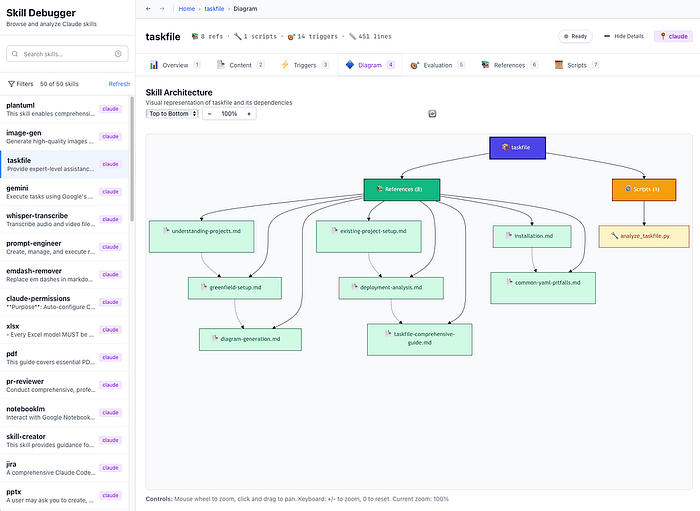
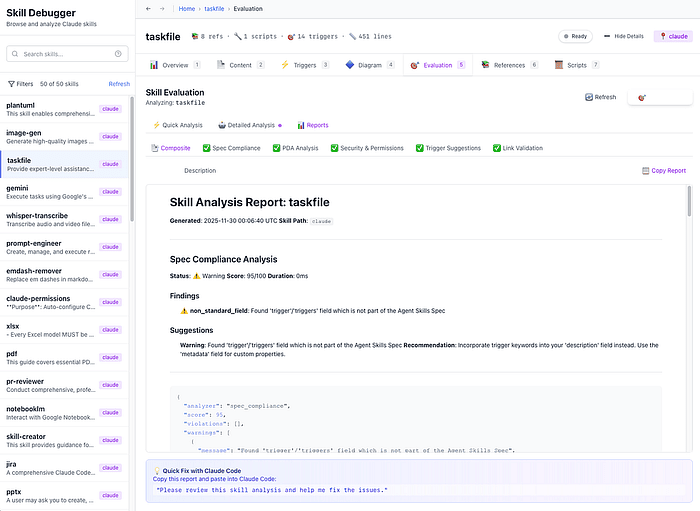
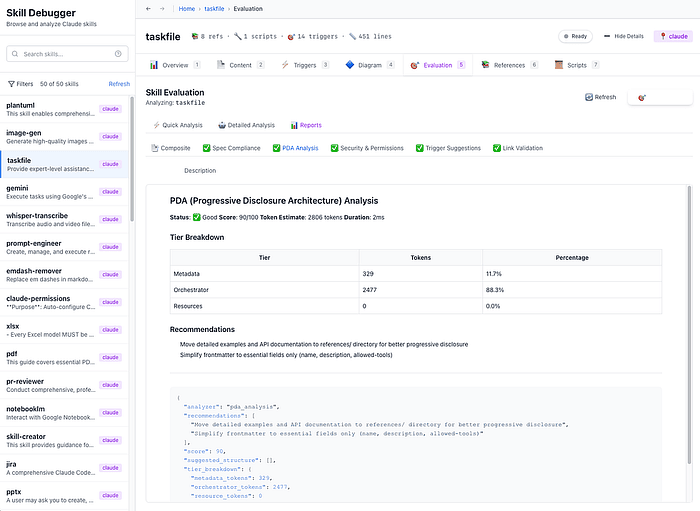
Recently, I wrote a desktop app called Skill Viewer to evaluate Agents skills for safety, usefulness, links and PDA.
Press enter or click to view image in full size
Press enter or click to view image in full size
Press enter or click to view image in full size
Press enter or click to view image in full size
Press enter or click to view image in full size
Press enter or click to view image in full size
Advanced Development Agents
- Architect Agent: Puts Claude Code into Architect Mode to manage multiple projects and delegate to other Claude Code instances running as specialized code agents
- Project Memory: Store key decisions, recurring bugs, tickets, and critical facts to maintain vital context throughout software development
- Claude Agents Collection: A comprehensive collection of 15 specialized agents for various development tasks
Visualization & Design Tools
- Design Doc Mermaid: Specialized skill for creating professional Mermaid diagrams for architecture documentation
- PlantUML Skill: Generate PlantUML diagrams from source code, extract diagrams from Markdown, and create image-linked documentation
- Image Generation: Uses Gemini Banana to generate images for documentation and design work
- SDD Skill: A comprehensive Claude Code skill for guiding users through GitHub’s Spec-Kit and the Spec-Driven Development methodology.
AI Model Integration
- Gemini Skill: Delegate specific tasks to Google’s Gemini AI for multi-model collaboration
- Image_gen: Image generation skill that uses Gemini Banana to generate images.
**Explore more at **Spillwave Solutions -- specialists in bespoke software development and AI-powered automation.