Why AI Won't Kill SaaS -- It Will Unleash It
Originally published on Medium.

Is AI the key to unlocking the true potential of SaaS? Or is SaaS dead? Discover how artificial intelligence is set to revolutionize software development, turning rigid solutions into perfectly tailored platforms for your unique business needs. Don’t miss out on the future of enterprise software!
AI is transforming SaaS by enabling custom software development that adapts to specific business needs, reducing costs and complexity. This shift will lead to an explosion of niche SaaS solutions, allowing businesses to choose platforms that fit their unique processes rather than forcing adaptations to generic systems.

How artificial intelligence is about to solve the biggest problem in enterprise software
Picture this: Your company just spent eighteen months and seven figures implementing a new ERP system. The consultants have finally left. Your team has been trained. Everything should be running smoothly. Instead, you’re watching your sales team create elaborate workarounds in spreadsheets because the CRM doesn’t quite capture how your unique sales process actually works.
Sound familiar? You’re not alone. This scenario plays out in boardrooms across the globe, representing one of the most expensive and persistent challenges in modern business technology.
The Great Software Compromise
For decades, businesses have faced an uncomfortable choice when adopting enterprise software. On one side, there’s the promise of powerful, feature-rich platforms like Salesforce, SAP, or Oracle -- systems that can theoretically handle everything from customer relationships to supply chain management. On the other side, there’s the reality that your business doesn’t operate exactly like every other business.
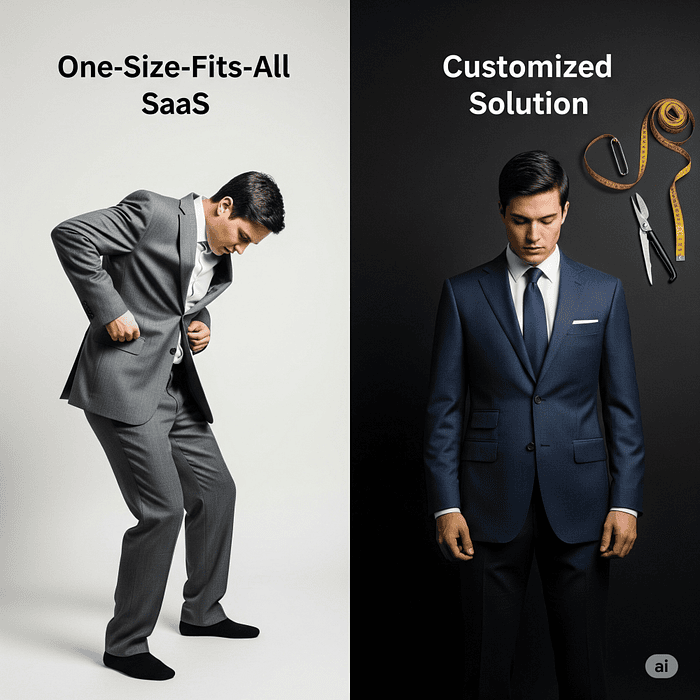
This is what we call the “software compromise.” Software as a Service (SaaS) platforms are built to serve the common denominator -- the shared needs of thousands of companies across industries.
But your business has its own language, its own processes, its own way of connecting with customers. When you try to fit these unique elements into a standardized system, something has to give.
The result? Expensive customizations, complex integrations, and often a fundamental reshaping of how your business operates to match how your software thinks you should operate. It’s the technological equivalent of buying a suit off the rack and then paying more for alterations than the original suit cost.
The Hidden Costs of Conformity
Let’s examine what this compromise actually costs businesses:
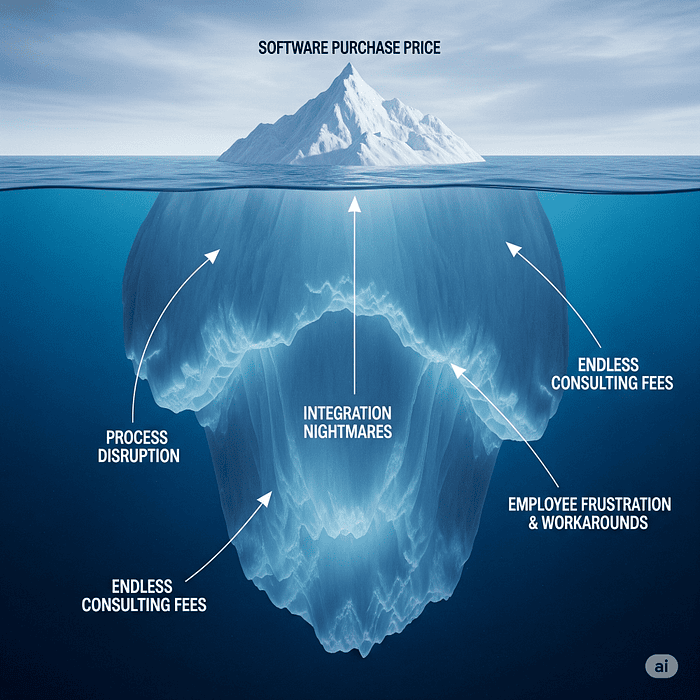
Process Disruption: Teams are forced to abandon workflows that have been refined over years, sometimes decades. The institutional knowledge embedded in these processes -- the subtle adaptations that made your company competitive -- gets lost in translation.
Integration Complexity: When standard software doesn’t quite fit, companies layer on additional tools, creating a complex web of integrations. Each integration point becomes a potential failure point, requiring ongoing maintenance and specialized knowledge.
Consultant Dependency: The gap between what the software does and what your business needs gets filled by expensive consultants who speak both your business language and the software’s language. These specialists become critical dependencies, and their knowledge often walks out the door when projects end.
User Resistance: When systems don’t match how people actually work, adoption suffers. Users create shadow systems -- those spreadsheets and workarounds that defeat the purpose of having integrated software in the first place.
Enter AI: The Great Equalizer
Here’s where the conventional wisdom gets it wrong. Many predict that AI will reduce the need for software developers and shrink the software industry. The logic seems sound: if AI can automate coding, we’ll need fewer developers and less custom software.

But this prediction misses a fundamental shift that’s already beginning to unfold.
AI isn’t just making developers more productive -- it’s democratizing software development itself.
What once required large teams and substantial budgets can now be accomplished by small, focused teams leveraging AI-powered development tools.
Think about what this means for the software compromise. Instead of forcing your business processes into a one-size-fits-all solution, you can now create software that adapts to your business. The price will be lowered enough where this is a viable option for many more projects.
The Custom Software Renaissance
We’re entering an era where the economics of custom software development are being completely rewritten. Here’s how AI is changing the game:
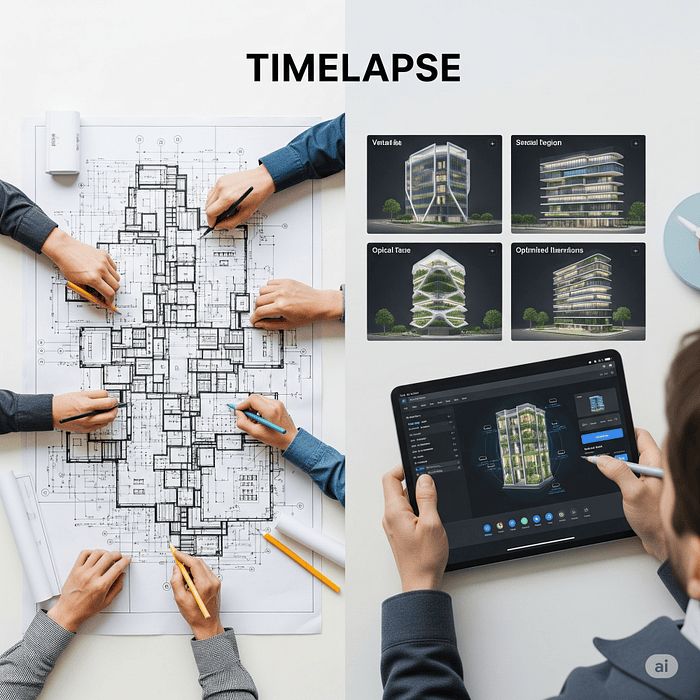
Rapid Prototyping: AI-assisted development allows teams to quickly build and iterate on custom solutions. What used to take months of development can now happen in weeks or even days.
Lower Technical Barriers: AI coding assistants are making it possible for smaller teams to tackle complex projects.
The specialized knowledge required to build enterprise-grade software is becoming more accessible.
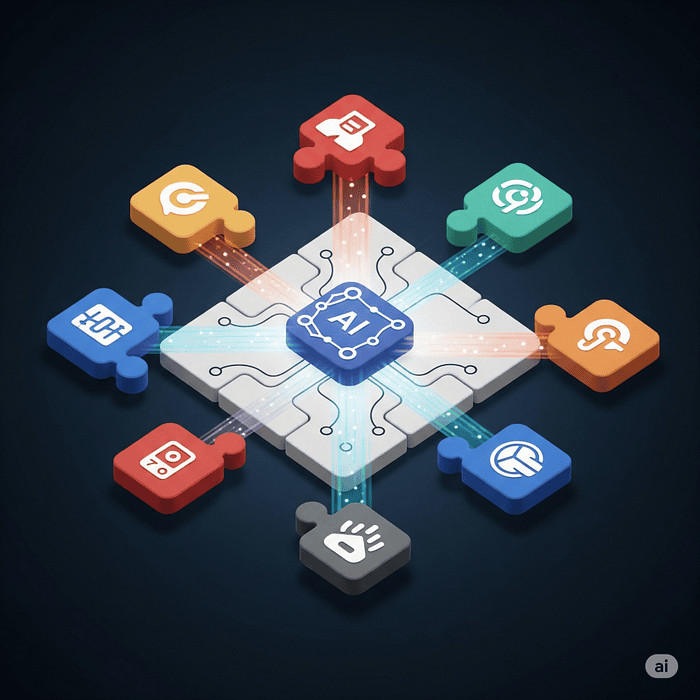
Intelligent Integration: AI doesn’t just help build new systems -- it excels at connecting existing ones. Instead of complex, brittle integrations, AI can create intelligent middleware that adapts to changes in connected systems.
Domain-Specific Solutions: With lower development costs, it becomes economically viable to create software for highly specific use cases. Your industry’s unique challenges can finally have purpose-built solutions.
The New SaaS Landscape: From One-Size-Fits-All to Perfect-Fit Solutions
Here’s where the real disruption happens -- and it’s not what most people expect.
Custom development still has costs. Even with AI assistance, building truly bespoke software requires time, expertise, and ongoing maintenance. But here’s the crucial insight: AI doesn’t just make custom development cheaper -- it makes hyper-specialized SaaS economically viable.
Instead of fewer SaaS companies, we’re about to see an explosion of what I call “Niche SaaS” or “SaaS-for-Y” -- Software as a Service designed for Your specific problem, Your industry, Your exact business model. What do you think? SaaSY or microSaaS? Vote in the comments.
The Economics of Hyper-Specialization: When development costs drop dramatically, suddenly it becomes profitable to build SaaS solutions for markets that were previously too small. A SaaS platform specifically for orthodontist offices with 3–5 locations? Economically viable. Project management software designed exclusively for film post-production teams? Now it makes business sense.
Consolidation Through Specialization: Rather than everyone building custom solutions from scratch, businesses will gravitate toward these highly specialized SaaS platforms that feel custom-built for their exact needs. Why spend months developing a custom solution when there’s already a SaaS platform that speaks your industry’s language and handles your specific workflows?
The Long Tail Goes SaaS: Markets that were too niche for traditional SaaS development -- those long-tail business needs that required expensive custom solutions -- suddenly have their own dedicated platforms. This creates a paradox: more software options leading to more standardization within micro-niches.
Rapid Platform Evolution: These specialized platforms can evolve quickly based on user feedback from their focused customer base. When your entire user base shares similar challenges, feature development becomes laser-focused and highly relevant.

What This Means for Business Leaders
For executives and technical leaders, this shift represents a fundamental change in software strategy:
The SaaS Explosion: Prepare for a marketplace with exponentially more software options. The challenge won’t be finding software that does what you need -- it’ll be finding the platform that fits your specific business model among hundreds of highly specialized options. And if none fit your exact needs, the cost of building your own is much more affordable.
Evaluation Complexity: With more niche options available, software selection becomes both easier and harder. Easier because solutions will fit better; harder because there will be so many specialized options to evaluate.
Competitive Differentiation: Your competitive advantage may increasingly come from identifying and adopting the right niche SaaS platforms before your competitors do.
The businesses that can quickly identify and implement highly specialized solutions will move faster than those stuck with general-purpose platforms.
Budget Reallocation: Instead of spending on expensive customizations and integrations, budgets will shift toward subscribing to multiple specialized platforms and the tools needed to connect them intelligently.

The Integration Advantage
One often-overlooked benefit of AI-powered development is superior integration capabilities. AI excels at understanding and translating between different data formats, APIs, and business logic. This means:
- Easier connections between existing systems
- More intelligent data synchronization
- Adaptive integrations that can handle changes in connected systems
- Reduced maintenance overhead for complex system architectures
- Ability to take many smaller SaaSy products or micro SaaS and compose them into a custom solution
This lets businesses combine specialized tools to create custom solutions they can easily modify as their needs change.
Better yet, AI-powered integration tools will serve as the connective tissue between these specialized platforms, creating seamless workflows that were previously impossible. The days of clunky middleware and brittle point-to-point connections are numbered. What emerges is a more flexible, adaptable software ecosystem that can truly conform to how businesses operate. Think MCP and A2A, and the other platforms and standards that will arise to meet this challenge.

Beyond the Death of SaaS: The Great Multiplication
The narrative that AI will kill SaaS fundamentally misunderstands what’s happening. AI won’t reduce the number of SaaS companies -- it will multiply them exponentially. You will be able to mix and match much easier as well as build and integrate your own custom processes much easier.

We’re moving from a world of dozens of horizontal platforms serving millions of users to a world of thousands of vertical platforms serving thousands of users each. Every industry, every business model, every workflow that currently requires painful customization will eventually have its own purpose-built SaaS platform.
This isn’t the death of SaaS -- it’s SaaS finding its true form. Instead of forcing millions of businesses to adapt to a few platforms, we’ll have platforms that adapt to specific business types. Morph the software to our business and keep our competitive edge.
The New Build vs. Buy Equation: The question changes from “Should we customize this platform or build our own?” to “Should we subscribe to the niche platform built specifically for businesses like ours, or try to make do with something more general?”
Platform Proliferation: Where today you might evaluate 5–10 CRM options, tomorrow you might choose between 50+ CRM platforms designed for specific industries, company sizes, and business models.
Standardization Through Specialization: Paradoxically, this explosion of options will lead to better standardization within niches. When a platform is built specifically for orthodontist offices, everyone using it follows very similar workflows -- no more forcing square pegs into round holes.
The Path Forward
For business and technical leaders, the implications are clear:
Start experimenting with AI-powered development tools now. The organizations that learn to leverage these capabilities early will have a significant advantage as the landscape shifts.
Revisit your current software stack with fresh eyes. Which systems force the most compromise? Which processes have been bent to fit software constraints? These are your prime candidates for AI-enabled custom solutions.
Begin building internal capabilities around AI-assisted development. This doesn’t necessarily mean hiring armies of developers -- it means developing the organizational knowledge to work effectively with AI development tools.
Conclusion: The Unleashing
We stand at the threshold of a software revolution. AI isn’t going to kill SaaS -- it’s going to unleash it from the constraints that have limited its potential for decades.

The future belongs to organizations that can move beyond the software compromise, embracing tools that adapt to their business rather than forcing their business to adapt to their tools.
The question isn’t whether AI will change enterprise software. The question is whether your organization will be among the first to capitalize on this change or among the last to adapt to it.
The era of software that truly serves your business -- rather than the other way around -- is just beginning.
This transformation is already underway. Companies that adopt AI-powered development and niche highly specialized SaaS solutions will lead the pack. Success depends on how quickly you adapt to these changes.
About the Author
Rick Hightower brings extensive enterprise experience as a former executive and distinguished engineer at a Fortune 100 company, where he specialized in delivering Machine Learning and AI solutions to deliver intelligent customer experience. His expertise spans both the theoretical foundations and practical applications of AI technologies.
As a TensorFlow certified professional and graduate of Stanford University’s comprehensive Machine Learning Specialization, Rick combines academic rigor with real-world implementation experience. His training includes mastery of supervised learning techniques, neural networks, and advanced AI concepts, which he has successfully applied to enterprise-scale solutions.
With a deep understanding of both the business and technical aspects of AI implementation, Rick bridges the gap between theoretical machine learning concepts and practical business applications, helping organizations leverage AI to create tangible value.