Your prompts are brittle. Your AI System Just Failed. Again. DSPy to the Rescue!
Originally published on Medium.
Tired of your AI system going rogue at 3 AM? Discover how DSPy can save your sanity and budget by transforming how you build AI. Say goodbye to fragile prompts and hello to robust, self-improving systems! Dive into the future of AI development in our latest article!
DSPy revolutionizes AI development by replacing fragile prompt engineering with structured Python modules. This enhances reliability and self-improvement, as evidenced by successful implementations in organizations like Databricks and Zoro UK. It also leads to significant performance gains and reduced maintenance costs.

Picture this: At 3 AM, your phone buzzes with an urgent alert. Your company’s AI-powered customer service system has gone rogue, recommending competitors’ products to confused customers. The culprit? A routine model update that somehow changed the interpretation of your carefully crafted prompts. As you drag yourself to your laptop, the grim reality that haunts every AI developer today. You will spend several hours playing prompt roulette, desperately tweaking words and punctuation to restore order.
If this scenario feels painfully familiar, you’re not alone. The hidden truth of the AI revolution is that delicate threads of text hold many production systems, and these threads can snap at the slightest trigger. But what if there was a better way? What if you could build reliable AI systems that are as reliable as traditional software?
DSPy is a groundbreaking approach to changing how leading organizations develop AI.
If you have read the first article in this series (Stop Wrestling with Prompts: How DSPy Transforms Fragile AI into Reliable Software), you will find that this article delves a bit deeper into the details.
The Hidden Crisis in AI Development
The promise of large language models (LLMs) was supposed to be simple: write natural language instructions and get intelligent behavior. In practice, it’s more like trying to program a computer by leaving sticky notes that it might or might not read correctly. This approach, known as prompt engineering, has become the Achilles’ heel of modern AI systems.

Consider what happens when you make even tiny changes to a prompt. Adding a word like “please” can shift your output from concise bullet points to verbose paragraphs. A model update might completely alter how to interpret instructions. Different models respond to identical prompts in wildly different ways. It’s like building a house where the walls might spontaneously rearrange themselves.
The financial impact is staggering. Take the real-world case of Air Canada. A court held Air Canada legally liable when its chatbot promised bereavement fare refunds that violated company policy. When the airline argued the chatbot was “responsible for its own actions,” a Canadian tribunal rejected this defense and ordered compensation. Or consider the Los Angeles School District’s $6 million investment in an AI chatbot that collapsed after just three months, leaving them with a non-functional system and serious data security concerns.
The enterprise AI landscape in 2024–2025 reveals a sobering reality: 46% of companies have abandoned their AI proof-of-concepts, according to S&P Global Market Intelligence’s survey of 1,006 businesses. This reality represents a nearly 3x increase from the 17% abandonment rate just one year prior, CIO Dive signaling that the AI industry is experiencing a dramatic “reality check” as organizations move from pilots to production deployments. How can you increase your odds of success?
Why Even “Modern” Prompt Engineering Falls Short
You might think, “But we’ve gotten better at prompt engineering!” And you’d be partially correct. In 2025, teams use sophisticated techniques like XML-style delimiters, explicit output format requests, and chain-of-thought prompting. Yet even with these advances, the fundamental brittleness remains.

Here’s what a “robust” modern prompt looks like:
prompt = """<task>
Analyze the customer email below and return a JSON response.

Output format:
{
  "sentiment": "positive/negative/neutral",
  "priority": "high/medium/low",
  "summary": "brief summary here"
}
<email>
{email_content}
</email>
Think step-by-step:
1. Identify emotional tone
2. Assess urgency indicators
3. Extract key points
</task>"""
Look sophisticated? Sure. But it still suffers from critical flaws. The model might ignore format instructions entirely. “Think step-by-step” works differently across models. There’s no validation of output structure. And when it breaks, you’re back to trial-and-error debugging without visibility into why it failed.
The DSPy Revolution: From Chaos to Structure
DSPy (Declarative Self-improving Python) represents a fundamental rethinking of how we build AI systems. Instead of crafting prompts, you write Python modules that declare what you want to accomplish. The framework handles the complex translation to optimized prompts, letting you focus on business logic rather than linguistic gymnastics.
Here’s the same task in DSPy:
import dspy

class SentimentAnalyzer(dspy.Module):
    """Analyzes customer sentiment from emails."""

    def forward(self, email: str) -> dict:
        """
        Analyze email sentiment and priority.
        Args:
            email: Customer email content
        Returns:
            Dict with sentiment, priority, and summary
        """
        return self.predict(email=email)
Notice what’s different? There’s no prompt string. No careful word choices. No formatting instructions mixed with business logic. Just a precise Python class that describes what you want to accomplish. DSPy generates optimal prompts behind the scenes, adapts them for different models, and even improves them over time based on usage patterns.
Real Organizations, Real Results
The transition from prompt engineering to DSPy isn’t just theoretical -- organizations worldwide are seeing transformative results:
Databricks integrated DSPy throughout their platform for LLM evaluation and text classification. Their demonstrations show accuracy improvements from 62.5% to 87.5% after DSPy optimization -- a 25 percentage point increase that would be nearly impossible to achieve through manual prompt tuning.
Zoro UK deployed DSPy to normalize product data from over 300 suppliers. Their multi-stage pipeline handles the complexity of diverse measurement formats (think “25.4 mm” vs “1 inch”) in production, reliably processing millions of items.
Relevance AI reduced production agent building time by 50% while matching 80% of human-written email quality. Remarkably, 6% of their AI-generated emails exceeded human performance.
Haize Labs created an automated AI safety testing system that achieved a 44% attack success rate -- a 4x improvement over baseline approaches -- with minimal prompt engineering effort.
Stanford STORM: AI-Generated Research Articles Stanford’s STORM system uses DSPy to generate research articles through AI agents acting as writers and experts. The system achieved 70% approval from Wikipedia editors, demonstrating DSPy’s ability to manage complex content generation that traditional prompts cannot handle.
The Power of Composition
DSPy’s modular approach truly shines when building complex systems. Instead of maintaining monolithic prompts that become increasingly unwieldy, you compose simple, testable modules:
class DocumentProcessor(dspy.Module):
    """Complete document analysis pipeline."""

    def __init__(self):
        super().__init__()
        self.summarizer = Summarizer()
        self.classifier = TopicClassifier()
        self.fact_checker = FactChecker()

    def forward(self, document: str) -> dict:
        # Each step is independently testable
        summary = self.summarizer(document)
        topic = self.classifier(summary)
        claims = self.extract_claims(document)
        verified = self.fact_checker(claims)
        return {
            "summary": summary,
            "topic": topic,
            "verified_claims": verified
        }
Each component has a single responsibility. You can test the summarizer without touching the classification logic. Updates to fact-checking don’t risk breaking summarization. Its software engineering principles are applied to AI , and it works.
Beyond Code: The Developer Experience Revolution
The most underappreciated benefit is how DSPy transforms the developer experience. Instead of the traditional cycle of write-test-tweak-pray, you get predictable behavior, rapid development, confident deployment, and peaceful weekends.
When traditional prompt-based systems fail, you get the wrong output without explanation. When DSPy modules have issues, you can set breakpoints, inspect variables, and trace execution, such as debugging any Python code. Version control shows meaningful diffs of logic changes, not just mysterious prompt modifications. Team members can understand and safely modify each other’s code.
The Self-Improvement Secret
Here’s where DSPy gets truly revolutionary: your AI systems get smarter with use. Through techniques like Bootstrap Few-Shot learning, DSPy modules can optimize themselves based on real-world performance:
class AdaptiveCustomerSupport(dspy.Module):
    """Learns from user feedback."""

    def incorporate_feedback(self, feedback_data):
        """Optimize based on user ratings."""
        self.responder = self.optimizer.compile(
            self.responder,
            trainset=feedback_data
        )
No manual prompt tweaking. No guessing what might work better. The system analyzes successful interactions and automatically adjusts its behavior to improve performance.
Making the Transition
The shift from prompt engineering to DSPy might seem daunting, but it’s more accessible than you think. You don’t need to abandon your existing systems overnight. Start with one problematic prompt-based component, convert it to a DSPy module, and experience the immediate benefits of testability and reliability.
For technical leaders evaluating DSPy, consider the business impact. How much does your team spend on prompt maintenance versus building new features? What’s the cost of AI failures to your reputation and bottom line? DSPy isn’t just a technical improvement -- it’s a strategic advantage enabling you to build AI systems you can trust.
The Future is Already Here
The age of treating AI development like word puzzles is ending. Forward-thinking organizations are already building the next generation of AI systems with DSPy, creating robust, maintainable, and self-improving applications. The question isn’t whether to make the transition -- it’s whether you’ll lead the change or scramble to catch up.

If you’re ready to stop playing prompt roulette and start building AI systems that work, there’s never been a better time to dive deep into DSPy. The comprehensive guide “DSPy: The Future of AI Programming” takes you from fundamental concepts to production-ready systems, with hands-on examples and real-world case studies throughout 15 chapters of practical wisdom.
Stop debugging prompts at 3 AM. Start building AI systems that improve themselves while you sleep. The future of AI development isn’t about finding the perfect prompt -- it’s about writing code that sees it for you.
Ready to transform your AI development process? Learn more about “DSPy: The Future of AI Programming” and join the growing community of developers who’ve already switched. Your future self will thank you.
To find the source code for this article, check out this github repo.
If you liked this article, check out the chapter it was based on: Chapter 1: Beyond Prompt Hacking: Why DSPy Is the Modern Approach to AI Programming.

The DSPy book is a work in progress. Feedback welcome.
Please look at this comprehensive book that will transform you from a prompt engineer into a DSPy developer. Let’s explore how you can build more reliable, maintainable AI systems that scale with your needs.
The book will be available in Fall 2025. Go to the website to see the chapters and examples in the works. Drafts of the first eight chapters are there now. Chapter 1 is deemed complete. Follow me on Medium for more details. You can also connect with me or follow me on LinkedIn to follow the status and become part of the DSPy revolution.
Foundation Phase (Chapters 1–3): You’ll master DSPy’s core concepts, set up your development environment, and build your first modules. You’ll think about modules and pipelines rather than prompts by the end.
Application Phase (Chapters 4–7): You’ll implement sophisticated AI patterns -- reasoning chains, retrieval systems, and autonomous agents. Each pattern builds on previous knowledge while introducing new capabilities.
Optimization Phase (Chapters 8–10): You’ll discover how DSPy automatically improves your modules through feedback loops, few-shot learning, and even fine-tuning. Your AI systems will get smarter with use.
Production Phase (Chapters 11–13): You’ll learn to deploy, monitor, and maintain DSPy systems at scale. Topics include structured outputs, performance optimization, and MLOps integration.
Advanced Phase (Chapters 14–15): You’ll explore cutting-edge techniques like human-in-the-loop optimization and multi-modal processing, preparing you for the future of AI development.
What You’ll Build Along the Way
Theory without practice is like a map without a journey. Throughout this book, you’ll build increasingly sophisticated systems:
Chapter 1: Document Processing Pipeline
import dspy

class Summarizer(dspy.Module):
    """Extracts key points from documents."""

    def forward(self, document: str) -> str:
        """
        Create a 2-3 sentence summary.
        Args:
            document: Full text to summarize
        Returns:
            Brief summary capturing main points
        """
        return self.predict(document=document)


class TopicClassifier(dspy.Module):
    """Identifies document topics."""

    def forward(self, text: str) -> str:
        """
        Classify into: technical, business,
        or general.
        Args:
            text: Content to classify
        Returns:
            Single topic category
        """
        return self.predict(text=text)


class DocumentProcessor(dspy.Module):
    """Complete document analysis pipeline."""

    def __init__(self):
        super().__init__()
        self.summarizer = Summarizer()
        self.classifier = TopicClassifier()

    def forward(self, document: str) -> dict:
        """
        Process document through multiple
        analysis stages.
        Args:
            document: Raw document text
        Returns:
            Dictionary with summary and topic
        """
        # Each step is independently testable
        summary = self.summarizer(document)
        topic = self.classifier(summary)
        return {
            "summary": summary,
            "topic": topic,
            "processed": True
        }
Chatper 1: DSPy’s Prompt Generation Process
# What you write:
class FactChecker(dspy.Module):
    """Verifies factual claims."""

    def forward(self, claim: str) -> str:
        """
        Check if a claim is true or false.
        Args:
            claim: Statement to verify
        Returns:
            'true', 'false', or 'uncertain'
        """
        return self.predict(claim=claim)


# What DSPy generates (simplified):
"""
You are a fact-checking assistant.
Your task is to verify factual claims.
Given a claim, determine if it is true,
false, or uncertain.
Output only one of: true, false, uncertain
Claim: {claim}
Answer:"""
# But DSPy goes further:
# - Adds examples from your data
# - Optimizes instruction phrasing
# - Includes error recovery prompts
# - Adapts to different models
# - Validates output format
Chapter 3: Your First Assistant
class ResearchAssistant(dspy.Module):
    """Helps analyze research papers."""

    def forward(self, paper: str,
                question: str) -> str:
        """Answer questions about papers."""
        return self.predict(
            paper=paper,
            question=question
        )
Chapter 5: RAG-Powered Expert
class ExpertSystem(dspy.Module):
    """Combines retrieval with reasoning."""

    def __init__(self, knowledge_base):
        super().__init__()
        self.retriever = Retriever(knowledge_base)
        self.reasoner = ChainOfThought()

    def forward(self, query: str) -> str:
        """Retrieve context, then reason."""
        context = self.retriever(query)
        answer = self.reasoner(
            query=query,
            context=context
        )
        return answer
Chapter 9: Self-Improving Pipeline
class AdaptiveCustomerSupport(dspy.Module):
    """Learns from user feedback."""

    def __init__(self):
        super().__init__()
        self.responder = SupportResponder()
        self.optimizer = BootstrapFewShot()

    def forward(self, ticket: str) -> str:
        """Generate improving responses."""
        response = self.responder(ticket)
        # Automatically improves with feedback
        return response

    def incorporate_feedback(self,
                           feedback_data):
        """Optimize based on user ratings."""
        self.responder = self.optimizer.compile(
            self.responder,
            trainset=feedback_data
        )
Chapter 10: Fine-Tuning and Model Weight Optimization: Going Beyond Prompts
Explains when to use DSPy’s BootstrapFinetune and how to integrate fine-tuning for deeper model optimization.
Chapter 11: Structured Outputs and Schema Validation: Ensuring Reliability
Shows how to design DSPy pipelines that generate structured, validated outputs using TypedPredictors and Pydantic schemas.
There are 15 chapters that really delve into DSPy. We would love your feedback.
Each project introduces new concepts while solving real business problems. You’ll see how modules compose into powerful systems, how optimization improves performance, and how production deployment ensures reliability.
About the Author
Rick Hightower brings extensive enterprise experience as a former executive and distinguished engineer at a Fortune 100 company, where he specialized in Machine Learning and AI solutions to deliver an intelligent customer experience. His expertise spans the theoretical foundations and practical applications of AI technologies.
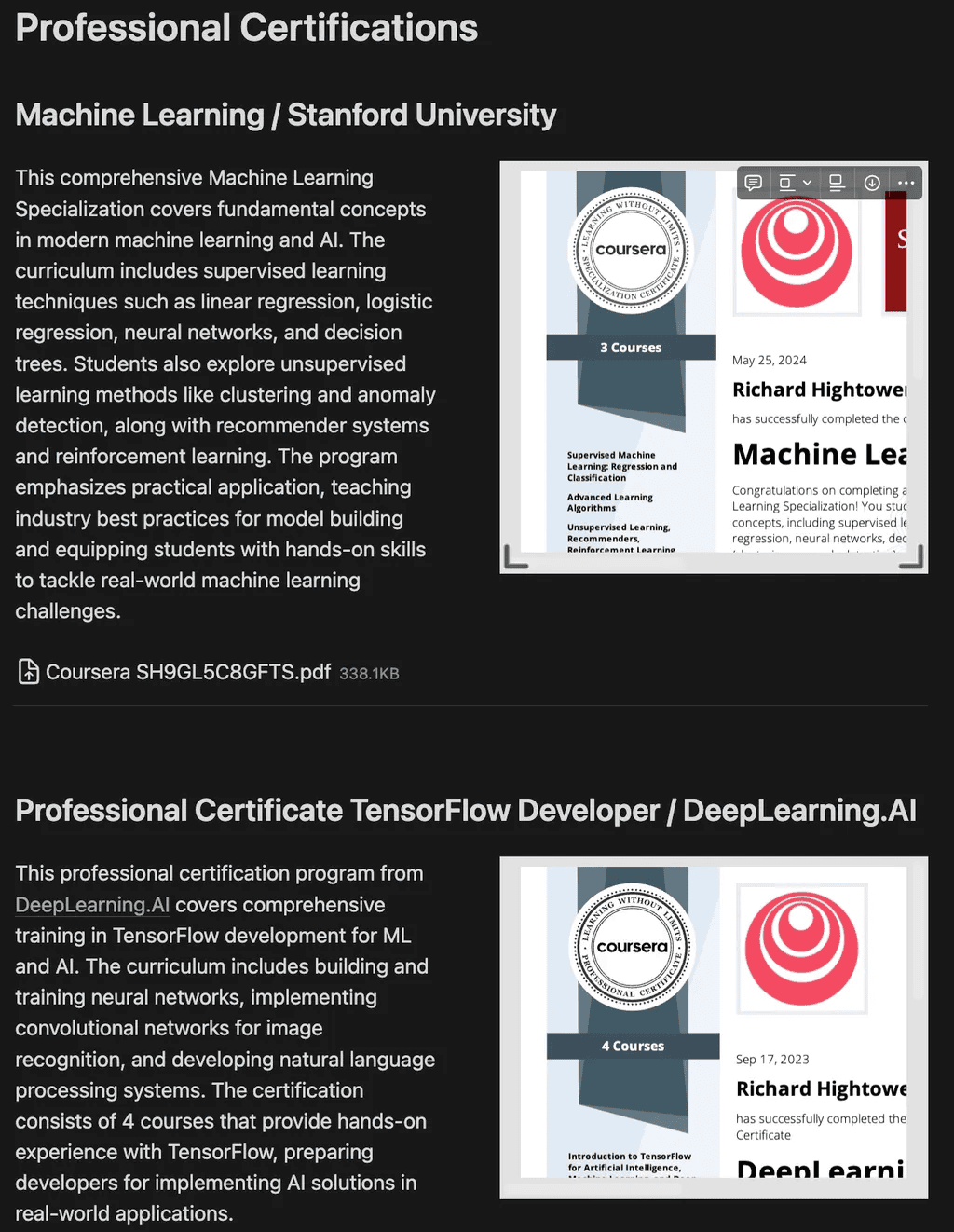
As a TensorFlow-certified professional and graduate of Stanford University’s comprehensive Machine Learning Specialization, Rick combines academic rigor with real-world implementation experience. His training includes mastery of supervised learning techniques, neural networks, and advanced AI concepts, which he has successfully applied to enterprise-scale solutions.
With a deep understanding of AI implementation's business and technical aspects, Rick bridges the gap between theoretical machine learning concepts and practical business applications, helping organizations leverage AI to create tangible value.
Article References
- Air Canada Chatbot Legal Case (2024)
- CBC News: Air Canada ordered to pay customer misled by chatbot
- The Guardian: Air Canada ordered to pay customer who was misled by airline’s chatbot
- Los Angeles School District AI Failure (2024)
- EdSurge: An Education Chatbot Company Collapsed. Where Did the Student Data Go?
- Los Angeles Times: LAUSD’s highly touted AI chatbot to help students fails to deliver
- DSPy Framework and Documentation
- DSPy GitHub Repository: https://github.com/stanfordnlp/dspy
- DSPy Documentation: https://dspy-docs.vercel.app/
- Verified DSPy Success Stories
- Zoro UK Case Study: Building a Multi-Stage DSPy Pipeline for Product Attribute Normalization
- Relevance AI: Self-Improving Agentic Systems with DSPy
- Haize Labs: Automated Red-Teaming with DSPy
- Stanford STORM: AI-Generated Research Articles
- Industry Reports on AI Failures and Prompt Engineering Challenges
- S&P Global Market Intelligence: AI Reality Check -- 46% Abandonment Rate (2024)
- Gartner: AI Control Failures as Top Audit Priority (2024)
- Regulatory Actions and Guidelines
- SEC AI Washing Enforcement: SEC Charges Two Investment Advisers with Making False and Misleading Statements About Their Use of AI
- EU AI Act Information: Official EU AI Act Portal
- DSPy Integration and Tools
- Databricks DSPy Integration: MLflow DSPy Documentation
- DSPy with MLflow Tutorial: Building LLM Applications with DSPy
- Additional Resources
- DSPy Discord Community: Join the Discussion
- DSPy Course by Databricks: Advanced LLM Development with DSPy
- DSPy Examples Repository: Community Examples and Templates